



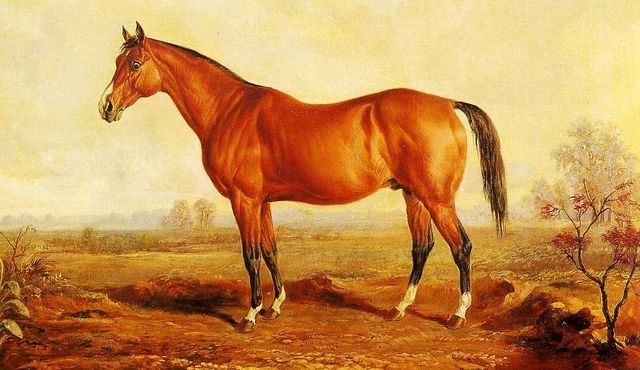
Picture: The great racehorse and influential stallion Lexington’s true worth to the thoroughbred breed became apparent through the effect the 1913 Jersey Act had on British thoroughbred development
The Jersey Act, introduced by Weatherby’s of Britain, stated that no horse or mare could be considered eligible for admission to the stud book unless traced without flaw on both sire’s and dam’s side of its pedigree to horses and mares themselves already accepted in the earlier volumes of this book.
It was in response to the panic selling of American bloodstock in the early 1900s due to a number of U.S. states banning gambling, which depressed Thoroughbred racing—and thus breeding—in the United States.
The gambling ban had led to an influx of American racehorses of dubious origin into Britain, because the loss of breeding records during the American Civil War coupled with the late beginning of the registration of American Thoroughbreds led many in the British racing establishment to doubt that the American-bred horses were purebred.
The act had disastrous long-term consequences for British bloodstock.
The Jersey Act came into effect in 1913 and, whilst intended as a cleansing measure, it stunted progress by denying thoroughbred status to some of the world’s fastest horses, including the descendants of Lexington, a great racehorse and champion sire in the USA 16 times but of doubtful origin on his dam’s side.
Most American-breds traced to Lexington at least once as he had saturated the breed.
By the 1920’s and 1930’s it became noticeable that the British-breds that were successful in international competition invariably had Lexington genes in their pedigrees despite the fact that the only legitimate source was via descendants who had been imported to Britain before 1913.
This should have sounded a warning to breeders and Weatherbys but they kept their heads in the sand and the Act was eventually only repealed in 1949 after the French had dominated British stakes races during the 1940’s.
It is no coincidence that one of the most influential lines of British origin that exists in thoroughbred breeding today traces back to Lexington and this is because a Lexington line stallion called Americus had arrived in Britain before 1913.
Americus was sire of a mare called Americus Girl, who was in turn dam of Lady Josepine, who was dam of the legendary Mumtaz Mahal.
Mumtaz Mahal will be found multiple times in all modern thoroughbred pedigrees.
Click here to read the details of the Jersey Act
Lexington has been the subject of a fascinating book recently and the author of the book gave an interesting talk on him recently.
