



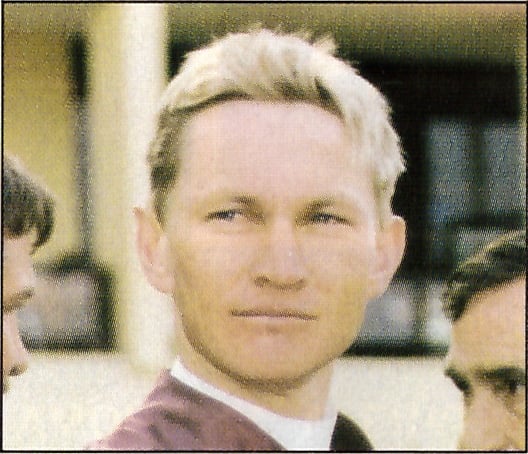
“Striker” was also known as “The Blonde Bomber” and this picture taken in 1994 gives an indication of how he acquired that nickname
Turf Talk will be running some articles about the legendary Piere “Striker” Strydom this week as it was announced he had not renewed his license for the forthcoming season, so he is just days away from official retirement.
The first article is about his reasons for retirement and his early years as a rider.
Part 1
Piere “Striker” Strydom is generally regarded as one of the two best jockeys in South African history together with Michael “Muis” Roberts and it was a sad moment when racing fans heard this week that he had not renewed his license for the forthcoming season, especially considering his two wins on Saturday at Turffontein Standside were vintage Piere Strydom.
“My last ride on Gold Cup day is Royal Victory and if he wins, I will call it a day then,” he chuckled.
It would be perfect to go out with a Gr 1 winner (HKJC Champions Cup), but otherwise his last meeting will be at the Vaal on July 31, which is his favourite South African course as will be discussed in one of the other articles this week.
There are a number of reasons Striker decided to hang up his boots.
He said, “I just came to the point where I didn’t feel like getting on a horse to ride. It’s always nice to ride these winners, it still gives you a thrill, and knowing that you’re doing the job right and to see other people happy. I’ve always been a competitive person, but how do I compete when I don’t want to ride. I still do the job I need to do, but when you start thinking about the possibility of getting injured again and stuff like that you know it is time to call it.”
Piere’s weight was also a problem. Sometimes he was not able to ride the top horses he was associated with because he could not make the weight. For example when three-year-old Fatal Flaw, whom he rode to Gr 1 WSB Cape Fillies Guineas glory, ran next in the Gr 1 Maine Chance Farms Majorca Stakes she was set to carry 55kg so he was unable to ride her.
He has also recently lost a trio of top rides with Quid Pro Quo departing overseas, Dyce injured and he was fired from See It Again.
Piere was looking forward to having a go at equalling the Hollywoodbets Durban July record of five wins in the big race, but after losing the See It Again ride his weight scuppered his chances of another July ride as all of the topweights were already booked.
His age also made insurance and medical aid costs so expensive that it was hardly worthwhile riding.
When he had a meeting with his insurance company recently the deal he got in the event he stopped race-riding was much improved and made his decision to retire a “no brainer.”
Piere felt he had come back too soon from his fall at the Vaal on New Year’s Eve in order to make it for the WSB Met and said that had also affected him.
He added, “I felt I was way better when coming back from my two-and-a-half week holiday in the USA. I could move my neck and all that, so that break does help you. Working through something is not always good.”
Striker revealed he was never supposed to be a jockey.
He recalled, “From the age of about 12 I went to the track in the school holidays and my Dad would put me on his horses and they would bolt and I would think ‘who in their right mind would want to do this? This is crazy.’ My cousins and friends would come and couldn’t wait to ride horses in the morning and those horses would bolt. I would think ‘these guys are stupid’. I used to hide away in the toilets, because I didn’t know how to ride horses. My Dad used to call me Bangbroek (scaredy pants)!”
He added, “I later went on a holiday with my Granny to Jo’Burg and the next minute I was told ‘you are going to Greyville in Durban to apply for the Academy’. I wasn’t even sure they were going to accept me as the criteria was more hectic then and there were about 32 people who applied.”
He continued, “Today there are only about ten that apply and that was why the jockey ranks were so strong in those earlier days, because the intake was a lot and then you fall by the wayside as they start in the first couple of weeks. Some guys even left because they felt they were being bullied and there was a lot of bullying going on in those days, it was actually sad.”
Piere wasn’t happy to be going to SAJA, which he joined at the age of 14 turning 15, “I didn’t know what to expect going to the Academy and I was scared to ride horses and I was on my own.”
He continued, “I overcame my fear because they put you on really quiet old horses. As you start managing these quiet horses, they put you on something a bit stronger and a bit more feisty, so you progress. You learn to ride a horse properly and then you go to track, which is another story and that’s when you trusted the trainer to put you on a horse that’s quiet.”
Striker was to become one of the great horseman jockeys and became particularly good at handling difficult horses due to the instinct he developed about what horses like and don’t like and how they like to be handled.
He had impressed the riding masters from day one and recalled, “When I started in the Academy they put up lists to show who had been making the most progress andI was high up on the lists most of the time.”
Piere’s first winner was the Johnny Nicholson-trained Saadabad at Scottsville in September 1982.
He felt his breakthrough towards becoming a great jockey happened when he went to the East Cape in his fourth year at the Academy and became East Cape champion apprentice and the following year he became the South African champion apprentice while still in the Eastern Cape. In his first year out of the Academy he became East Cape champion jockey usurping Gavin Venter, which was a fine achievement as the latter rode for the powerful Stanley Greeff yard.
The tough love of his father Hekkie Strydom paid off in getting Piere into the Academy and Hekkie then honed Piere’s race-riding skills.
“My Dad used to say to me you don’t win a race at the 200m mark, you win it at the winning post and he would make me sit on horses for as long as possible. The conditions suited this style as the pace in the East Cape was always too fast.”
This was all a learning curve as Piere soon recognised you could not win on all horses in that way as some could not quicken well enough, but as the style suited the conditions and the wins were actually often late flying ones, the local journalist know as “Rob Roy” nicknamed him “Striker”.
Piere said, “PE gave me a huge boost. It was a smallercentre and still is, but by riding winners it taught me how to ride a race. It doesn’t matter whether it’s PE or Bloom or wherever, that is where I learned my trade.”
“Then I moved to Joburg in 1988.Louis Goosen helped me to to make the move. Iwas going out with his sister at the time.”
“In Jo’Burg it was basically doing the same thing. It was just getting tolearn the different tracks and riding against different jockeys and riding different horses”.
“It was an unknown. The word was out that I had a lot of potential, butI’d never ridden in Jo’Burg, so you’re still not sure you’re going tomake it. Basically Louis and myself gave us three months in Jo’Burg, if we didn’tmake it, we were going to go back to PE.Louis had been living in Jo’Burg. He helped me as an agent.He was able to phone for rides and ask the trainers for rides . I was thisyoung, shy little guy that didn’t know anyone. So Louis got me going.”
He continued, “Brett Warren had a strong yard in thoe days so I got some good rides from him and picked up some other rides and these horses started arriving at big prices, so people realised I had some ability.”
He admitted, “What helped me, although it is not a nice thing to have to say, is that I basically came to Jo’Burg because of the Henneman disaster. Six months after that disaster they were still a bit short of jockeys, so there was a gap. So I took the gap and the winners stated flowing, so I decided Jo’Burg’s the place to stay and I ended up finishing second on the Highveld that season with just nine months of race riding.”
Striker was champion jockey the following season.
Only those who witnessed it would be able to truly appreciate just how much of a sensation Striker was on the Highveld and he became the idol of the adoring fans, who crammed onto the grandstands every weekend.
An indication of how popular he was that when he rode the Pick 6 on July 14, 1990, the only jockey to ever achieve this feat, it was likely the smallest Pick 6 payout in history, well below R100.
Incidentally, he did not have six winners in a row that day as a match race was staged in between the Pick 6 legs and he was on the losing horse Brainteaser, easily beaten by Divine Act.
However, Striker was well on his way to becoming a living legend.
