



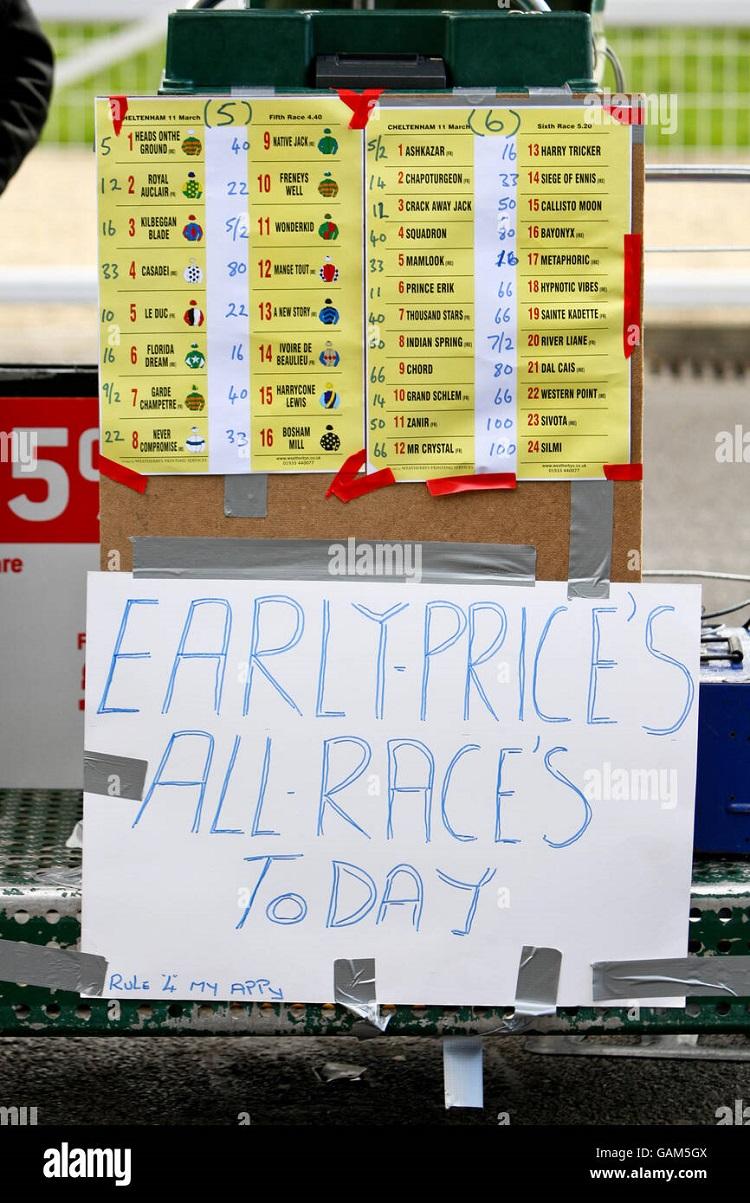
A bookmakers board
UK Racing guru Simon Rowlands wrote this article back in 2007, but it is still relevant today.
Building your own book is a must to turn punting into profit says racing journalist Simon Rowlands in this week’s Rowley File
I got round to reading “A Bloody Good Winner” – the book by professional gambler Dave Nevison – the other day, and a bloody good read it was as well.
What attracted me to the book, as much as anything, was a strange piece in The Irish Field, in which the reviewer described Nevison’s method of compiling his own tissue and then betting where he saw value, rather than because he thought a horse “would win”, as “unorthodox”.
It is not the only way of doing things, certainly, but well nigh every successful punter I have met prices up events at least part of the time and appreciates the concept of value.
Nevison himself does not go into much detail about what is involved in the process of compiling a tissue – creating your own assessment of the odds of an outcome happening – so I thought I’d ask around a few people who know a thing or two about this subject.
First off, a bit of simple arithmetic.
Odds should be converted into percentages and then summed for all possible outcomes. If the likelihood of an outcome is 100% – such as that something will win the race you are pricing up – then the sum of your odds percentages should be the same.
Odds are converted into percentages by dividing 100 by n when dealing with decimal odds (n being the decimal odds themselves) or by n+1 when dealing with fractional odds (n being the fractional odds themselves). A 4.0 shot on Betfair is taking 25% out of the book (100/4). A 2/1 shot at fixed odds is taking 33% out of the book (100/(2+1)).
Ian Dean, a former colleague at The Sportsman and part of the Betfair-Timeform odds-compiling team, looks to get a feel for the overall strength or otherwise of the race before moving on: “A horse’s price is a reflection of the opposition, as well as of itself”.
Andy Richmond, head of the Betfair-Timeform team, and Paul Smith, Spotlighter with Racing Post, usually try to identify the front two or three in the betting early on and invest more time in getting these “right”. The odds of other horses follow more easily from this, they reckon.
I tend to try to “brainstorm” a race in one go and then go back and tweak the prices and incorporate more information after this initial overview. More than about 14 runners tends to make my head hurt and often causes me to move on!
And therein lies one of the advantages of pricing up for yourself. You don’t have to price up races you don’t like or find too hard. Specialisation is key. Play to your strengths.
What’s more, you don’t have to be precise about each and every horse you are pricing up, unless you are doing it for publication. Andy Richmond recommends coming up with a range of prices in the first place and then narrowing this.
Some horses are easy to price. Others, perhaps unexposed and/or trained by stables who get the money down when a win is expected, are not. The former may be “between [3.5] and [4.0]”. The latter may be “between [2.0] and [8.0]”!
I prefer to concentrate on races where speculation is not a huge issue: handicaps; Group/Graded and Listed races; races for exposed maidens; races where you have got plenty to go on but where the last value has not already been squeezed out of the market.
I also like to refer to the odds at which a horse started the last time it ran. This needs to be viewed in the context of the race it was running in, how it ran, when it ran, and what it is running in now.
We punt, among other reasons, because we think the market is wrong. Sometimes it is.
But it would be folly to overlook the fact that the market is a distillation of an incredibly large amount of information about the competitors in a given race and at a given time.
A 10/1 shot that finishes mid-field in a 12-runner handicap had a roughly average chance before the race according to the market and performed in the race as if the market was right. This is a simplification, but I hope you get the idea.
And finally, as Andy Richmond says: “If you are struggling to price the runners, at the very least you should be able to put them in some sort of order. Get the order right and the prices themselves often follow.”
I would strongly recommend anyone who takes their betting at all seriously to give pricing up a go and to compare their results with the markets on Betfair. It is a good discipline – a vital discipline, perhaps – to learn.
And, in spite of the unavoidably schoolteacherish tone of some of the above, it can actually be good fun!
