



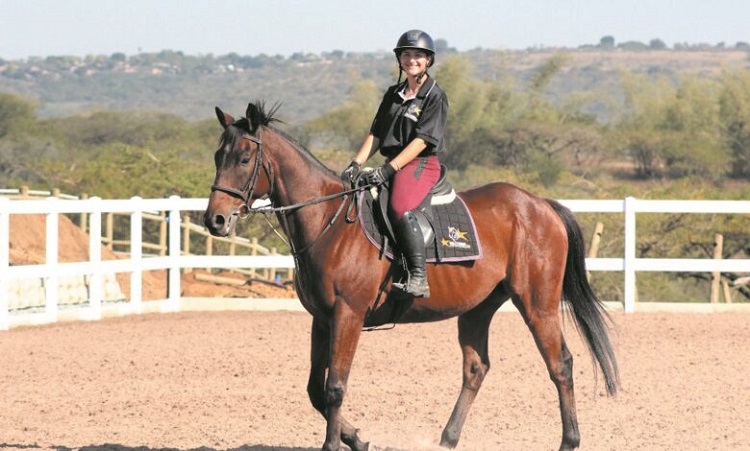
Shylo Frances riding Zig Zag in the arena at Ashburton Training Centre. Photo: Nqubeko Mbhele
The Hollywoodbets Sponsored programme started in 2021 and has since rehomed 43 horses while helping to improve their performances, leading to multiple wins after their rehabilitation.
Kayla Shaw (The Witness)
Shylo Frances riding Zig Zag in the arena at Ashburton Training Centre.
Nicole Wille, an advocate for equine welfare, has launched a unique programme aimed at securing a dignified retirement for racehorses once their competitive days are over.
Wille partnered with Hollywoodbets to establish a sanctuary, Life After Racing, that ensures the horses are well cared for post-retirement, having been moved by the short careers racehorses typically have.
“I’ve been privileged to go overseas and experience the industry in America and England,” Wille said.
“I noticed that racehorses have such a short career. Some race until they’re six or seven. Some retire much younger.”
There are so many horses bred throughout the world in a year. So, what happens to them all? Let’s say 50% of them actually make it as racehorses.
And the rest? Wille explained that there is a stigma attached to those who don’t make it and some are put down while others live in terrible conditions.
To ensure that horses, both retired and injured, are treated correctly, Wille pitched the idea of Life After Racing to Hollywoodbets, who agreed to back the initiative.
“We at Hollywoodbets want to ensure that our horses, who give us so much pleasure when they compete at the racetrack, do not end up in these terrible conditions and that they are looked after when they retire,” said Wille.
As a part-timer, she handled a few horses while working full-time at a veterinary hospital. After her nine-to-five day job, she would train and start the rehoming process for the horses.
As it grew, the initiative needed bigger and better facilities, leading it to where it currently resides — Ashburton Hollywoodbets Training Centre.
“[During the growth] it turned into a rehab programme for not only retired horses but also those injured,” she said. “They would go back to training after the programme.”
The programme started in 2021 and has since rehomed 43 horses while helping to improve their performances, leading to multiple wins after their rehabilitation.
It’s a very tough sport on them. Like any athlete, they need physio; they need a break.
The programme starts with an evaluation which she does personally. If necessary, a vet will also be present.
The horse will then be trotted out to see if it is unsound before being touched all over to identify any sensitive spots on their bodies.
“From there, we see where they need help especially with major injuries needing veterinary help,” she said.
“Some just have aches and pains which me and the physio can sort out.”
Wille said most begin with an initial rest for the body to recover, then begin body work with the physio.
“They get various machines put on them like shockwave machines, beamers, and electromagnetic therapy,” she said.
The horses will then go into a light work program which will increase until they begin training again.
Wille explained many tools are used, such as resistant band training, which works the different muscles and helps for an overall better athlete.
Another tool is balance blocks.
The horses go into the lunge ring daily and use an equine treadmill.
Wille also makes use of a signed contract when rehoming a horse. This allows for “close tabs” on the horse’s conditions for Wille and her colleagues.
Shylo Frances (19) has worked with Nicole since the beginning. She and fellow assistant Megan Trott agreed with the need to give back to racing horses.
“It’s pretty great what they’re doing,” Trott said.
“With the way it’s growing, there will be lots of exciting opportunities.”
Meanwhile retired racehorses, when possible, are retrained for dressage, general riding among other things.
