



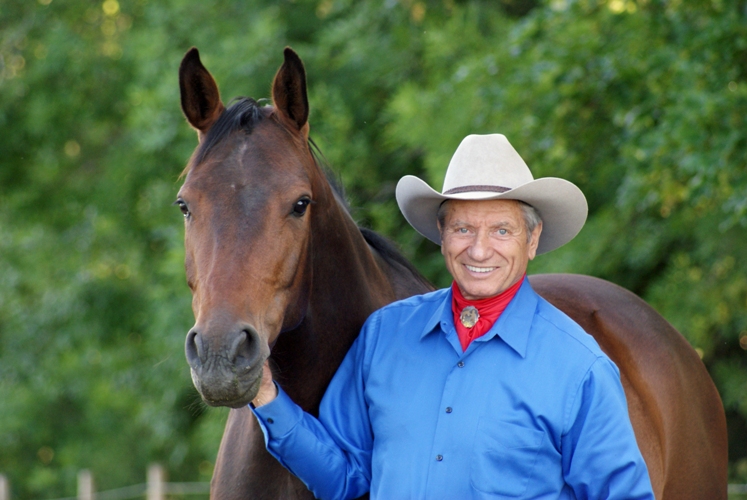
Monty Roberts became a nonagenarian in May but he is still active in promoting his “join-up” techniques of natural horsemanship, which are widely used today in starting horses as well as in training, including with racehorses.
His techniques have enabled diligent horseracing trainers to create mutual respect and clear communication between horse and trainer.
Kelly Marks, a former British showjumper and European Ladies thoroughbred racehorse jockey champion, was described once by Monty Roberts as the perfect person to demonstrate and teach his “horse-whispering” techniques to audiences and pupils alike and South African industry people were privileged to watch her in action at the South African Jockey Academy in December, 2008, which is fittingly the year Roberts was made Personality Of The Year in the British Equestrian Magazine “Your Horse”.
Not many racing enthusiasts know much about how “join-up” works.
It is worth revisiting that day when Marks put on a demonstration that had the Summerveld audience fascinated and sometimes gobsmacked.
Three problem horses, volunteered by locals, were used in the demonstrations.
Join-up involves the use of body language and energy to win a horse’s confidence over. The specific aim is for the horse to view the teacher as a trusted leader and protector. Eye contact is a very important part of the process.
In the wild the capacity to move other horses around is the only manifestation of leadership, so the join-up process is kicked off by the use of lunging.
Marks emphasised that lunging is not about tiring a horse out and shouldn’t be done for longer than five minutes. The process should include making the horse stop and change direction.
The teacher can start working with the horse once she’s got its attention. The first sign of this is ear movement and then licking and chewing.
Marks gradually decreases her energy until the horse slows to a walk before standing still.
An excellent sign that the horse’s trust is being won is when it lowers its head – a frightened horse will always carry its head high.
When the horse is still, Marks walks around it in an arc and approaches it from the side with the aggressive front on gait of the predator, her eyes focused on the eye of the horse.
The moment the horse turns and makes eye contact, Marks turns away from the horse, lowers her head and walks away from it, thereby showing she has no aggressive intent and can be trusted.
Soon the horse will follow her and, either immediately or later, will go right up to the shoulder of the teacher. The teacher should stroke it to show praise.
Scratching a horse’s whither is one of the best methods of affection, and has been proven to lower a horse’s pulse rate, while being able to pick the feet up is a sign of trust.
Getting a horse to back up by pushing it on the chest is another important lesson during join-up, while a vital aspect of the process is termed “pressure and release”.
When pulling on a horse’s halter or rein, the reactive pull by the horse must be timed to coincide with a release. The horse then recognises the teacher as an “intelligent being” and soon knows that it will be rewarded by a release of pressure if moving in the right direction.
After join-up is completed the teacher is viewed not only as a leader but a protector or refuge. Problem-solving or breaking in is then tackled.
Saddles are introduced slowly and calmly, Marks emphasising that it is important to let the horse know that “we are in this together”. Calmness helps the horse to view the teacher as a leader and relaxes them.
The girth area is tickled to check for any discomfort before the girth is tightened and join-up is practised again once the saddle is on.
The horse is then lunged on a long double-rein and in this exercise the vital practise of pressure and release is the main lesson.
Then a life-size dummy is first placed tentatively on the horse’s back until it gets used to it. After that a rider can mount, first by lying sideways on the saddle and dismounting, before attempting to get into the stirrups.
Marks stunned the owner of the second horse, a nervous and sometimes aggressive seven-year-old piebald who had never before been backed or saddled despite numerous attempts by various people. He went through the process, all the way to being ridden, as quietly as a lamb.
However, it was the last demonstration that really emphasised Marks’ amazing affinity and patience with horses as she slowly convinced former racehorse, Veni Vici, that a float was nothing to fear.
After a lengthy process, she eventually had him walking into and backing out of the float at will from every conceivable angle.
