



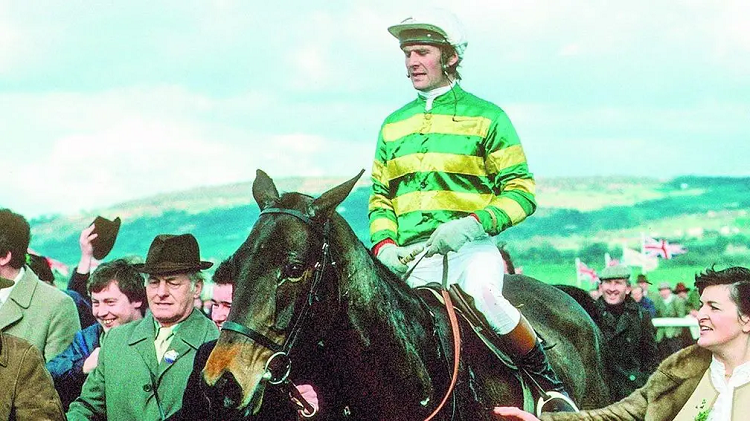
Mister Donovan is led in following his success in the 1982 Sun Alliance Novices’ Hurdle
Credit: Gerry Cranham
Lee Mottershead (Racing Post)
They say you never forget your first. JP McManus has never forgotten. Without his first Cheltenham Festival winner the rest might never have followed, nor a financial investment in jump racing of unprecedented proportions.
McManus desperately wanted Mister Donovan to win. He desperately wanted the gamble to be landed.
Here truly was a bet that changed racing. The winning owner and punter has certainly implied as much. With McManus you sometimes have to read between the lines. When it comes to the lines he has spoken about the impact to him, and therefore to others, of the 1982 Sun Alliance Novices’ Hurdle, the race’s significance becomes clear.
“My most important one at Cheltenham must have been the first one, Mister Donovan in 1982,” said McManus a few years ago. Then he added another sentence, a small nuanced droplet, as is his way. “He was needed,” said the man who needed him, a man so many others have subsequently needed. Yes indeed, Mister Donovan changed a great deal.
In the 2019-20 campaign, McManus had at least one horse with 46 trainers based in Ireland. In Britain the number was 21. He races around 350 horses each season, all of which account for 350 sets of individual training fees. Yet it is not just trainers who benefit from his largesse, but also pre-trainers, jockeys, stable staff, breeders, auction houses, transporters, feed merchants and countless others, including those employed at Martinstown Stud, where so many of McManus’s former racehorses live out a happy retirement.
McManus, needless to say, benefits as well. He does it and he spends it because he loves it.
That love affair arguably hung on the opening race on the second day of the 1982 festival, the meeting at which he has tasted success more regularly than any other owner. That was not the case on the morning of March 17, 38 years ago. Truth be told, the afternoon of March 16 had been pretty grim. So had a number of Cotswolds afternoons in the past.
The reality is the hallowed meeting had not always been kind. Through the 1970s the son of County Limerick became established as a fearless bookmaker and punter, one given the sobriquet of ‘The Sundance Kid’ by legendary writer Hugh Mcllvanney. He also became an owner, his emerald green, yellow hoops and white cap colours first carried to victory by Cill Dara in a Naas Flat race on July 20, 1977.
McManus, however, is much more a jumps man than a Flat man. So is Edward O’Grady. McManus had reaped rewards through backing O’Grady’s runners, especially in bumpers, prior to his first official involvement in the yard as the owner of Jack Of Trumps, a horse whose career would be marked with considerable ill fortune when it came to almost anything associated with Cheltenham.
In 1980 Jack Of Trumps was cruising when brought down at the fifth-last fence of the Gold Cup. One year earlier he was ruled out of the race by injury when strongly fancied. In 1978 he had fallen when odds-on favourite for the National Hunt Chase. In the 1979 running of the four-miler McManus again had the odds-on favourite, Deep Gale. He, too, hit the deck, this time at the sixth-last fence. On YouTube you can only just see the horse crash out. The noise made by the watching audience remains powerful.
“Deep Gale did a sort of Bambi on ice at the fence,” says O’Grady. “Boots Madden actually landed running and only just missed catching him. I swear to God, if he had caught him he might still have won. I like to think so, anyway.
“Of all the losses, that was the most frustrating. The cheer that should have been made for him when he won was made by the bookmakers when he fell. I’ll never forget that noise.”
The problem with Mister Donovan is he also made a noise, although that did not alter the way he looked. To O’Grady’s eyes, he looked glorious.
“In 1979 I was the judge at a pre-sale show,” recalls O’Grady. “Mister Donovan was a three-year-old at the time and I made him the champion. Being a good judge, I bought him as well. Three months later, I sold him to one of my very good owners, subject to veterinary examination.
“Demi O’Byrne, the famous one, went in to his box to examine him, started listening to his heart and then ran out of the stable. ‘Christ, what’s wrong with you?’ I asked him, to which he replied, ‘Jaysus, he’s got such a bad murmur in his heart I’m afraid he might fall down on me’.
“That sale obviously failed to go through. The horse ended up becoming part of the family and Judy, my then wife, rode him in a number of bumpers. He was always there to be sold but because of the bad heart murmur not many people were keen to buy him. In fact, it was only after his final race before Cheltenham at Naas that JP bought him. Even then, he was sold only for what he cost me, and that was two years after I paid for him.”
O’Grady had relieved himself of 8,200gns for the son of Choral Society. Going into Cheltenham some onlookers may have questioned his wisdom, given Mister Donovan had been defeated in his three previous outings over hurdles. However, in that Naas race, staged 18 days before the Sun Alliance, he finished third to Fredcoteri, a subsequent dual winner of the Irish Sweeps Hurdle.
“JP is a very good race-reader,” says O’Grady. “At the time I was training the horse for myself and aiming to peak him at Cheltenham. In order to do that, he ran over what was probably an inadequate trip at Naas as a way of sharpening him up. It was a superb trial. We knew he would be so much better over the longer trip.”
A few observers raised eyebrows at his run over the shorter distance, so much so that O’Grady was encouraged to take out an injunction against one particular publication.
“Some people weren’t as complimentary as they should have been,” says O’Grady, adding: “Personally, I think that was mostly due to jealousy.”
Bookmakers and punters are not motivated by jealousy but rather money. They studied the 1982 Sun Alliance – now the Ballymore Novices’ Hurdle – and sent off maiden hurdler Mister Donovan the 9-2 second favourite. The Tommy Ryan-ridden six-year-old had opened on course at 6-1 but was bigger in the morning. Nobody other than McManus knows what prices he took but plenty of past reports indicate he swept up £250,000. Given the winner’s prize-money was £15,977.50, that was many a pretty penny.
“We loaded up on him at the time and it was significant that he won,” McManus once told Donn McClean in an interview for what was then Racing UK, while he has also been quoted saying: “I hadn’t owned the horse for very long, but he had been laid out for the race and it all came right on the day. It was great to have a winner at Cheltenham but the fact that I backed him made it all the sweeter. The money was important.”
McManus, who if not betting on credit was known to prefer banker’s drafts over cash, had lost money to the bookmakers on the festival’s opening afternoon. O’Grady understands why those same bookmakers were wary as the clock ticked down to 2.15pm that Wednesday afternoon.
“I would suggest knowing JP had bought the horse would have been like an electric shock for layers,” says O’Grady. “Unless they had been sleeping under some stone, bookmakers must have regarded JP buying the horse as important.”
John Christie, betting at the Roy Christie stand, was one of the bookmakers.
“In those days, monumental amounts of money flew around the Tattersalls ring and the rails at the Cheltenham Festival,” he says.
“It was the heyday of racecourse bookmaking. Tattersalls bookmakers took fortunes. The buzz and excitement at Cheltenham was incredible. When JP was in the ring the money flying through the air would have been phenomenal because all the tic-tacs would have seen him and bookmakers would have been backing his horses, hedging their liabilities.”
Christie adds: “Everybody knew who JP was. He was always very unflustered and always very polite. He would often come up to the stand. He didn’t send minions over to place the bets on his behalf. He enjoyed the battle, having had so much experience as a bookmaker himself.
“If we were offering 5-1 about one of his horses, he might ask if we would lay him a £10,000 to £2,000. We would say, ‘Can we do you a £5,000 to £1,000, JP?’ However much you offered him he would accept and then move on down the line. Bookmakers didn’t panic if JP was punting. They would all want to accommodate him and lay a bet, which is why Mister Donovan shortened up only from 6-1 to 9-2 in the ring.
“JP would have good days and bad days. As he was invariably backing his own horses, you would think he would win regularly, armed with the information he was privy to, but JP would back his losers as much as his winners. That’s another reason why bookmakers in the ring were prepared to take the bets.
“It absolutely wasn’t the case that you took the bet and got ready to pay out immediately. You always thought you had your chance of getting the horse beat.”
They did not get Mister Donovan beat. He was ridden to minimise risk, always prominent and in front from the final descent. Up the home straight it became a protracted duel between the Irish raider and the Bob Champion-ridden Spider’s Well, competing, somewhat ironically, in the silks of O’Byrne, the vet who had been fearful Mister Donovan might collapse on top of him.
That morning at O’Grady’s yard, O’Byrne ran away from Mister Donovan. At Cheltenham, Mister Donovan ran away from O’Byrne’s horse, winning their battle by a length and a half. McManus was significantly richer than he had been before the race. Whether or not his cash influx came from one source or many is unclear.
“Although it’s true that £250,000 was a lot more then than it is now, it wasn’t actually a vast amount relative to the number of bookmakers who would take decent bets,” says Christie. “I could name 50 on-course bookmakers who would have taken £5,000 to £1,000 back then. That alone would make up the £250,000. In those days, that sort of bet would have been seen, expected and accommodated.”
It may well have been accommodated by bookmaker Stephen Little.
“I don’t feel it’s right to discuss individual punter’s bets,” says Little, having spent a little time studying his records. “What I will say is the biggest bet I laid on the horse was £5,000 to £1,000, from which you can draw your own conclusions. I actually wasn’t betting too big in those days. It was only really later that JP started coming to me for huge bets.”
Little adds: “Taking on JP was exciting. It was helpful as well because it sort of pushed me into taking big money. Usually if he backed a horse I would have to back the horse myself because of the size of his bet and to limit my liabilities. With JP, I never had to worry about waiting to get paid, either.”
This time JP was the one who could enjoy being paid. “I don’t remember quite how much we had on but it was important at the time anyway,” he has said. Absolutely critical at the time was O’Grady’s masterful preparation of Mister Donovan.
“Training horses with murmurs is a tough business,” admits O’Grady, who insists he did not have “a sixpence” on Mister Donovan himself.
“Over the years I’ve learned you can finesse horses with a murmur to peak on one day. That’s the day you want to be on because that day isn’t going to come back for a long time.
“He was an average horse with a heart problem who peaked on the right day. That doesn’t always, or indeed often, happen, but that happened to be one of those splendid days when it did.”
The day became increasingly alcohol-driven, although teetotaller McManus would likely have stuck to tea.
“It was the first time I had organised a box at Cheltenham,” remembers O’Grady. “It was one of those little old fashioned boxes that led on to a flat roof overlooking the parade ring. They comfortably took eight people, maybe a maximum of ten. After the Sun Alliance that poor little box had to accommodate what must have been a couple of hundred Irish people and so much champagne the roof nearly caved in.
“Mister Donovan certainly wasn’t a banker but people seemed very happy to celebrate the fact JP and I had enjoyed a Cheltenham winner – particularly as they knew JP would pick up the tab.”
He has been picking up the tab ever since.
“His support of jumping is so big that it’s very hard to quantify,” says Michael Grassick, chief executive of the Irish Racehorse Trainers Association. “A lot of the smaller trainers wouldn’t exist without his patronage. His loyalty is unbelievable as well.”
Trainer Eddie Harty highlights an especially positive aspect of McManus’s benevolence.
“The people who are always looked after are the people at the coalface,” says Harty. “There’s always a few quid coming to the lads in the yard. That wouldn’t be the case with every owner, particularly these days. The staff are never forgotten.”
Nor forgotten is Mister Donovan’s Cheltenham Festival triumph. Jumping’s most powerful and prolific owner has now enjoyed 66 wins at the greatest of all meetings, seven of them coming this year, when he famously celebrated a four-timer on the Wednesday.
“I often wonder whether I would have been able to have any of the others if Mister Donovan had been beaten,” said McManus, who won big when he bought a previously unsuccessful hurdler from a trainer whose expertise resulted in a reputed and timely payout now worth the equivalent of around £1 million.
“Win or lose, JP never discussed his gambles with me,” says O’Grady. “I therefore had just one job – that was to produce winners. There was no additional pressure coming from JP backing the horse. There was just the pressure that comes from trying to win a race at Cheltenham.”
The winner of that first race in 1982 is now long since gone. He is, quite rightly, remembered on one of McManus’s walls.
O’Grady says: “Whenever Demi O’Byrne and I were both invited to dinner at Martinstown, JP would always ensure Demi was seated opposite a big picture of Mister Donovan beating Spider’s Well. We’ve had so much gas about it. We would win the race again every time.”
For McManus, and for the sport he adores, it was a vital race to win.
