



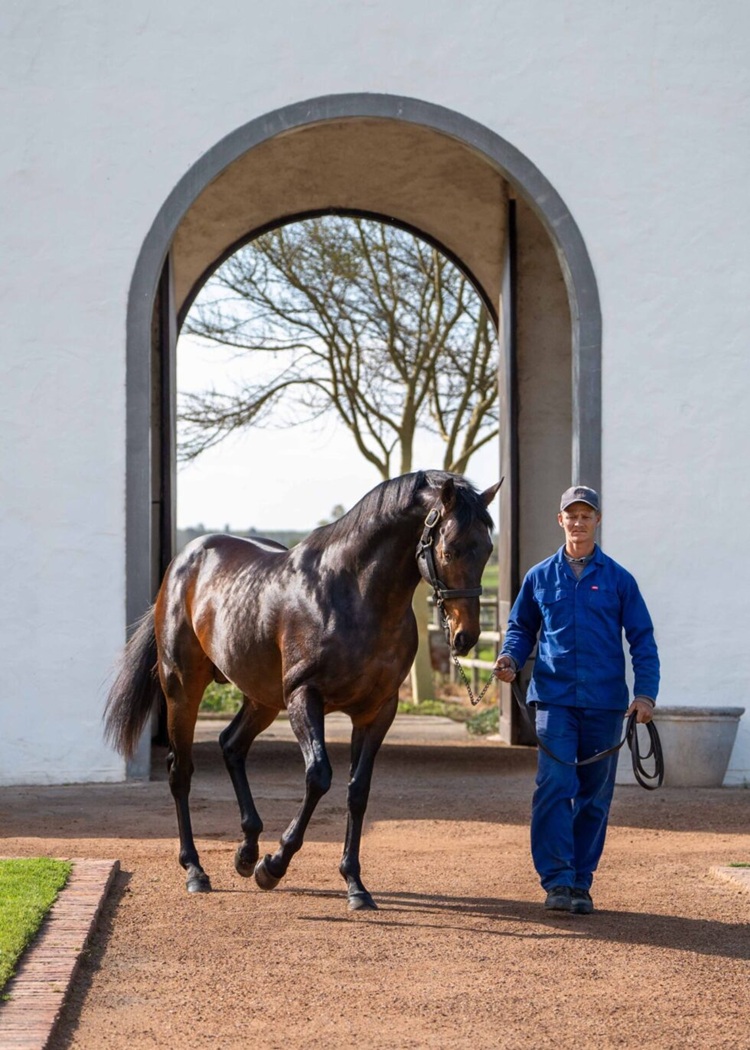
Picture: Kommetdieding

David Mollett
Around the world we’ve seen wild fires and earthquakes – now in South Africa – get ready for a stampede.
On August 10, top owners, trainers, breeders and bloodstock agents will hit the road to Klawervlei Stud at Bonnievale in the Cape for the stud’s dispersal sale. To say the menu is enticing is an understatement.
Try this on for size. Eight shares in Vercingetorix who is as popular as England footballer Jude Bellingham, the pin-up boy after the World Cup.
Then you’ve got four shares in Kommetdieding, two in One World, two in Rafeef and 89 broodmares.
Grant Knowles – the jack-of-all-trades in Cape racing – has a huge history with the stud and has witnessed the highs and lows. Six breeding championships is the obvious high.
“The quality and depth of the broodmare band is exceptional,” says Knowles.
“These mares have formed the backbone of Klawervlei’s success and I’m confident they will continue to reward their owners.
“Every year a few quality lots slip through the cracks – Kommetdieding is the perfect example as he was sold here for just R55000 in 2019 and went on to win the Durban July and is now a promising young stallion.
Unlike Vercingetorix, One World and Rafeef, the jury is out on Kommetdieding as the few progeny that have been offered haven’t been overly popular with buyers.
It will be interesting to see which breeder takes shares in this well-performed horse home.
In a landmark deal, Klawervlei has been purchased by businessman and leading owner, Laurence Wernars.
“We are purchasing a beautifully equiped farm, but not the existing stock. We currently have 54 mares spread around the country and most of them will be relocated to Klawervlei,” said Wernars.
John Koster, who has held the reins at the famous stud for many years, said: “Laurence is a man with huge energy and a deep passion for horse racing, breeding and people.”
He also has a great sense of humour. He quipped: “Can you imagine a businessman in a suit and gumboots trying to look after quality thoroughbreds.”
It has to be said its been another reasonably successful season for Klawervlei – statistics to July show them in sixth place behind Varsfontein, Wilgerbosdrift/Mau, Drakenstein, Maine Chance and Ridgemont.
However, one has to applaud both Varsfontein and Wilgerbosdrift/Mau with stake earnings of R36,1m and R34,3m respectively.
Molly asked Grant Knowles. who will be conducting the Sale, a few questions:
1. Presumably all roads lead to Bonnievale for top owners, trainers, breeders and bloodstock agents – could this me the stud’s biggest party? FOR SURE. KLAWERVLEI HAS ALWAYS KNOWN HOW TO HOST A PARTY, AND THIS IS NO EXCEPTION. THIS WILL BE A FITTING START TO A BRAND NEW CHAPTER.
2. What could be the highlight of the Sale. Possibly the sale of the shares in boom sire, Vercingetorix? SHARES IN BOTH VERCINGETORIX AND RAFEEF WILL PROVE TO BE VERY POPULAR. BUT MARES IN FOAL TO BOTH WILL ALSO BE ON MANY A BREEDERS RADAR.
3. What is your view on Kommetdieding whose few progeny haven’t really taken off. I WOULD’NT SAY THEY HAVEN’T TAKEN OFF. HE HASN’T THROWN A PARTICULAR TYPE OF YEARLING, SO WE EAGERLY AWAIT HIS FIRST RUNNERS
4. Is there a particular broodmare set to make a big price. THE PROLIFIC KLAWERVLEI FAMILIES WILL ALL BE WELL SOUGHT AFTER. ESPECIALLY THOSE IN FOAL TO LEADING SIRES. THERE ARE A NUMBER OF CANDIDATES TO BE WELL SUPPORTED IN THE SALES RING.
5. A few lines on your long involvement with the stud. I WAS FORTUNATE ENOUGH TO SPEND 16 YEARS WORKING AT KLAWERVLEI WITH JOHN KOSTER . WHAT A PRIVILEGE IT WAS TO LEARN FROM ONE OF THE VERY BEST HORSEMAN ON THE PLANET. WE ENJOYED BREEDING THE LIKES OF VERCINGETORIX ONE WORLD, AND WILLIAM LONGSWORD TO NAME BUT A FEW. THE FONDEST MEMORIES THAT I COULD EVER TAKE WITH ME.
No Need For UK Racing To Launch The Lifeboats
Justin Snaith’s comment – quoted on racing websites – that in order to survive UK racing needs to take a leaf out of SA’s revival will have caused raised eyebrows both here and in Britain.
“I think Britain would have to look at what’s happened in SA,” said the champion trainer. “We were bankrupt and racing here was absolutely done here five years ago.”
“We were lucky that people came forward – where is the change in Britain?”
One thinks that Mr Snaith is getting a bit ahead of himself.
I cover UK racing every day and the Cape trainer is probably right that “UK racing levels are falling behind.”
Certainly there is a case for midweek meetings getting more prizemoney, but a crisis it is not.
One only has to look at the success of the big days – many more than here – such as Royal Ascot, the Grand National (1m pounds prizemoney), the Derby and recent King George (1,13m pounds).
The Ascot meeting really got the pulses racing with top horses, owners, trainers and jockeys and, yes, excellent prizemoney throughout the five days.
Felicity Barnard, CEO of Ascot racecourse, said “It’s been a fantastic week, a real feast for everybody that has been with us whether you were here for racing, fashion, food or music.”
“We knew we had momentum coming into the meeting because the racing promised to be fantastic and we expected crowds to be up.”
When the sums were completed it showed a total of 294 541 people had attended over the five days – a 2,8% increase on 2025.
“The main thing for us is delivering the best possible experience for those thar come,” concluded Barnard.
One will get the same enthusiasm for the Grand National, Derby and York where Ombudsman should draw a bumper crowd in three weeks time.
This hardly suggests that British racing is calling for the lifeboats.
While Justin Snaith must be applauded on another memorable season, his advice to a country with a huge racing history will have fallen on deaf ears.
*Editor – all true racings fans love British racing, but Justin Snaith might have a point when considering Betfred are set to close 132 shops due to British tax challenges. An ex-pat South African living in a small town called Truro has also sent in a comment that when he moved there earlier this decade there were three Betting shops in the town and there is now only one left. British horseracing is supported by a statutory 10% levy on bookmakers’ gross profits, so the closure of so many bookmaker shops is dire news for the health of British racing.
