Fourie Barometer 356 (updated after racing on 23/04/2024)
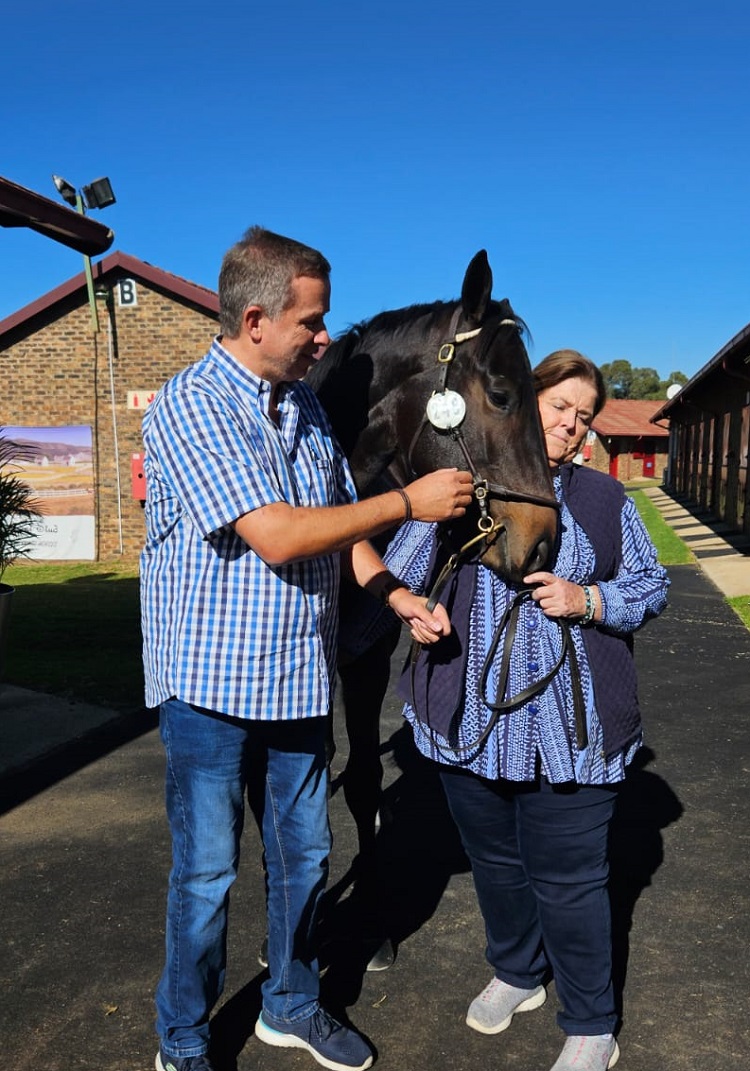
David Abery Is Reaping The Rewards Of A Bold Decision


Wilgerbosdrift Manager Shane van Zyl Was Overwhelmed By R6m Price Tag


Charl Pretorius Deserved Winner Of LKP Writer's Award
The colour blue has become an integral part of the L’Ormarins King’s Plate, which was fittingly won this year by Gaynor Rupert, the first time she had won the prestigious weight for age mile as an owner. (Picture: Chase Liebenberg)
Few would argue against Charl Pretorius being called South Africa’s best racing writer and he is deservedly off to Glorious Goodwood after winning the L’Ormarins King’s Plate writers’ award.
Below is the entertaining piece Charl submitted:
By Charl Pretorius
The lady nudged her partner and exclaimed, “It’s all, so… blue!”
She was standing in the ticketing queue on the infield at Hollywoodbets Kenilworth on L’Ormarins King’s Plate Day, 2024, looking across the track at hues of blue around the beautifully renovated grandstand, one hand shielding her eyes from the late-morning glare.
An amusing thought crossed my mind: “Seriously? Do you know where you are, lady?”
By her attire – a flowing, white summer dress with a light blue floral pattern that fluttered in the gentle breeze, she must’ve known. Her man, presumably her husband, donned a matching suit with a wide-brimmed hat. “Oh yes, darling, how splendid,” he said in a tone vaguely reminiscent of King Charles III in his Coronation Speech in 2023. Smart and eloquent. Probably British, but forgiven if he, too, thought he was about to attend a race meeting at Glorious Goodwood.
With blue armbands being fitted to keen wrists by exquisite young ladies in blue jockeys’ silks and white breeches, and anticipation buzzing under clear blue skies, another thought came: Why is it that expressions like ‘feeling blue’ or ‘having the blues’, describe sadness or melancholy? Is it because the great artist Pablo Picasso used blue in many of his paintings during what is known as his ‘Blue Period’ – 1901 to 1904? During this time, he predominantly used various shades of blue to convey themes of sadness, poverty, and human suffering.
Perhaps Picasso started a trend in western culture, reinforced by a host of popular songs like Bernie Wayne’s 1950 hit, ‘Blue Velvet’, Neil Diamond’s ‘Song Sung Blue’ in 1972 and Elton John’s ‘I Guess That’s Why They Call It The Blues’ in 1985. And Mondays – sunny or cloudy – are, invariably, still, ‘blue’!
King Charles I of England (1600–1649) was associated with the colour blue because his personal emblem included a blue field with three fleurs-de-lis. Blue was Queen Elizabeth II’s favourite colour. For her, it denoted trustworthiness and authority. King Charles III wore a tailored blue suit with a floral blue tie when he delivered his Christmas message in 2023.
Gaynor Rupert and her teams at L’Ormarins and Drakenstein Stud have transformed blue from a colour into a soul-stirring sensation, characterized by grace, tranquility and stability; a splash of spunk and spirit added for good measure. The 163rdKings Plate unveiled its majestic canvas in a symphony of blue shades, woven into a vibrant tapestry. Every corner was adorned with the regal colour, each shade a testament to the event’s grandeur. Horses thundered down the track, enveloped in a sea of blues, a spectacle that embodied the grace and power of this prestigious event. If Picasso was alive today, and had accepted an invitation to the King’s Plate, Hollywoodbets would lay short odds that he’d pick another colour for his wistful reflections.
I had to wonder if the organisers used a sophisticated pantonechart to blend their selection of serene shades so seamlessly into this day? There can be up to 270 different ‘blues’ on the pantonepalette when they’re tinted for variations including vibrant azure, vivid cerulean and versatile teal. How did they do this, so well?
Near the railside entrance from the track stood a Light Blue 153 BMW Isetta, or ‘the bubble’, a micro mobility vehicle that is now a highly coveted vintage model from the Franschoek Motor Museum at L’Ormarins Estate. She took pride of place this year with a collectors’ item 1957 Mercedez Benz 220s (Dark Sky Blue) and a 1995 Chevrolet Bel Air (Light Sky Blue) parked on the infield.
Just a few steps away there was a cobalt blue and white gazebo where a four-piece outfit played some blues, jazz and soulful melodies, casting a relaxed and easy-going atmosphere over the growing gathering of event goers.
To their right, rows of bright blue umbrellas and tents with white-and-dark blue stripes contrasted against a bespoke carousel featuring white fibreboard ponies. The ponies’ manes, tails, and saddlecloths were painted in an interplay of butterfly blue and navy.
In the middle of the open luncheon area was a bar, well stocked and especially big on Cruz Vodka, poured from what looked like limited-edition, silky, royal blue bottles. “This is going to be our most popular drink today,” predicted Jesse, the attendant, asked what he thought the young crowd was going to be sipping. He fixed a refreshing kicker for me, mixed with lime and topped with an edible berry blue flower.
With some early courage gained, I tried to sneak under the imposing new parade ring arch and into the coveted saddling enclosure before the first race. I’d seen a beautiful photo of jockey Savanna Valjalo, published in a preview for the Okapi International Ladies Race by Sporting Post. Her eyes had struck me as being a most unusual light, arctic blue. There was an outside chance of looking into them while she waited here for trainer Justin Snaith and his connections.
Alas, two beefy paddock guards halted my miscalculated advances and I walked back out front to watch the pre-race parade from an orchid-blue seat on the stand, newly fitted. As it happened, Savanna won the contest on Gravity. Her success was a memorable thrill for early fans, and it set the tone for later arrivals, streaming through the gates.
It was off to the Syd Garrett Room where the racing media was hosted, comfortable and adequate with a nice view and a famous-brand coffee bar. To my surprise, however, accredited photographers were the only ones afforded parade ring access. I tried to bypass the rule with some name-dropping, but witnessed a strange phenomenon: Every race day official I asked for a parade ring pass, raised brows, cleared throats and turned, like, indigo blue. Racing hacks, even the most charming among us,may soon be somewhat out of fashion with the advent of AI andwriting bots. No, sir. No exceptions!
No problem, really, and in all fairness encouraging, because it showed that Cape Racing’s focused and disciplined drive to regain lost exclusivity is being carried out to the letter by its staff. They have made racing in the region special again, fast reviving a sport that carries the rare allure of fulfilling, high-profile entertainment attainable by people from all walks of life.
I joined breeder Jan Mantel in the Peninsula Room for a glass of Chardonnay and was struck, again, by the refined elegance of this event – flower arrangements in tableaus of mauve andlavender on the tables, mixed with turquoise, periwinkle and ultramarine and inviting guests to indulge in a sensory feast for both the eyes and the palate.
Drakenstein Stud’s runners compete in ‘Cornflower Blue’, a medium shade of blue named after the cornflower plant. Most online resources describe it as blue with a slightly purplish or greyish tint, similar to the colour of the cornflower’s blossoms. Its calming tones are associated with qualities like delicacy, simplicity, and elegance. On the track, let it be said, Drakenstein’s silks are associated with the same classic contours, but also with muscled strength, athleticism, speed and power.
Just after 15:25, Drakenstein’s three-year-old Beach Bomb lined up in the day’s first major feature, the Grade 1 Cartier Paddock Stakes over 1800m. She produced a powerful finishing burst to run down the older superstar, Princess Calla.
An electric atmosphere was palpable on every level of the grandstand and throughout the surrounding areas in anticipation of the day’s top-billed contest between Drakenstein’s championchestnut, Charles Dickens and his formidable adversary, See It Again in the L’Ormarins King’s Plate, due to take place next. The organisers had built in a fine tension-reliever. Six, pure white Lipizzaner stallions, draped in sapphire blue blankets, appeared on the lush green turf. They drew gasps with their beauty and stunning precision.
Just after 16:10 came the moment of richly deserved glory for Drakenstein Stud with the running of the main event. Drakenstein’s 24 years of sponsoring this awe-inspiring January spectacle culminated in a display of true thoroughbred athleticism to provide Gaynor Rupert with her first success as an owner in the event’s renowned weight-for-age mile. Charles Dickens, in pursuit of the race leader, See It Again, surged forward from the middle of the pack, devouring the distance between them with each resounding hoofbeat. He crossed the line with an air of nonchalance, almost three lengths clear to the roar of the appreciative crowd. “Record settled, record straight!” enthused race caller Alistair Cohen in reference to their series of legendary duels. In accepting the winning silverware, Gaynor conceded that this would go down as the most memorable race day of her life.
As the day drew to a close, the sun receded and I made my way towards the car park. The buttresses of steel blue Table Mountain rose majestically over Kenilworth and its adjacent, leafy suburbs. Into the west, the Helderberg loomed in a distant, smoky blue.
I caught sight of Gaynor, seated casually on a steel bench within the prize-giving enclosure. Her gaze was fixed on the Best Dressed and Best Hat presentations, where the finalists had embraced the blue theme with an enviable sense of style.
Gaynor herself was a vision of elegance in a white dress adorned with roses of cornflower blue, her head crowned with four roses of a lighter shade. It was at that moment another observationstruck me: Perhaps the judges had overlooked the true winner. With such grace and flair, Gaynor could have easily outshone the contestants herself. Yet, of course, that would have been against the rules. Also, although true, publicly saying so might be seen as flagrant brownnosing. Or, should I say, blue-nosing?


Daughter Of Dynasty Mare Wins For Barnane/Hollywood In Ireland
Cheeky Wink wins in the Kieswetters’ Barnane Stud colours (Gowran Park Meta)
The Barnane Stud-bred three-year-old filly Cheeky Wink, trained by Johnny Murtagh, one second time out over a mile and one-and-a-half furlongs at Gowran Park today (Tuesday) under the exciting talent Ben Coen.
Cheeky Wink is by Masar (New Approach) out of the grey South African-bred Dynasty mare Smiling Blue Eyes, who won both the Gr 3 Fillies Mile and the Gr 2 Gauteng Fillies Guineas, trained by Sean Tarry.
Cheeky Wink is raced by Barnane Stud in partnership with Owen Heffer of Hollywoodbets.
Barnane Stud is owned by South African Wayne Kieswetter and family, who also own Ridgemont in South Africa.
The Kieswetter/Heffer partnership have had Gr 1 success over jumps in both Britain and Ireland recently and will be hoping for the same on the flat.
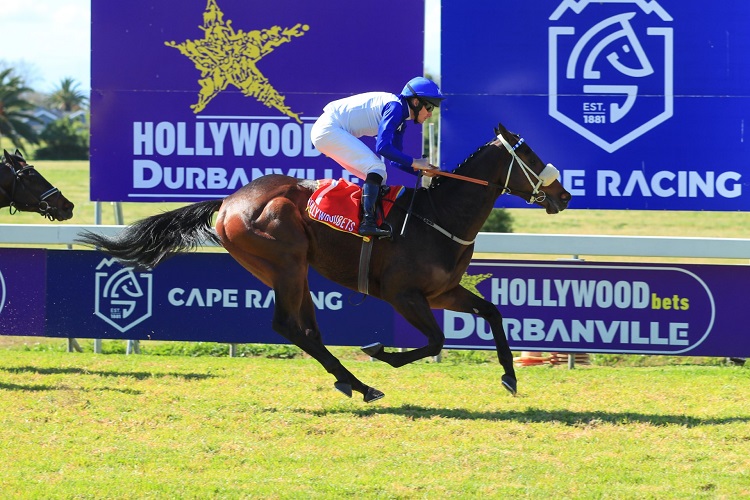
‘Louis’ and ‘Commander’ Face Off
Coastal Command is the tip to win Race 6. (Picture: Wayne Marks)
Graeme Hawkins (Gold Circle)
Pick 6 players have found the going really tough at Hollywoodbets Kenilworth recently and today’s race meeting at the Cape Town track again includes a number of very challenging races, particularly the last two events on the 8-race programme. Bankers are at a premium but perhaps our choices for the sixth race, a Progress Plate over 1400m, can be narrowed to Port Louis and Coastal Commander, who share favouritism in the ante-post market.
In receipt of 6kgs from Port Louis, my slight preference lies with Coastal Commander but he has not raced since finishing fourth in the 2000m SplashOut Cape Derby (Gr 1) two months ago, whereas Port Louis’ current form is strong and his fitness levels not in question. Prior to the Derby, Coastal Commander ran second in the richly-endowed Gold Rush over 1600m and it’s quite possible that 1400m may be on the sharp side for the son of Lancaster Bomber these days, but off bottom weight he does make plenty of appeal.
Port Louis was a good second behind Rascallion in the recent Variety Club Mile but he is equally at home over this trip and from a handy draw should make a bold bid for top honours. He has not won a race for 442 days but his form is solid and the 4yo son of Gimmethegreenlight is overdue his fourth career victory. His stable companions, Zil Moris and Zoomie, are not entirely without winning chances but Richard Fourie’s strike rate for Brett Crawford is impressive by any standard and Port Louis could be the pick of Crawford’s trio.
The first race, a Maiden Juvenile Plate (Fillies) over 1400m, could turn out to be a match between Dixieland Band and Babelicious. With the advantage of a better draw and the services of Fourie, I am leaning towards Dixieland Band but both must be included in the opening leg of the Bipot. Pentolina can show marked improvement from her debut run and may be considered for larger permutations.
Justin Snaith sends out the very well-bred debutante, Bela Vista, in the second race, a Maiden Plate (F&M) over 1100m, and she has been priced up favourite in the early market exchanges. She comes up against the older and more experienced Tequila Sky, who has finished runner-up in her last three starts and is well overdue a visit to the winner’s enclosure. Pink Moon would have needed her last run after a lengthy break and has plenty of scope for improvement.
The opening leg of the Pick 6, a Maiden Plate over 1600m, could go the way of the fast-improving Amancio. The son of Silvano was narrowly behind Etoilefillante two months ago but that was only Amancio’s second start and he can turn the tables here. Etoilefillante rates an obvious threat along with Daimyo and Azzuri and, to a lesser extent, Prince of Tibet.
The fourth race is an Open Maiden over 1800m and the race is ripe for an upset result. Early favourite, Kwite A King, has been withdrawn and in his absence I fancy the chances of long-time maiden, Lockheedlightning, as an each way selection. Apache Chief’s last run can be safely ignored and Eric Sands’ runner will go better here, while of Nocturnal Flight, Juan Les Pins and Red Rackham are capable of winning this modest contest.
The fifth race is a low grade Class 5 Handicap (F&M) over 1400m which sees a re-match between Grandiosa and Veronique. At the weights there should be little to choose between the pair while Fly To Rio can never be discarded in this type of race. The maiden Ticking Bomb is an interesting runner but her form suggests she could be competitive. United We Stand and Little Miss Pink have some claims and must be respected. Veronique is my narrow first choice but she will need to reproduce her best form to come out on top.
The seventh race, a Middle Stakes (F&M) over 1100m is extremely competitive and punters will need to cast their nets as wide as possible. Southern Skies may be worth an each-way flutter but without much confidence as most of the 11-strong field rate winning chances.
The eighth race, a Class 5 Handicap over 1100m with an average merit rating of 60, is another very difficult race with the potential to produce a “bomb” result. Wordsworth has been placed in his last three outings and should go well again but he is just a two-time winner from 52 starts – a clear indication of his limitations. Why Not Jackie won well three weeks ago but has never been the most consistent filly around and Whiskey Bravo can progress further after showing some improvement in his most recent start. Not an easy end to the race meeting!

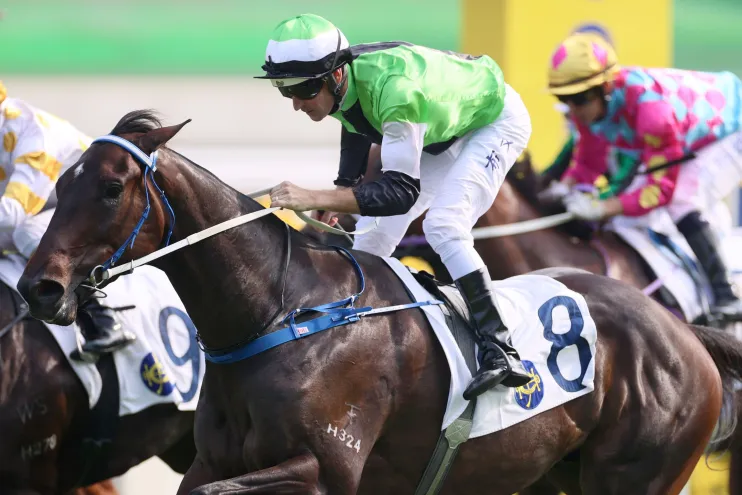
Happy Valley Wednesday Analysis And Selections
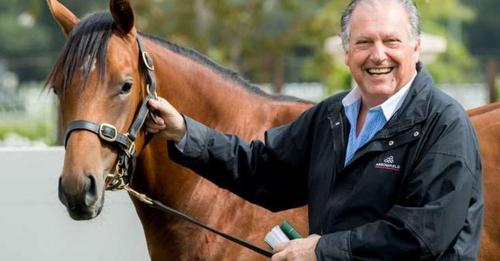
Messara: There Is More To Horse Ownership Than Just Money
John Messara (Picture: Brownwen Healy)
TDN
Arrowfield Stud founder and chairman John Messara has long taken a global view when it comes to breeding and has formed strong strategic links with fellow major breeders in Europe and Japan. He recently spoke with our colleagues at The Thoroughbred Report on the perceived stagnation of the Australian Pattern race programme and now shares with Emma Berry his wider views on racing and breeding in various jurisdictions and the decision to send a special mare to be based in Europe.
EB: You have had associations with European entities before, notably with the Aga Khan Studs. What has prompted you to decide to send mares to Europe to be bred to northern hemisphere time?
JM: Well, we have sent only one mare at this point, specifically to access Frankel (GB). That mare is quite a special one for us, The Broken Shore (Aus) (Hussonet), a half-sister to Redoute’s Choice (Aus) and also the dam of Champion three-year-old filly Shoals (Aus). Our partner, Jonathan Munz, persuaded us to relocate her in Europe on a permanent basis for easier access to Frankel (GB) and of course our aim is to try to breed a good colt by this great stallion. It means we’ll have to race her progeny in Europe, but that should be fun.
EB: I note that you have recently mentioned potentially standing the offspring as stallions if they are colts and perform well enough. Do you feel that there are certain European stallions whose offspring could work well in Australasia and, crucially, be well received by breeders?
JM: Certainly, the stallion ranks in Europe and America offer a wider range of elite stallions for a mare like The Broken Shore than here at home, and Frankel in particular is quite special and very suitable for her. Australasian-bred stallions currently dominate our sire premierships but young stallions like Harry Angel (Ire), Too Darn Hot (GB), Blue Point (Ire), St Mark’s Basilica (Fr) and Pinatubo (Ire) are being given every chance to succeed here.
EB: The Autumn Sun (Aus) (Redoute’s Choice {Aus}) was recently represented by his first Group 1 winner, Autumn Angel (Aus). Would you ever consider shuttling him, particularly given his family, and with his younger siblings being based back in Europe?
JM: Yes, we would consider shuttling him, if a sound opportunity was to arise. The Autumn Sun has got off to a solid start in Australia and hopefully there’s more to come. He’s a stallion with a relaxed attitude, who would handle the travelling and transitions between hemispheres.
EB: How do you view the increasing importation of middle-distance and staying horses from Europe to Australia? Do you feel there is enough encouragement in the Australian breeding industry for breeders to try to produce this type of horse at home?
JM: We certainly have the racing programme and the prize-money for middle-distance horses, albeit that there is an historical demand for precocious speed animals. And yes, the flow of imports of European middle-distance horses and their success on the track here has been something of a wake-up call, causing Australian breeders to consider a more diverse approach to their breeding options. We at Arrowfield have been on that path for some time, with stallions like Dundeel (NZ), Maurice (Jpn) and The Autumn Sun. I am hoping that the exaggerated focus on two-year-old racing is behind us and that we start producing horses with a more versatile aptitude.
EB: Do you feel that there is there too much emphasis internationally on two-year-old success?
JM: The statistics are interesting: in Australia 12% of all stakes races are for two-year-olds, while in Great Britain and Ireland it’s more than 20%, yet Australia has been much more focussed on two-year-old racing. The Golden Slipper, established in 1957 and still the world’s most valuable two-year-old race, is undoubtedly one reason; another is our broad ownership base including syndicates of people keen to see their horses run early.
While it is naturally exciting to see each season’s juveniles stepping out, and they are a vibrant part of Australian racing’s mix, I sense that this focus on two-year-old racing isn’t quite as intense as it once was. I suggest that at least a couple of factors are responsible for this: mature European horses winning our middle-distance races; and the success in Australia of stallions like High Chaparral (Ire), Street Cry, So You Think (NZ), Dundeel and Maurice.
EB: From your perspective, do Royal Ascot and other major meetings in this part of the world have enough allure for Australian owners and trainers? Or is it simply the case that financial rewards are greater at home and in jurisdictions such as Hong Kong and Japan?
JM: Yes, I do think Royal Ascot retains its appeal for Australians – at least, I’m yet to meet anyone who has been underwhelmed by it. A stakes win at any of the top European meetings is a great asset in a pedigree and a wonderful, bucket-list experience for most of us. I would say, without much hesitation, that most Australian owners would enjoy the challenge of taking on the world, if they had the horse to do it. There is more to horse ownership than just money!
EB: Japan is another country with which Arrowfield has strong links. What is it that drew you to become involved in standing stallions such as Maurice and Admire Mars? Do you keep mares in Japan?
JM: We have had a 25-year, strong and productive relationship with the leading Japanese stallion farm, Shadai Stallion Station, and with Katsumi Yoshida’s Northern Farm; these are hugely successful breeding operations. We have stood horses here in Australia on the shuttle and have partnered with them in other cases. Japanese stallions have offered us diversity by providing outcrosses for our relatively small gene pool. We sometimes ship mares to Japan to access particular stallions in Southern Hemisphere time, such as Sunday Silence and Deep Impact (Jpn). We also operate a broodmare partnership with Northern Farm which has produced 7 Group 1 winners including Horse of the Year Weekend Hussler (Aus), Blue Diamond winners Reaan (Aus) and Tagaloa (Aus) and last weekend’s Australian Oaks winner Autumn Angel (Aus).
EB: What do you feel that other breeding nations can learn from the Japanese model?
JM: My observation is that the Japanese breeding industry relies more on the excellence of racetrack performance than the fashionable pedigree or commercial saleability. They have bred many, many internationally competitive athletes that way. The efficiency and scope of their training facilities is amazing and they are constantly looking for ways to do things better.
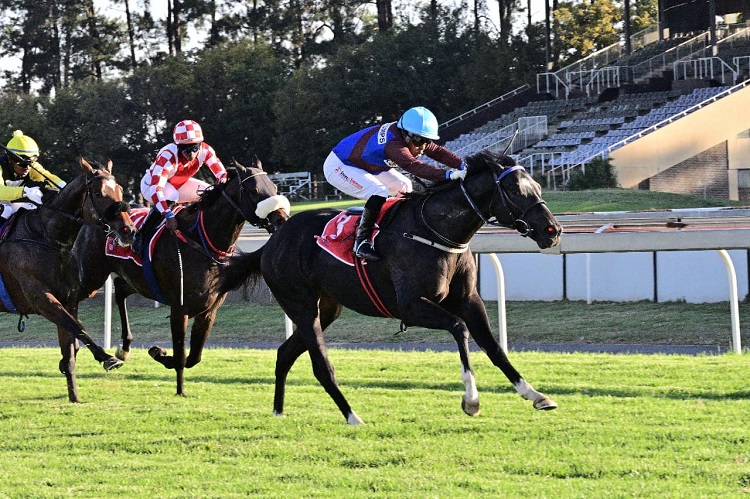
Yeni, Crawford Doubles
Today’s Question
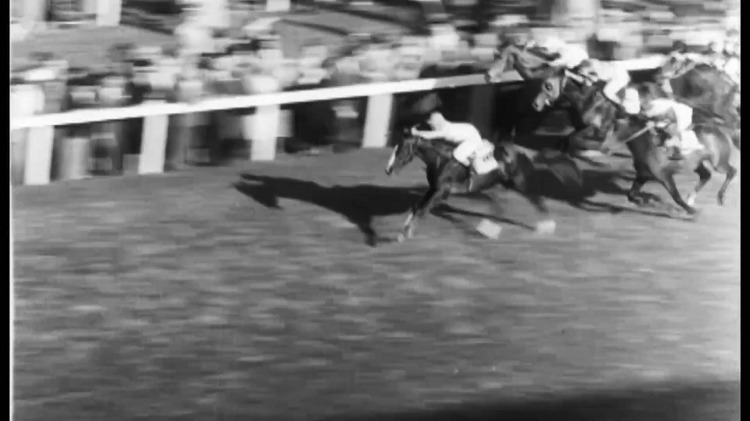
Picture: C’est Si Bon wins the 1954 July
Dennis Labistour trained two July winners, Gay Jane (1951) and C’est Si Bon (1954). But what first is he accredited with in July history?
Midweek FIELDS
Hollywoodbets Kenilworth, Wednesday
Today’s Question Answer
1931 saw the first known incidence of people flying in to watch the July. They were Mr J Hursh and Mr R Liebanwitz who flew from East London to the Stamford Hill aerodrome in a Union Airways Fokker monoplane piloted by Dennis Labistour.