Hashtagyolo Is Paying Dividends On Her Big Price


Tracktion Events Ignites a New Era in Race Day Entertainment
Where music, fashion, and racing collide for South Africa’s next generation
Location: Hollywoodbets Kenilworth, Cape Town, South Africa
Get ready for a race day like no other. Tracktion Events is redefining the experience, fusing music, fashion, sport, and social culture into one unforgettable celebration.
Designed for students and young professionals, Tracktion unites Cape Town’s next generation in a showcase of energy, individuality, and connection.
The launch event, Tracktion @ Hollywoodbets Kenilworth, takes place on Wednesday, 3 December 2025, featuring an exclusive student-only area, live DJ sets, food trucks, bars, and a golden-hour afterparty, all built for content creation and sharing.
It’s not just an event. It’s a new social moment for South Africa’s students.
“Tracktion is not your parents’ race day,” says Jamie Bailey, Director and Co-Founder of Tracktion Events. “It’s where racing meets the party and the crowd is the vibe. It’s the perfect opportunity to bring horse racing into student life.”
With access to over 65,000 students across UCT, Stellenbosch University, Varsity College, and Red & Yellow, Tracktion offers brands a powerful platform to connect with South Africa’s most trend-driven audience — students aged 18–24 who shape what’s next in culture and conversation.
 The event will feature a Best Dressed Couple competition and a student race to close out the afternoon, ensuring memorable moments and strong media appeal.
Tracktion @ Hollywoodbets Kenilworth marks just the beginning. Plans are already underway for a national series of student race day experiences across South Africa in 2026, with early partners gaining first-mover advantage and priority collaboration opportunities.
For brands, creators, and culture-shapers — this is where the next generation shows up.
This is Tracktion Events — where every moment comes to life.
TICKETS AVAILABLE: Tracktion | Home
Media Contact
Jamie Bailey
Director, Tracktion Events
info@tracktion.club


My Best Shot Has The Hardest Altitude Aclimatising Task In The Cup
My Best Shot has been supplemented for the Betway Summer Cup and Richard Fourie has been booked, but this Fire Away gelding might feel the effects of altitude at Turffontein more than the other raiders (Pauline Herman Photography)
My Best Shot is one of the supplementary entries for the Betway Summer Cup together with Shoot The Rapids, Anfield’s Rocket and Mastership and he joins See It Again, Royal Victory, King Pelles, Shoot The Rapids, Madison Valley and On My Honour as potential raiders for the big race.
Richard Fourie has already been booked for the Alan Greeff-trained My Best Shot.
The question of altitude will no doubt surface when the raiders are discussed, but in fact it is going to be My Best Shot who is going to have the hardest time of it according to anecdotal evidence.
My Best Shot will raid from Fairview Training Centre, whereas all of the other raiders will raid from Summerveld.
That is is significant because in fact Summerveld is already at a third of the altitude of Johannesburg, whereas a horse raiding from Fairview will take in a full altitude increase from sea level to the 1753m of Johannesburg.
A study of the effects of altitude on racehorses has never been done for the reason that South Africa is the only major racing country in the world where it is considered an issue.
However, South African trainers have their own theories learnt through trial and error over decades of practice.
Athletic performance in thoroughbreds, as in humans, is interlinked with oxygen supply.
Haemoglobin, an iron-containing protein within the red blood cell, carries oxygen to the rest of the body and the more haemoglobin present the more that can be carried.
However, when the number of red blood cells is too large there is a traffic jam effect and blood flow is restricted.
This is termed haemo-concentrating and is chiefly associated with intact males.
Gelding can help solve haemo-concentration and apparently long, slow work is another relieving influence.
Additives can provide the raw material to create haemoglobin, but the only thing that causes haemoglobin to rise is exercise.
The aim of training is to stress the system, so that bone marrow makes more haemoglobin for the workload.
A gradual increase in workload is therefore best.
Scientific studies done on the impact of altitude on human athletes is unlikely to be of much use in thoroughbreds as they have different makeups to humans.
Firstly, over realistic distances, thoroughbreds are physiologically more capable of adapting to high altitude than human athletes, because a horse’s spleen holds approximately one third of its total red blood cells and these are hold in reserve until mobilised through exercise, stress and excitement.
However, the measurement of haemoglobin and red blood cell content in horses can’t always be exact because even the anticipation of the needle can cause excitement and the consequent release of the splenic blood.
Furthermore, there is a debate in literature as to which component of splenic blood is more important in the development of VO2 max in racehorses.
VO2 max is the maximum capacity of an athlete’s body to transport and use oxygen during incremental exercise.
Some evidence suggests that the overall increase in circulating blood volume is more important.
However, other evidence suggests that the increase in circulating red cells and Heamatocrit (the volume percentage of red blood cells in blood), independent of volume, are more important.
Furthermore, it has been discovered that horses have two types of red blood cells, one being rigid and the other balloon-like.
Horses with more of the balloon-like cells will find it easier to move blood into the muscles and the lungs.
On average horses have 40% rigid and 60% fluid cells, but a horse with only 5% rigid cells would have a tremendous advantage, all else being equal, and this may be an area that explains why some horses are superior to their fellows.
South African trainers generally believe that horses have to be worked harder at altitude.
In order to get a horse fitter it has to reach a stage where it is in oxygen debt.
Incrementally, a horse will be worked to reach this stage until it is fit enough to race, and at altitude horses need to be fitter to race because the oxygen content of the air is less.
It stands to reason that a horse trained at high altitude that will start going into oxygen debt at the 400m mark in a Highveld race might still be debt free by the 200m mark when raiding at sea level.
However, Corné Spies, who is probably the most travelled trainer in South Africa, has been quoted as saying, “If the horses stay at the coast after their runs they tend to go flat. It would take about six weeks or two months for them to aclimatise and they would then begin to thrive. But taking them in and out is not a problem, so I ship them up and down to keep the positive effect of high altitude training.”
It is also generally agreed that horses raiding the Highveld from the coast would struggle at distances beyond a mile.
Horses raiding out of Summerveld have done it, but Geoff Woodruff, a five-times National Champion trainer, who has plenty of experience of training on both the coast and at altitude, pointed out that Summerveld is already a third of the altitude of the Highveld.
It is also generally agreed that coastal horses campaigning on the Highveld hit a flat spot at roundabout the 19 day mark that can last for a week or so, although Woodruff believes it takes three to six months for a horse to aclimatise to altitude, unless it’s a sprint-miler.
There are many extenuating factors to consider on the subject of thoroughbreds and altitude, such as the temperament of the horse and how well it travels.
However, there are those who would say, “If a horse is good enough, it would win on the moon.”

Rafeef's 3YOs Are Making Headlines
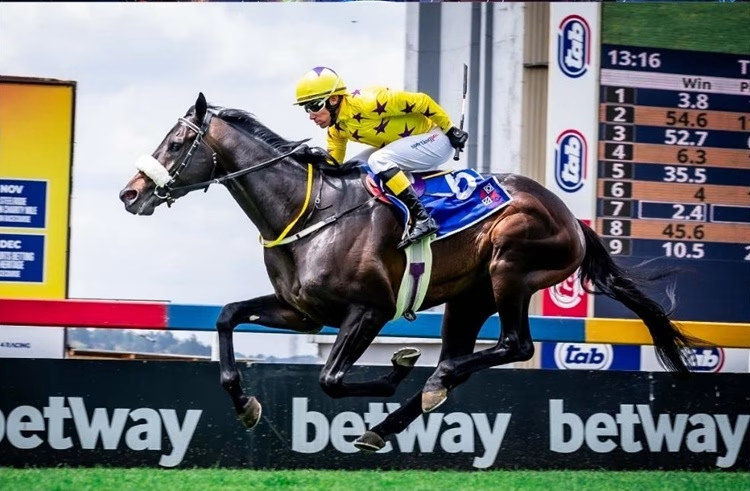
Dawson’s Anvil impressed on debut at Turffontein on Sunday (JC Photos)
Cape Breeders
Ridgemont’s red hot sire Rafeef has been enjoying a stellar period with his three-year-olds.
Rafeef is the sire of Dawson’s Anvil, who made an impressive, winning debut at Turffontein on Sunday. Trained by Mike and Mathew De Kock, the three-year-old Rafeef colt romped home to win the Betway Maiden Plate by nearly three and a half lengths. Bred by Bush Hill Stud, the exciting Dawson’s Anvil races for Hollywood Racing.
Another exciting three-year-old prospect for Rafeef is Beware, who made it two wins from three starts when he won at Hollywoodbets Kenilworth on Saturday.
On Monday Rafeef hit the headlines again.
The G1 winning son of Redoute’s Choice looks to have a very exciting sort in the form of his three-year-old daughter Reet Petite.
The latter made it three wins from three starts when she won impressively at Hollywoodbets Kenilworth on Monday.
Trained by James Crawford, Reet Petite was given a confident ride by Richard Fourie in Monday’s Race Coast Incentives Powered by Hollywoodbets Class 4 (F and M) (1600m).
Racing just off the pace early on, Fourie bought his mount with a strong run as Reet Petite stormed home to win as she liked by two and a quarter lengths.
Bred by Ridgemont Highlands (who own her in partnership with Devin Heffer), Reet Petite is out of the Daylami mare Super Elegant. The filly is a full-sister to the smart Enchanting Choice.
Monday’s winner is one of two Rafeef fillies entered for the upcoming G1 World Sports Betting Cape Fillies Guineas.
The inform Rafeef, currently fifth on the General Sires premiership, was South Africa’s Leading First Season Sire of 2020-2021.

Famous Lady Can Lead Them A Merry Dance

Winner Puts Ferraris In Pole Position For Longines IJC Berth
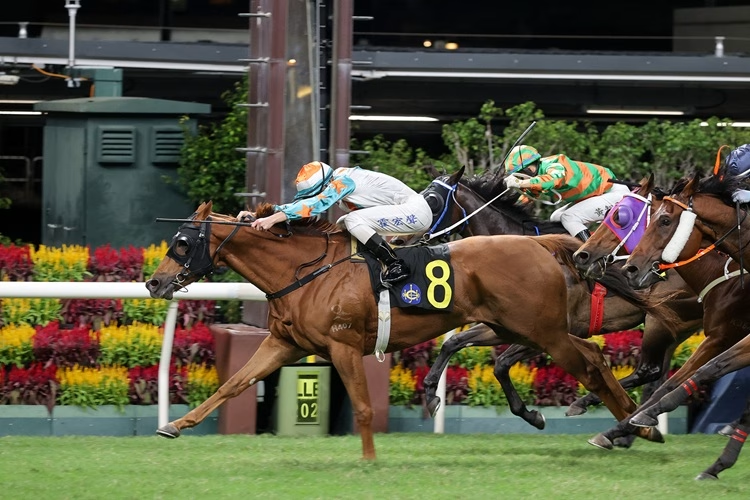
King Oberon gets up to give Luke Ferraris a vital win (Picture: HKJC)
Luke Ferraris showed why he is lying second on the Hong Kong jockey club at Happy Valley today when scoring on the Douglas Whyte-trained King Oberon, paying a Tote dividend of 21.
King Oberon came from a wide draw of nine in the Class event over 1200 and he was then caught wide in midfield. However, Ferraris never panicked and just allowed the horse to relax and use his big stride. The si-year-old found plenty in the straight and stretched away to a 0,75 length victory, his second in succession, both of them under Ferraris from wide draws.
Ferraris is on 14 wins for the season, one ahead of Hugh Bowman, and he is thus in the hunt to win a personal first ever berth in the Longines IJC (International Jockeys Challenge) as leading jockey (Purton has already qualified as champion jockey).
Lyle Hewitson is on nine wins.
Zac Purton is way out in front on 34 wins.


Damyan Pillay And Dezahn Louw Doubles
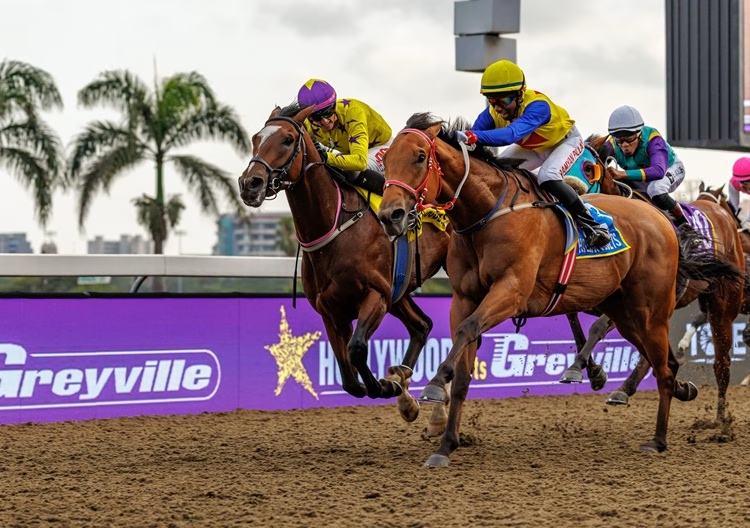
Damyan Pillay scored a quick double when extracting a late surge from the Garth Puller-trained Duke Of Marmalade gelding Imperial Power (Candiese Lenferna Photography)
Damyan Pillay and Dezahn Louw, both 4kg claimers, scored doubles on the Hollywoodbets Greyville poly today.
Pillay has gone to 17 career wins, so is nearing the end of his 4kg claim, and Louw is on 14 career wins.
This season Pillay has had eight wins at a strike rate of 10.67%.
Louw has had eleven wins at 10%.
Craig Zackey had one winner today to go to 77 for the season, eight clear of Richard Fourie.
The KZN Jockeys championship is being led by Serino Moodley on 29 wins, with Tristan Godden next best on 23 and Callan Murray, Sean Veale and Craig Zackey are next best on 18, 18 and 15 respectively.
The KZN trainers championship is being led by Stuart Ferrie on 15 wins with Gareth van Zyl and Mike and Mathew de Kock next best on 14 each, while Alyson Wright, Dean Kannemeyer and Andre Nel follow them on 13, 13 and 12 wins respectively.


Today's Question
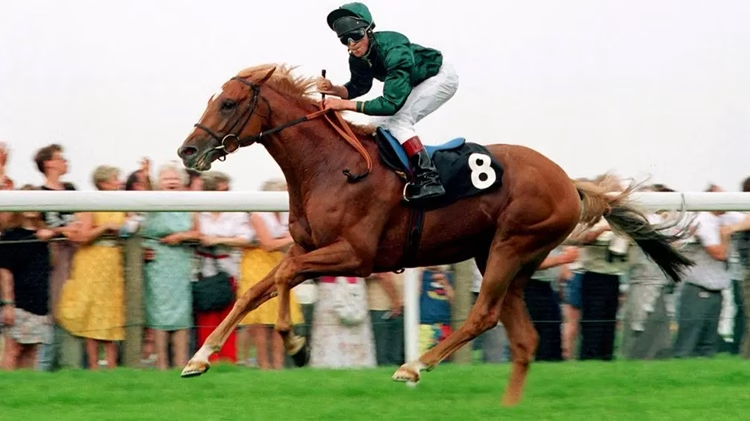
“A foal and his money are soon parted,” was an interesting play on words used in a racing headline in the Evening Standard in late 1997. What was the headline referring too?
The picture gives a clue to the answer Credit: Mark Cranham (racingpost.com/photos)

FIELDS, Tuesday, 11 November
Today’s Question Answer
A sales patron had paid 2,5m Guineas for a ten month old weanling by Generous.