




Picture: Dean Street (Master Of My Fate). (Wayne Marks)
Young Woodruff Hopes To Celebrate Women’s Month With Feature Win
Her four-year-old, Dean Street, faces the toughest task of his career in Saturday’s R80,000 Racehorse Owners Association Middle Stakes


Picture: Street Outlaw heads the CTS Ready To Run log (Wayne Marks)
The First CTS Ready To Run Log As At 11 August
The first log for the 2022 CTS Ready To Run Stakes has been published.
The R600 000 race will be contested over 1400m at Kenilworth on Sunday, 30 October. It will follow the 2022 CTS Ready To Run and Unbroken Two-Year-Old Sales scheduled for Saturday, 29 October.
The CTS Ready To Run Race is restricted to eligible graduates of the 2021 CTS Ready To Run Sale, and entries will open at 11:00 on Monday, 17 October. Supplementary entries are due by 11:00 on Friday, 21 October, with declarations due by 11:00 on Monday, 24 October.
Vaughan Marshall’s colt Street Outlaw (Master Of My Fate) is at the top of the first log, having been given a merit rating of 96 by the handicapper following his debut success over subsequent G3 stakes winner, We’re Jamming.
Candice Bass-Robinson’s Piroshka (Quasilo) has a win and four places to show from five starts. He finished ahead of Street Outlaw when they were beaten by Dave The King recently and, rated 95, occupies second place on the table ahead of third-placed Royal Aussie (Royal Mo), a fast-improving type from Justin Snaith’s yard, who has already won over the course and distance.
Mike Miller’s G3-placed Sabatini (What A Winter) holds fourth ahead of Captain Peg (Jay Peg), a smart filly and the only two-time winner in the Top 5 so far. Stuart Pettigrew’s runner shares fifth with Franz Lehar (Querari), who has had his form well franked, with no fewer than four winners having come from behind him on his impressive Scottsville debut in June.
More changes and updates will follow as the log changes, and connections of the potential runners and racing fans will be updated regularly.
Below, the Top 20 on the log as it stands on 11 August 2022:


Jarred Samuel Enjoying Life As Workrider For Douglas Whyte


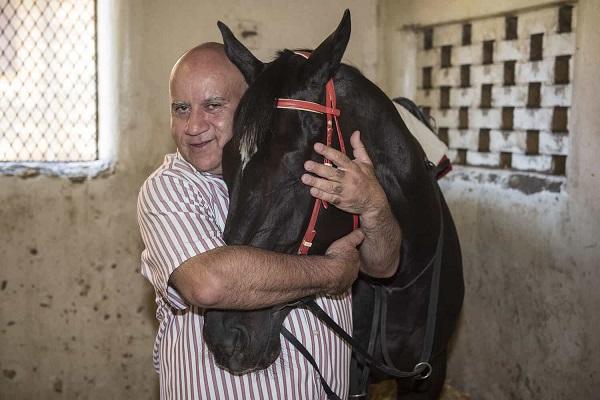
Picture: Paul Peter (Michel Bega).
The Horses Know Paul Peter Is A Champion


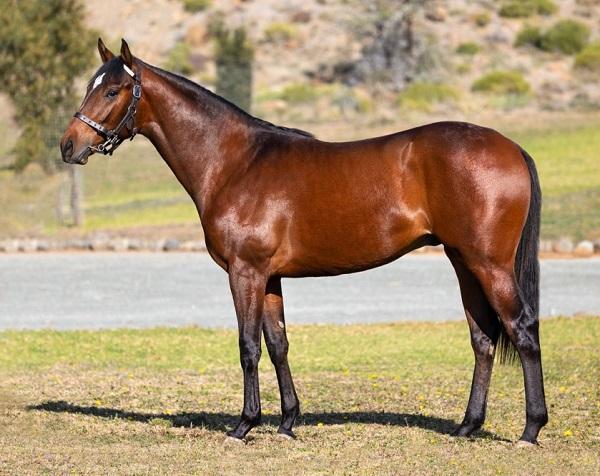
Picture: Lot 205 at the BSA August Sale is Drakenstein Stud-bred Lancaster Bomber colt Battle OfThe Bulge
Drakenstein Offering Relative To Cousin Casey At August 2yo Sale
Drakenstein are sending a draft of eleven to the BSA August Two-year-old Sale (26-27 August).


Picture: Record rainbow caught at Vogel Vlei (Frances Bell).
A New Record At Birch Brothers
The Birch Brothers are the most prolific winners of the SA Breeders Championship in history, winning it more than 40 times, but also like to keep their own list of farm records.

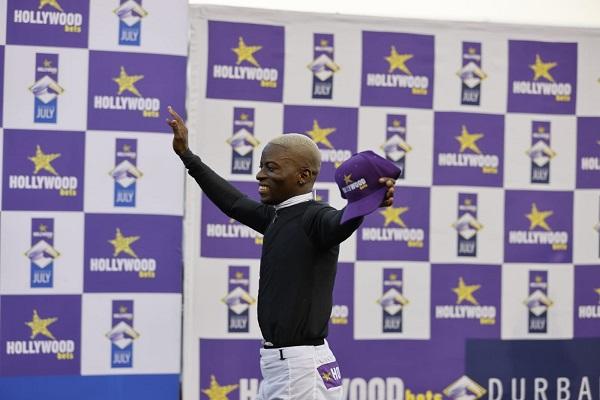
Picture: S’Manga Khumalo (Hollywoodbets).
Khumalo/Greeff Mean Business This Season
S’Manga Khumalo clinched an early double for Alan Greeff on the Fairview Poly today to make it eight wins for the combination this season.
Khumalo has only ridden in Gqeberha to date this season and all eight of his winners, at a strike rate of a phenomenal 42%, have been for Greeff.
Greeff has had nine winners at 21.43%.
However, reigning East Cape champion trainer Gavin Smith outdid him today, scoring a treble. He has now had four winners at a lowly 6.06%, which is sure to improve.
Sharon Kotzen ended last season in fine form and has started this season well too, scoring a double today to take her tally for the season to three winners at 15.79%.


Today’s Question
What is meant by Harmonised Screening Limits (HSL’s) and Detection Times (or Withdrawal Times) in horseracing?
Picture: Horse medication injection
Kenilworth Saturday Fields

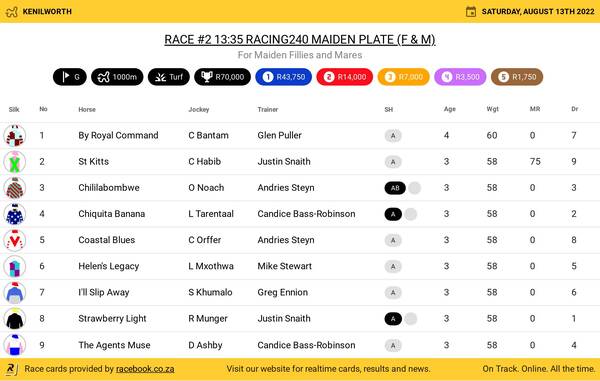

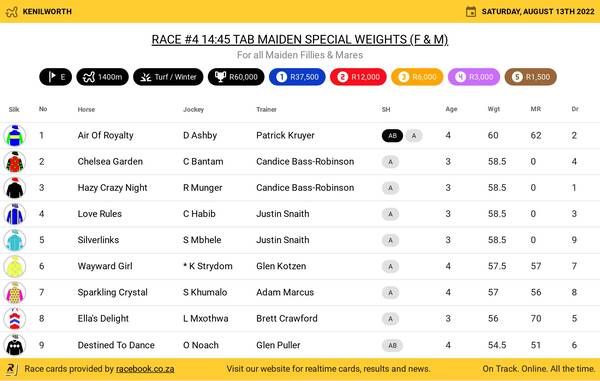


Hollywoodbets Scottsville Sunday


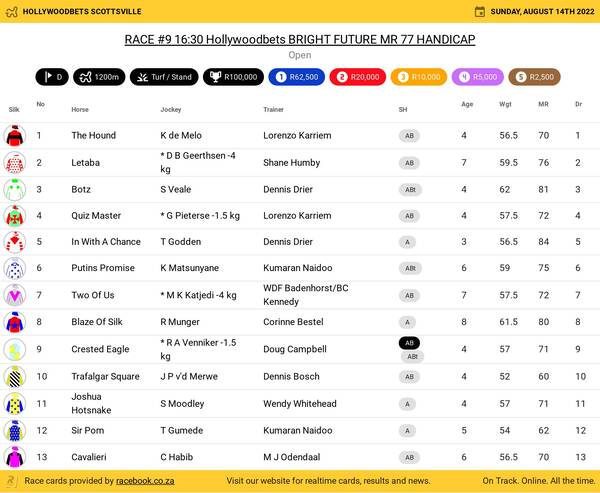

Today’s Question Answer
Today horseracing regulatory bodies usually distinguish between the control of illicit substances (doping control) and the control of therapeutic substances (medication control).
“Doping” drugs, such as agents that stimulate the central nervous system, can artificially enhance the horse’s physical capacity and its competitive instinct, and there is zero tolerance of these drugs.
However, an anti-doping policy should not impede the use of legitimate veterinary medications and therefore another important philosophy that most regulatory bodies now employ is that a “zero tolerance rule” is not suitable for medication control.
The high level of sensitivity of modern screening methods allows traces of legitimate medications to be detected long after their presence is having any effect.
In the past this has led to some trainers attaining “positives” and being unfairly labeled as “cheats” by the uneducated racing public.
The general racing public do not have the knowledge to differentiate between irrelevant traces and levels that are having a pharmacological effect, or, even worse, to differentiate between therapeutic medicine and “dope.”
Most regulatory bodies have now established the use of harmonised screening limits (HSL) relating to commonly used drugs in equine medication.
The limit is the level of the medication detected in the urine or plasma below which there will be no pharmological effect on the horse.
The HSL’s, which are set according to the regulatory body’s research analysis, are normally kept secret and veterinarians are instead given a list of detection times otherwise known as withdrawal times.
This is the time it will take for the expected detected level of the medication to be below the HSL.
Most veterinarians allow a day or two more than the detection time to be safe, because horse’s have varying metabolisms and in some the medication will take longer to reduce than in others.
In January this year the IFHA (International Federation Of Horseracing Authorities) provided ISL’s (International Screening Limits) and IRL’s (International Residue Limits (to to control certain contaminants and environmental substances) as guidelines.
CLICK HERE TO SEE THE IFHA’S ISL’s AND IRL’s
Picture: Blood and urine samples are tested against HSL’s.
