Snaith Barometer: 188
Target: 222
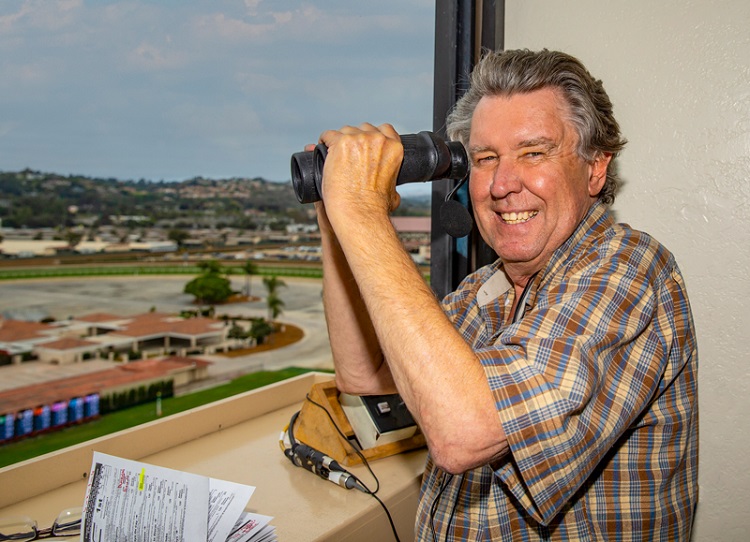
Iconic Commentator Trevor Denman Retires
Picture: Trevor Denman in the Del Mar commentary box (© Benoit Photo).
Trevor Denman set a trend of commentary style in South Africa with the great commentator Craig Peters revealing he was influenced by him and following on from that Clyde Basel modelled himself on Peters, Craig’s son Sheldon modelled himself on both Denman and his father, whilst current commentator Naqeeb Munshi clearly models himself on Basel.
Denman was the first out here to inject varying tones of voice into his commentaries, and thus his voice tone gave a clue to just how strongly a horse was travelling, and he became an icon in the USA when introducing his style over there.
His commentary of the 2009 Breeders Cup Classic is recognised as one of the all time great commentaries in horseracing history as the crowd went with his instinctual raised tone as the great Zenyatta switched to the outside and they virtually lifted the roof off the grandstand (Click here to hear the commentary).
Denman began calling in South Africa in 1971.
He left for the USA in 1983 and has been there ever since.
www.dmtc.com wrote the below article about Trevor’s retirement:
Iconic race caller Trevor Denman has announced his retirement after 40 years on the job at Del Mar. Denman will be succeeded at the seaside track by veteran track announcer Larry Collmus, the voice of the Kentucky Derby, Preakness Stakes and Breeders’ Cup for NBC Sports.
Denman, 72, who first started calling races in 1971 in his native South Africa, has been in the booth atop the Del Mar grandstand for all but one summer racing season since 1984. A Southern California racing institution, he also served as the caller at Santa Anita from 1983-2015, and for a time, called races at every stop on the Southern California circuit, including Hollywood Park and Fairplex Park.
“This is one of the hardest decisions I have ever made,” Denman said. “But my soul is telling me that now is the time.”
Denman and his colorful story-telling style of race calling effectively changed how the sport was heard in America. Rather than the straight reporting of positions during the running, he would weave a tale of what was unfolding and – using his background from early days at the South African jockey school as well as his special feel for the game – would often alert racing fans to events likely to happen well before they did.
“We knew this would eventually come with Trevor, and now it is here,” added Del Mar CEO Joe Harper. “We’ve been so lucky to have the best in the business in our booth for all these years, and now all we can do is wish him and his wife Robin the very best on their road ahead.”
Collmus, 58, has called races around the world since his first at Bowie Race Track in Maryland in 1985. His first full-time job as a track announcer came when he was 20 years old at Birmingham Turf Club in Alabama. Since, he has ascended to call many of the most important races of this century, including American Pharoah’s Triple Crown run in 2015, every scintillating Breeders’ Cup performance since 2012 and the 2023 Dubai World Cup.
“Del Mar racing fans have been so fortunate to have Trevor as the announcer here and we’re excited that someone of Larry’s stature and experience can succeed him,” said Del Mar president Josh Rubinstein. “Just as we’ve been lucky to have Trevor in the booth all these years, we’re lucky now to have Larry here.“
Collmus has served as the regular race caller for Del Mar’s fall Bing Crosby meet since he took over that role from Denman in 2020. He also serves as an on-camera racing analyst for FanDuel TV.
“I grew up listening to Trevor and have loved his unforgettable calls for decades,” Collmus said. “It is an absolute honor to follow him at Del Mar. Calling the races there in the fall the last five years has been a great experience and I’m thrilled to be the new full-time voice of Del Mar.”
Denman called races for more than 50 years. Besides his extensive Southern California stint, he worked at tracks in the Bay Area and on the east coast, as well as calling the Breeders’ Cup races when ESPN had the TV rights to the championship event. Additionally, he provided the calls in several racing movies and dozens of television shows. He currently lives with his wife Robin on a 500-acre farm in the Minnesota countryside.


Andrew Fortune Is Off The Mark
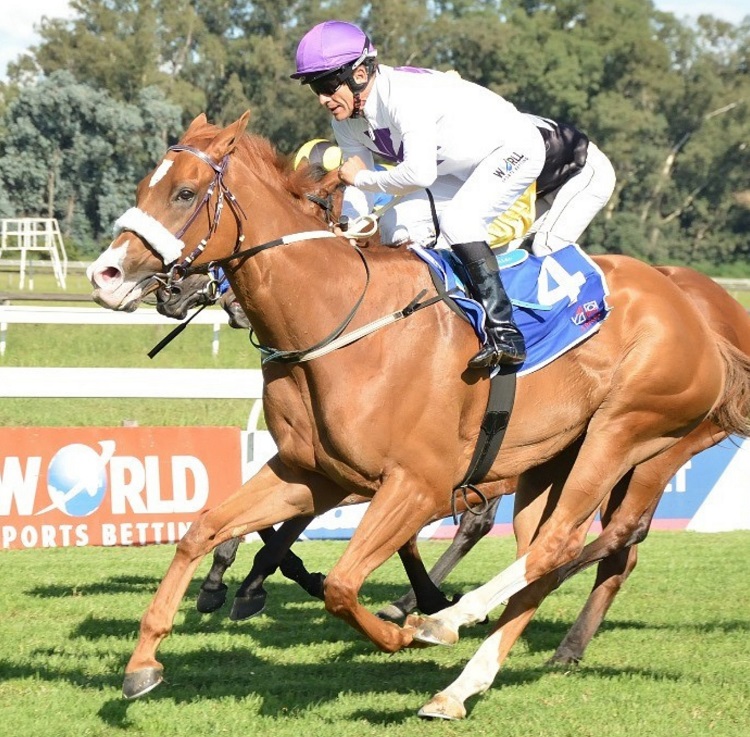
Andrew Fortune was back in the winner’s enclosure after a gap of more than seven-and-a-half years. (JC Photos).
Andrew Fortune has never been the most stylish jockey, but horses have always run for him and his win today on Var Park was a typcical Fortune win. Low draws are unfavourable over the Vaal Classic track 1000m course by trends and he had the lowest draw of all. Nevertheless, he sat still on the horse and was soon off the pace. He switched the five-year-old Var gelding inward and somehow the horse began to make up the leeway in effortless fashion with the rider continuing to sit still. He hit the front at the 300m mark and Fortune then got lower in the saddle and showed the horse the whip and delivered a couple of backhanders while shaking the reins. Var Park opened up a three length lead and Fortune was able to do another typical fortune by “smutsing” in the last 50m i.e. looking around and then stopping riding and patting the horse. He got home by three-quarters of a length.
Fortune was emotional in the winner’s enclosure and for once became lost for words as he thanked his wife Ashley Fortune for allowing him to follow his instincts and spoke of the “long road” it had been for him to get back in the race-riding saddle.
He was able to explain that he had not enjoyed Austalia, where he had to do such mundane jobs as clean out stables, and he added, “… and I decided to start riding again, I don’t know why … and here I am.”
Vark Park had drifted out from 11/2 to 14/1 and beat home the 7/1 shot Tchaikovsky.
It is interesting to note the Grant Maroun-trained Var Park’s last three wins have been with jockeys in their late 50s aboard.
57-year-old Piere Strydom won on him on January 18, 2024, 58-year-old Piere Strydom won on him on January 30 this year and 57-year-old Andrew Fortune won on him today.
It had been 2814 days since Fortune’s previous win and Var Park was the 6th ride of his comeback.
Fortune looked likely to score a double as he was on the long odds-on shot in the last race, Dylan’s Champ, but this horse was found to not be striding out by the on course veterinarian and was scratched down at the start.
Gavin Lerena and Ryan Munger both scored doubles at the meeting.
Lerena is now in joint second place on the national log together with Richard Fourie on 151 wins and he has achieved it at a strike rate of 25.72%.
Munger’s stint in South Africa during the Canada off season has yielded an impressive 23 wins at a strike rate of 21.50%.




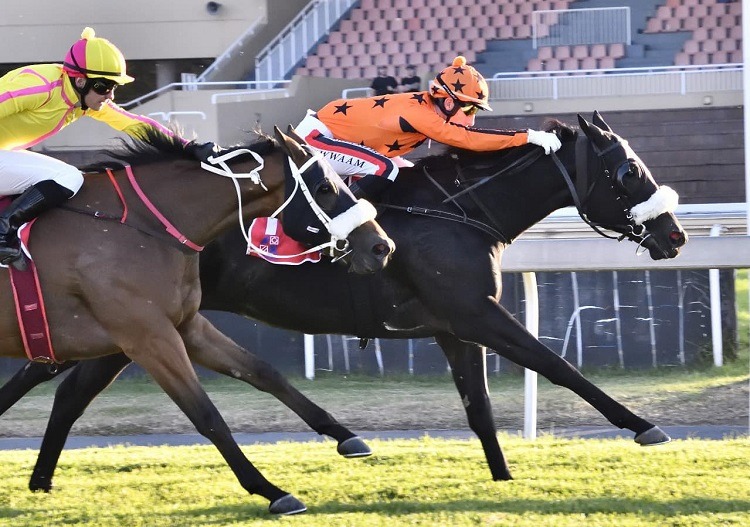
Munchkin Can Go One Better

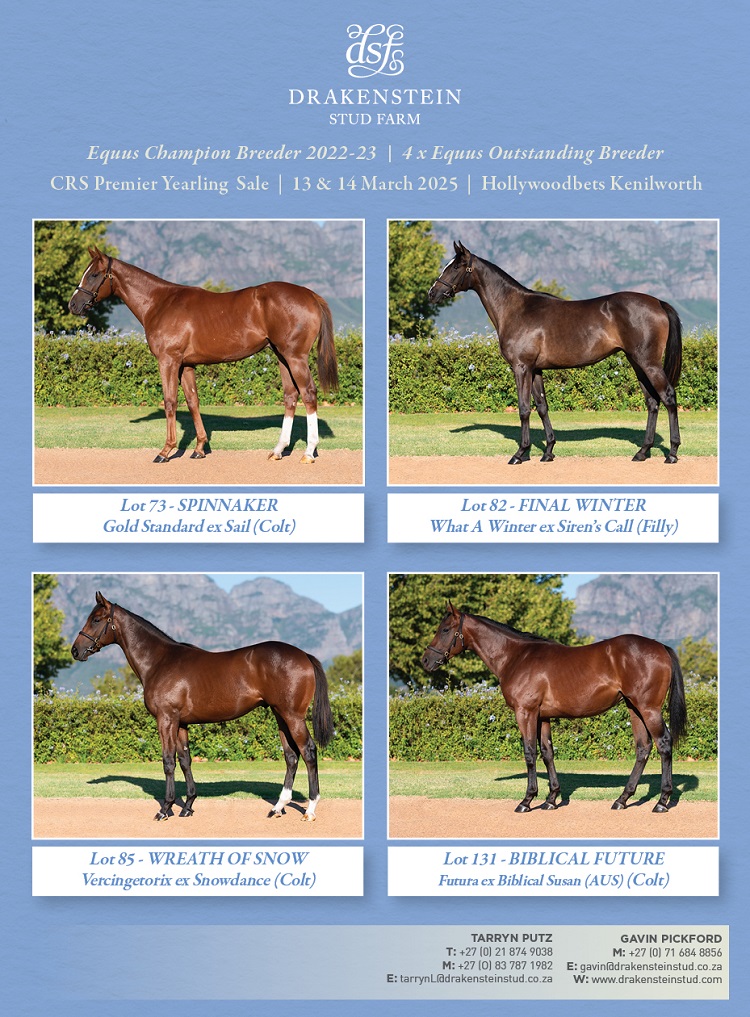

Black Swan Stud Bring Ten Classy Prospects To Premier Sale
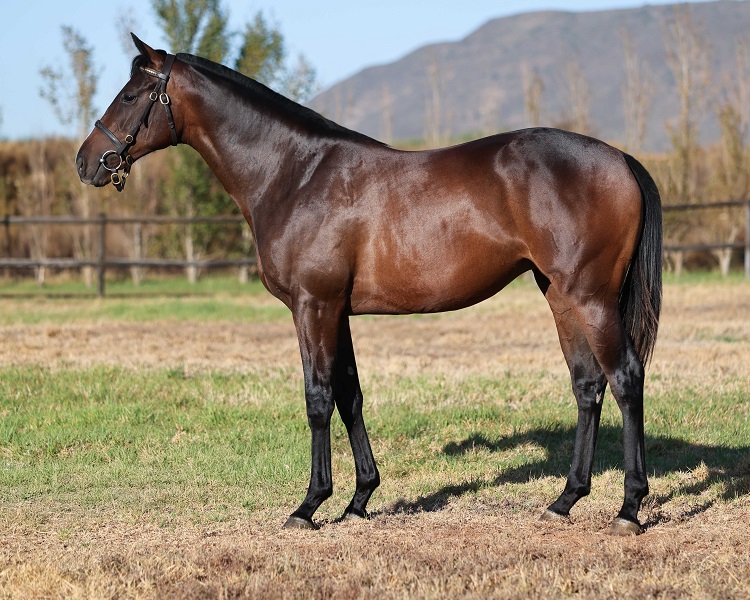
Lot 2 is a filly by Master Of My Fate out of Cape Fillies Guineas winner Field Flower, which makes her a half-sister to Met runner up and now sire Last Winter.
Black Swan Stud is a farm which continues to churn out smart winners. The Robertson farm’s growing list of high-class alumni include the classy half-sisters Celtic Rumours and Almond Sea, winners of this season’s G2 Betway Joburg Spring F and M Challenge and Listed Betway Swallow Stakes respectively.
Black Swan also made waves at the Summer Sale earlier in the year, where they sold a full-brother to Almond Sea for R600 000.
Home to champion Elusive Fort, whose numerous high-class offspring include the charismatic G1 Vodacom Durban July/G1 World Sports Betting Cape Town Met winning sire Kommetdieding, Black Swan Stud has prepared a quality draft for the 2025 Premier Yearling Sale. Their Premier string includes not only yearlings by Elusive Fort, but also by such stallions as Erupt, Gold Standard, Flower Alley and Master Of My Fate.
A few likely standout lots include:
Lot 2: f Master Of My Fate -Field Flower
Master Of My Fate consistently ranks as among the leading sires in South Africa. His top daughters include such G1 winners as Sentbydestiny and Zarina, G2 Wilgerbosdrift Gauteng Fillies Guineas winner Lady Of Power, and G3 Goals And Gallops Final Fling Stakes queen Pretty Betty. Master Of My Fate is also sire of promising current fillies as Destiny Of Fire, Lady Springfield, Tap Shoes and Two G’s, while his Splicethemainbrace won eight of her first ten starts.
The Silvano sired Field Flower was a top-class performer who won the G1 Avontuur Estate Cape Fillies Guineas, beating Laverna, Croc Valley, and Townsend. At stud, Field Flower has produced six winners including G1 Sun Met runner up and sire Last Winter.
This filly is a strong, well proportioned type who walks well and with purpose. She is hard to fault on conformation.
Lot 80: f Elusive Fort -Silvan Star
Silvan Star showed tremendous ability during her career, winning seven times, including the G3 Final Fling Stakes and Listed Highlands Stud Ladies Mile, and finishing third in both the G1 HSH Princess Charlene Empress Club Stakes and G1 The Premier’s Champions Challenge.
At stud, Silvan Star has produced the useful Nothingelsematters.
Out of the Lecture mare Bold Choice, Silvan Star is a three-parts sister to champion Bold Silvano, with the latter a son of Silvan Star’s granddam Bold Saffron.
This filly is strong, correct and a good active walker, with a well proportioned body. A deep chest and a strong, sloping shoulder make her an eye catching prospect.
Lot 91: f Elusive Fort -Step Out
This filly is just the third foal for her dam, with Step Out’s first foal being the useful Walk With Me. A daughter of six time South African champion sire Silvano, the well bred Step Out is a half-sister to G2 Betting World 1900 winner Solid Speed, and two other black type horses.
From the family of recent Hong Kong winner Mid Winter Wind, Step Out also hails from the family of Singapore champion Lizarre.
This filly looks to be a speedy type who is strong and correct. Well put together, she is a busy walker who has a good action.
Lot 159: f Gold Standard -Elusive Heart
Trippi’s son Gold Standard made his mark with his small first crop producing the graded stakes winning fillies Golden Hostess and Hold My Hand.
Elusive Heart, whose sire Elusive Fort is enjoying increasing success as a broodmare sire, was a high-class racemare who won or placed in nine black type races. Her biggest win came in the 2018 G3 Vasco Prix Du Cap, where Elusive Heart accounted for the likes of Rose In Bloom, Captain’s Flame, Final Judgement and Goodtime Gal. Elusive Heart, whose first runner, a full-sister to the filly on sale, has won, also showed top-class form when finishing third in the G1 Garden Province Stakes. On that occasion, Elusive Heart accounted for such top-class performers Gimme Six, Simply Royal, Folk Dance, She’s A Giver and The Secret Is Out.
This is a beautiful, eye catching filly who walks like a dream. She is correct and strong through the shoulder and quarter.
Lot 169: c Gold Standard -Golden Dawn
From one of the best families in the stud book, this colt is a half-brother to three winners. His dam, bred on similar lines to the Goldmark sired champion Trademark, is Listed Sweet Chestnut Stakes winner Golden Dawn, a half-sister to G1 Golden Slipper winner Chestnuts N Pearls.
This is the great Party Time family, responsible for such stars as In The Fast Lane, Trademark, and Let’s Rock ‘N Roll.
This is a lovely, strong colt who is a very good walker with a lovely stride who fills the eye.
Lot 193: f Elusive Fort -Omaticaya
Champion Elusive Fort is well known as the sire of July/Met winning star Kommetdieding, but he has also sired a host of top-class fillies. They include Grade One winners Siren’s Call and Lauderdale, G1 Cape Fillies Guineas runner up Safe Harbour, SA Oaks winner Secret Potion, and graded stakes winners Big Burn, Elusive Heart, Fort Ember, Freedom Charter, and Sprinkles.Omaticaya, a daughter of six time South African champion sire Silvano, was a smart performer whose four wins included a triumph in the Listed Jamaica Handicap. Beaten just over three lengths, by Beach Beauty, in the G1 Klawervlei Majorca Stakes, Omaticaya also finished second in the following year’s Jamaica Handicap.
An elegant, racy filly who fills the eye and is well grown and correct. She has a very athletic walk, and is beautifully put together.
For more information on this draft, interested parties can contact Walter Cowe on 063 662 1250.

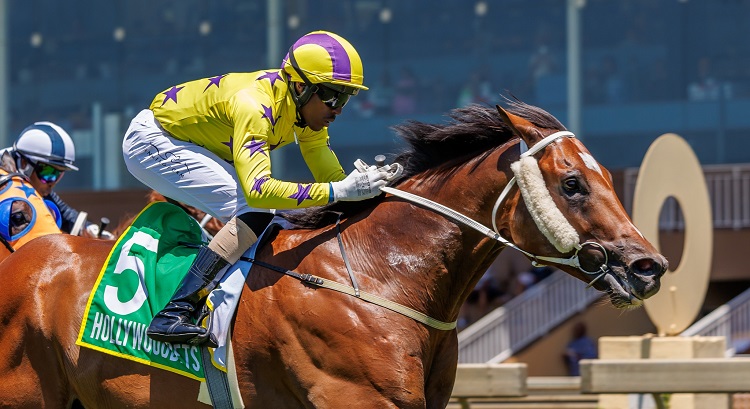
Tyrconnel Can Record Another Win





Hopes And Dreams Have A "Frantastic" Draft!
Picture: Lot 13 is a colt by Rafeef out of dual Gr 1-winning Dubawi mare Happy Archer.
Hopes And Dreams Stud is home to one of the best-bred stallions in South Africa. Frantastic, who showed promise in a brief racing career, is a son of unbeaten superstar Frankel, one of the world’s great stallions.
Among Frankel’s numerous star performers are Arc winner Alpinista, as well as such Gr 1 winners as Adayar, Hurricane Lane, Chaldean, Logician, Soul Sister, Anapurna, Inspiral, Lake Victoria and Cracksman.
The latter, a full-brother to Frantastic, was an outstanding performer who won eight of 11 starts, with Cracksman’s six group victories including back to back running’s of the Gr 1 Champion Stakes.
Cracksman, Champion Sire in France in 2003, made waves at stud when his unbeaten son Ace Impact, a member of Cracksman’s first crop, won the 2003 Gr 1 Qatar Prix de l’Arc de Triomphe.
Hopes And Dreams Stud will be bringing a six strong draft at the Premier Yearling Sale, with this draft made up of yearlings sired by Hawwaam, Legislate, Malmoos and Rafeef.
Lot 13: f Rafeef – Happy Archer
By a Gr 1 winning son of Redoute’s Choice, out of a dual Gr 1 winning daughter of Dubawi, this filly has plenty to recommend her. She shares her sire Rafeef with such high-class fillies as Frances Ethel, Mon Petit Cherie, Beating Wings, Mrs Browning and Chasing Happiness, among others, while her dam, Happy Archer, was a top-class racemare.
Happy Archer, whose sire Dubawi is broodmare sire of more than 80 stakes winners, won a trio of graded races, notably the Gr 1 Thekwini Stakes and Gr 1 Garden Province Stakes, and she earned more than R1.3 million in stakes.
Already the dam of four winners, Happy Archer is herself a half-sister to high-class Australian stakes-winner Femina Fashion.
Lot 7: c Malmoos – Ruby And Roses
A son of champion sire Captain Al (as is One World), South African Triple Crown winner Malmoos has his first yearlings this year. This colt is out of a mare who won four times, and his granddam, Rahy Cashmere, is a daughter of outstanding sire and broodmare sire Rahy.
Rahy In Cashmere, in turn, is a winning half-sister to US stakes winner Knit One Purr Too, and her dam Luxuriously is a Danzig half-sister to a pair of US graded stakes winners. This is the same female line as outstanding milers Intikhab, Polish Precedent and Zilzal, as well as Gr 1 Preakness Stakes winner Seize The Grey.
Lot 200: c Hawwaam – Quepid
Champion Hawwaam has made a fine start with his two-year-olds, with his first two runners including the smart debut winner Read All About It.
The five time Gr 1 winner shares his sire Silvano with current star sire Vercingetorix.
Quepid, the dam of this colt, is a twice winning daughter of Querari, whose daughters have already produced the likes of Chansonette and Peach Daiquiri. A half-sister to the six-time winning dam of the very speedy Chocolate Soldier, Quepid is out of Flowing Stars, a daughter of Western Winter and Gr 3 Champagne Stakes winner Waterwise.
Lot 204: f Legislate – Russet Savannah
This filly is a daughter of Horse Of The Year and four time Gr 1 winner Legislate, a stallion who sports some outstanding statistics.
She is out of Russet Savannah, by world leading broodmare sire Spectrum, with Russet Savannah having already produced five winners. The well-bred Russet Savannah is a winning half-sister to Gr 1 Allan Robertson Fillies Championship/Gr 2 KZN Fillies Guineas winner On Her Toes, and her dam Savannah Breeze is a three-time winning half-sister to Gr 1 winners Follow The Falcon and Savannah Queen.
Lot 213: Malmoos – Silver Tiara
This colt is out of the useful racemare Silver Tiara, herself a daughter of Listed Sun Classique Handicap runner up Satin Silver. The latter was sired high-class Australian sire Commands, the broodmare sire of more than 50 stakes winners including multiple Equus Champion Got The Greenlight.
Satin Silver, a half-sister to the dam of Listed Breeders Guineas winner Europeana, is out of the Rainbow Quest mare Bow Street, a half-sister to Gr 3 winners Love Everlasting and Baron Ferdinand. This is the female line of such outstanding international performers as Shirley Heights, Pentire and Divine Proportions among others.
Lot 233: Malmoos – Zagara
Out of a mare sired by Malmoos’ close relative Master Of My Fate, this colt’s twice winning dam is a half-sister to Surcharge, aka Yulong Prince, winner of the Gr 1 Daily News 2000 in South Africa and the Gr 1 Cantala Stakes in Australia. Zagara’s dam Congestion Charge, also the granddam of Mauritian star Walls Of Dubrovnik , is a three-parts sister to Gr 3 Queen’s Vase winner Endorsement, and Zagara’s second dam, Overdrive, is a five time winning daughter of the highly influential sire and broodmare sire Shirley Heights. This is the family of numerous top-class performers including champion racehorses and top-class sires Kris and Diesis.
For more information on Hopes And Dreams Stud and their Premier Sale draft, interested parties can contact Suzette Viljoen on 082 773 3811.


JP McManus's First Cheltenham Win Changed Racing History
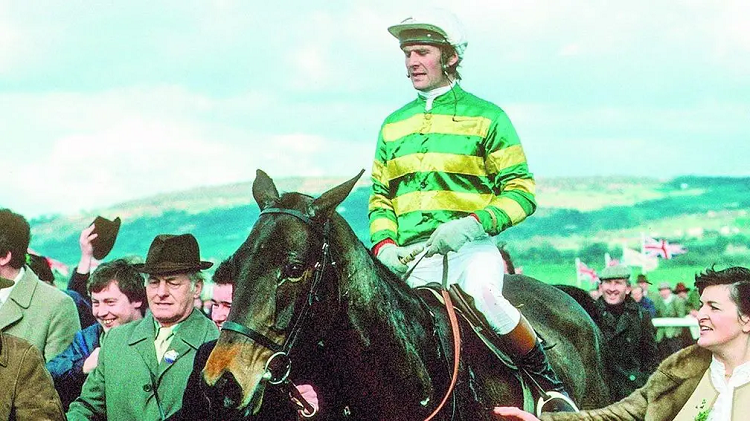
Mister Donovan is led in following his success in the 1982 Sun Alliance Novices’ Hurdle
Credit: Gerry Cranham
Lee Mottershead (Racing Post)
They say you never forget your first. JP McManus has never forgotten. Without his first Cheltenham Festival winner the rest might never have followed, nor a financial investment in jump racing of unprecedented proportions.
McManus desperately wanted Mister Donovan to win. He desperately wanted the gamble to be landed.
Here truly was a bet that changed racing. The winning owner and punter has certainly implied as much. With McManus you sometimes have to read between the lines. When it comes to the lines he has spoken about the impact to him, and therefore to others, of the 1982 Sun Alliance Novices’ Hurdle, the race’s significance becomes clear.
“My most important one at Cheltenham must have been the first one, Mister Donovan in 1982,” said McManus a few years ago. Then he added another sentence, a small nuanced droplet, as is his way. “He was needed,” said the man who needed him, a man so many others have subsequently needed. Yes indeed, Mister Donovan changed a great deal.
In the 2019-20 campaign, McManus had at least one horse with 46 trainers based in Ireland. In Britain the number was 21. He races around 350 horses each season, all of which account for 350 sets of individual training fees. Yet it is not just trainers who benefit from his largesse, but also pre-trainers, jockeys, stable staff, breeders, auction houses, transporters, feed merchants and countless others, including those employed at Martinstown Stud, where so many of McManus’s former racehorses live out a happy retirement.
McManus, needless to say, benefits as well. He does it and he spends it because he loves it.
That love affair arguably hung on the opening race on the second day of the 1982 festival, the meeting at which he has tasted success more regularly than any other owner. That was not the case on the morning of March 17, 38 years ago. Truth be told, the afternoon of March 16 had been pretty grim. So had a number of Cotswolds afternoons in the past.
The reality is the hallowed meeting had not always been kind. Through the 1970s the son of County Limerick became established as a fearless bookmaker and punter, one given the sobriquet of ‘The Sundance Kid’ by legendary writer Hugh Mcllvanney. He also became an owner, his emerald green, yellow hoops and white cap colours first carried to victory by Cill Dara in a Naas Flat race on July 20, 1977.
McManus, however, is much more a jumps man than a Flat man. So is Edward O’Grady. McManus had reaped rewards through backing O’Grady’s runners, especially in bumpers, prior to his first official involvement in the yard as the owner of Jack Of Trumps, a horse whose career would be marked with considerable ill fortune when it came to almost anything associated with Cheltenham.
In 1980 Jack Of Trumps was cruising when brought down at the fifth-last fence of the Gold Cup. One year earlier he was ruled out of the race by injury when strongly fancied. In 1978 he had fallen when odds-on favourite for the National Hunt Chase. In the 1979 running of the four-miler McManus again had the odds-on favourite, Deep Gale. He, too, hit the deck, this time at the sixth-last fence. On YouTube you can only just see the horse crash out. The noise made by the watching audience remains powerful.
“Deep Gale did a sort of Bambi on ice at the fence,” says O’Grady. “Boots Madden actually landed running and only just missed catching him. I swear to God, if he had caught him he might still have won. I like to think so, anyway.
“Of all the losses, that was the most frustrating. The cheer that should have been made for him when he won was made by the bookmakers when he fell. I’ll never forget that noise.”
The problem with Mister Donovan is he also made a noise, although that did not alter the way he looked. To O’Grady’s eyes, he looked glorious.
“In 1979 I was the judge at a pre-sale show,” recalls O’Grady. “Mister Donovan was a three-year-old at the time and I made him the champion. Being a good judge, I bought him as well. Three months later, I sold him to one of my very good owners, subject to veterinary examination.
“Demi O’Byrne, the famous one, went in to his box to examine him, started listening to his heart and then ran out of the stable. ‘Christ, what’s wrong with you?’ I asked him, to which he replied, ‘Jaysus, he’s got such a bad murmur in his heart I’m afraid he might fall down on me’.
“That sale obviously failed to go through. The horse ended up becoming part of the family and Judy, my then wife, rode him in a number of bumpers. He was always there to be sold but because of the bad heart murmur not many people were keen to buy him. In fact, it was only after his final race before Cheltenham at Naas that JP bought him. Even then, he was sold only for what he cost me, and that was two years after I paid for him.”
O’Grady had relieved himself of 8,200gns for the son of Choral Society. Going into Cheltenham some onlookers may have questioned his wisdom, given Mister Donovan had been defeated in his three previous outings over hurdles. However, in that Naas race, staged 18 days before the Sun Alliance, he finished third to Fredcoteri, a subsequent dual winner of the Irish Sweeps Hurdle.
“JP is a very good race-reader,” says O’Grady. “At the time I was training the horse for myself and aiming to peak him at Cheltenham. In order to do that, he ran over what was probably an inadequate trip at Naas as a way of sharpening him up. It was a superb trial. We knew he would be so much better over the longer trip.”
A few observers raised eyebrows at his run over the shorter distance, so much so that O’Grady was encouraged to take out an injunction against one particular publication.
“Some people weren’t as complimentary as they should have been,” says O’Grady, adding: “Personally, I think that was mostly due to jealousy.”
Bookmakers and punters are not motivated by jealousy but rather money. They studied the 1982 Sun Alliance – now the Ballymore Novices’ Hurdle – and sent off maiden hurdler Mister Donovan the 9-2 second favourite. The Tommy Ryan-ridden six-year-old had opened on course at 6-1 but was bigger in the morning. Nobody other than McManus knows what prices he took but plenty of past reports indicate he swept up £250,000. Given the winner’s prize-money was £15,977.50, that was many a pretty penny.
“We loaded up on him at the time and it was significant that he won,” McManus once told Donn McClean in an interview for what was then Racing UK, while he has also been quoted saying: “I hadn’t owned the horse for very long, but he had been laid out for the race and it all came right on the day. It was great to have a winner at Cheltenham but the fact that I backed him made it all the sweeter. The money was important.”
McManus, who if not betting on credit was known to prefer banker’s drafts over cash, had lost money to the bookmakers on the festival’s opening afternoon. O’Grady understands why those same bookmakers were wary as the clock ticked down to 2.15pm that Wednesday afternoon.
“I would suggest knowing JP had bought the horse would have been like an electric shock for layers,” says O’Grady. “Unless they had been sleeping under some stone, bookmakers must have regarded JP buying the horse as important.”
John Christie, betting at the Roy Christie stand, was one of the bookmakers.
“In those days, monumental amounts of money flew around the Tattersalls ring and the rails at the Cheltenham Festival,” he says.
“It was the heyday of racecourse bookmaking. Tattersalls bookmakers took fortunes. The buzz and excitement at Cheltenham was incredible. When JP was in the ring the money flying through the air would have been phenomenal because all the tic-tacs would have seen him and bookmakers would have been backing his horses, hedging their liabilities.”
Christie adds: “Everybody knew who JP was. He was always very unflustered and always very polite. He would often come up to the stand. He didn’t send minions over to place the bets on his behalf. He enjoyed the battle, having had so much experience as a bookmaker himself.
“If we were offering 5-1 about one of his horses, he might ask if we would lay him a £10,000 to £2,000. We would say, ‘Can we do you a £5,000 to £1,000, JP?’ However much you offered him he would accept and then move on down the line. Bookmakers didn’t panic if JP was punting. They would all want to accommodate him and lay a bet, which is why Mister Donovan shortened up only from 6-1 to 9-2 in the ring.
“JP would have good days and bad days. As he was invariably backing his own horses, you would think he would win regularly, armed with the information he was privy to, but JP would back his losers as much as his winners. That’s another reason why bookmakers in the ring were prepared to take the bets.
“It absolutely wasn’t the case that you took the bet and got ready to pay out immediately. You always thought you had your chance of getting the horse beat.”
They did not get Mister Donovan beat. He was ridden to minimise risk, always prominent and in front from the final descent. Up the home straight it became a protracted duel between the Irish raider and the Bob Champion-ridden Spider’s Well, competing, somewhat ironically, in the silks of O’Byrne, the vet who had been fearful Mister Donovan might collapse on top of him.
That morning at O’Grady’s yard, O’Byrne ran away from Mister Donovan. At Cheltenham, Mister Donovan ran away from O’Byrne’s horse, winning their battle by a length and a half. McManus was significantly richer than he had been before the race. Whether or not his cash influx came from one source or many is unclear.
“Although it’s true that £250,000 was a lot more then than it is now, it wasn’t actually a vast amount relative to the number of bookmakers who would take decent bets,” says Christie. “I could name 50 on-course bookmakers who would have taken £5,000 to £1,000 back then. That alone would make up the £250,000. In those days, that sort of bet would have been seen, expected and accommodated.”
It may well have been accommodated by bookmaker Stephen Little.
“I don’t feel it’s right to discuss individual punter’s bets,” says Little, having spent a little time studying his records. “What I will say is the biggest bet I laid on the horse was £5,000 to £1,000, from which you can draw your own conclusions. I actually wasn’t betting too big in those days. It was only really later that JP started coming to me for huge bets.”
Little adds: “Taking on JP was exciting. It was helpful as well because it sort of pushed me into taking big money. Usually if he backed a horse I would have to back the horse myself because of the size of his bet and to limit my liabilities. With JP, I never had to worry about waiting to get paid, either.”
This time JP was the one who could enjoy being paid. “I don’t remember quite how much we had on but it was important at the time anyway,” he has said. Absolutely critical at the time was O’Grady’s masterful preparation of Mister Donovan.
“Training horses with murmurs is a tough business,” admits O’Grady, who insists he did not have “a sixpence” on Mister Donovan himself.
“Over the years I’ve learned you can finesse horses with a murmur to peak on one day. That’s the day you want to be on because that day isn’t going to come back for a long time.
“He was an average horse with a heart problem who peaked on the right day. That doesn’t always, or indeed often, happen, but that happened to be one of those splendid days when it did.”
The day became increasingly alcohol-driven, although teetotaller McManus would likely have stuck to tea.
“It was the first time I had organised a box at Cheltenham,” remembers O’Grady. “It was one of those little old fashioned boxes that led on to a flat roof overlooking the parade ring. They comfortably took eight people, maybe a maximum of ten. After the Sun Alliance that poor little box had to accommodate what must have been a couple of hundred Irish people and so much champagne the roof nearly caved in.
“Mister Donovan certainly wasn’t a banker but people seemed very happy to celebrate the fact JP and I had enjoyed a Cheltenham winner – particularly as they knew JP would pick up the tab.”
He has been picking up the tab ever since.
“His support of jumping is so big that it’s very hard to quantify,” says Michael Grassick, chief executive of the Irish Racehorse Trainers Association. “A lot of the smaller trainers wouldn’t exist without his patronage. His loyalty is unbelievable as well.”
Trainer Eddie Harty highlights an especially positive aspect of McManus’s benevolence.
“The people who are always looked after are the people at the coalface,” says Harty. “There’s always a few quid coming to the lads in the yard. That wouldn’t be the case with every owner, particularly these days. The staff are never forgotten.”
Nor forgotten is Mister Donovan’s Cheltenham Festival triumph. Jumping’s most powerful and prolific owner has now enjoyed 66 wins at the greatest of all meetings, seven of them coming this year, when he famously celebrated a four-timer on the Wednesday.
“I often wonder whether I would have been able to have any of the others if Mister Donovan had been beaten,” said McManus, who won big when he bought a previously unsuccessful hurdler from a trainer whose expertise resulted in a reputed and timely payout now worth the equivalent of around £1 million.
“Win or lose, JP never discussed his gambles with me,” says O’Grady. “I therefore had just one job – that was to produce winners. There was no additional pressure coming from JP backing the horse. There was just the pressure that comes from trying to win a race at Cheltenham.”
The winner of that first race in 1982 is now long since gone. He is, quite rightly, remembered on one of McManus’s walls.
O’Grady says: “Whenever Demi O’Byrne and I were both invited to dinner at Martinstown, JP would always ensure Demi was seated opposite a big picture of Mister Donovan beating Spider’s Well. We’ve had so much gas about it. We would win the race again every time.”
For McManus, and for the sport he adores, it was a vital race to win.


Today's Question
How many amateur jockeys have won the Cheltenham Gold Cup and who was the last to do it?
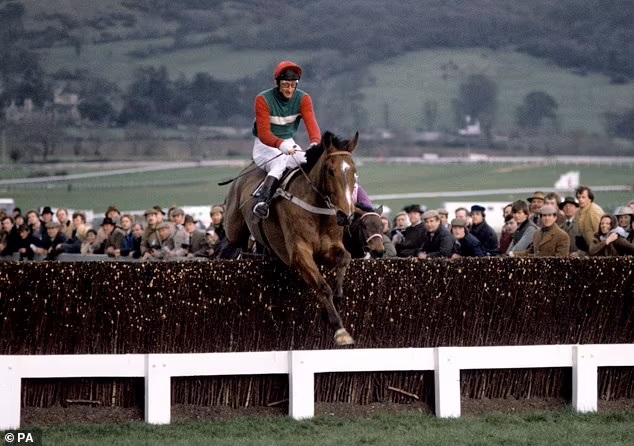
Picture: Jim Wilson wins the Gold Cup as an amateur on Little Owl in 1981. (Picture: PA)
Today’s Question Answer
The Cheltenham Gold Cup had its 100th anniversary last year, with the first running having been in 1924, and only four amateur riders have ever won it with each of them having one win apiece.
The last amateur to win it was Sam Waley-Cohen in 2011, a memorable renewal which saw Long Run defeating the legends Denman and Kauto Star.