



They are not sure yet whether the Golden Loom winner Sheela will be one of their Cape Flying contenders.


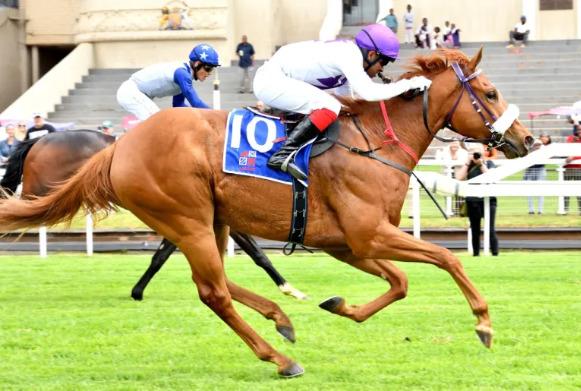
Liverpool Fan Grant Maroun eyeing Cape Guineas With Anfields Rocket
Grant Maroun was still monitoring his gelding Anfields Rocket on Wednesday, to see how he has pulled up after winning Saturday’s Grade 3 Allied Steelrode Graham Beck Stakes over 1400m, and there are other factors to consider before committing to the Grade 1 Hollywoodbets Cape Guineas.
Maroun both trains and owns the Klawervlei Stud-bred horse and said, “There are also races in Jo’burg which he might end up missing if the trip is too hard on him. I don’t have any experience of travelling down to Cape Town, so don’t really know how it effects horses, but it is a R2 million race so I do have to seriously think about it. He will either run in the Dingaans or the Cape Guineas and I will decide by the end of next week.”
Maroun comes form a long line of racing horsemen, so knows the ins and outs of the game and was surprised to hear on TV that he had believed his horse to be a certainty.
He said, “We did expect a good run, but I wasn’t losing my head and thinking he was a good thing.”
He revealed that some had told him he was making a mistake keeping young Kaidan Brewer on for the race and he said, “Kaidan is very underrated and is going to be a proper little rider. He knows the horse and nobody else was going to ride him, I was very happy to have him on.”
He added the strongly built Brewer reminded him of Weichong Marwing in the saddle, the latter’s sublime seat and exceptional balance being his key assets.
Brewer repaid the guv’nor by riding a faultless race.
Maroun said, “The race worked out differently to what I had thought, but it worked out well. The pace was hot and the horses drawn on the outside who tried to go forward all finished poorly, so I think we made the right decision to drop him out.”
Grant bought Anfields Rocket as a weanling on an online auction for a mere R11,000. The horse has thus joined the growing list of bargains who have have been prominent in feature races recently.
He said, “I thought they had written the stallion (Coup De Grace) off too soon, I felt there was still something. We brought him mainly on his looks having seen the videos of his conformation. I did have two Coup De Graces before. They had showed us quite a bit at home, but had issues – you couldn’t blame it on the stallion. My son Ryan also remembered Anfields Rocket’s half-brother Counts Rocket had been full of potential and had been highly regarded by trainer Glen Kotzen, but had gone wrong.”
Counts Rocket was a Listed winner as a juvenile and finished third in the Grade 3 Politician Stakes.
Grant and Ryan are both big LIverpool F.C fans and decided to name the Coup De Grace youngster in the famous club’s honour. Grant had suggested “Merseyside Rocket” but Ryan’s suggestion won the day.
Anfields Rocket was promising from day one in training.
Grant said, “He wasn’t flashy but he gave every jockey who rode him a good feel and they all said he was a very good horse. When we jumped him to pass him at the gates for the first time he showed us how good he was.”
Time will tell whether the athletic chestnut Anfields Rocket will be the next Grade 1 winner for a famous racing family.

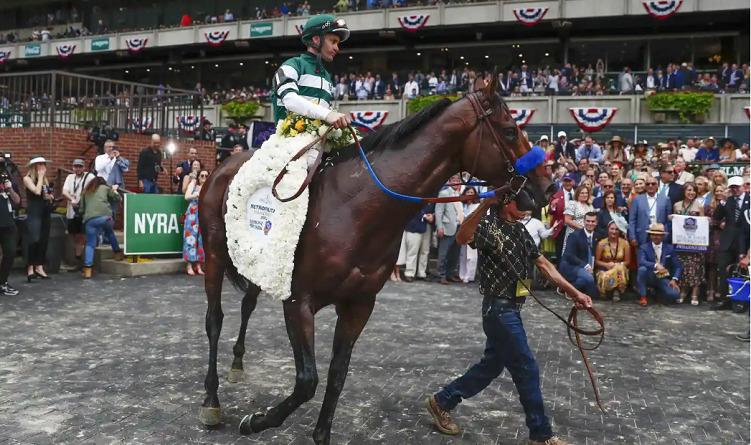
Flightline Poised For All-time Great Status At Breeders’ Cup
America’s multi-million dollar meeting will overshadow the Melbourne Cup and the jumps racing at Aintree this week
Greg Wood (The Guardian)
With all due respect to Australia, where the Melbourne Cup stopped the nation at around 4am GMT on Tuesday, the attention of the racing world this week will focus squarely on the Kentucky bluegrass, and the 14 Grade One events that make up the 39th running of the Breeders’ Cup at Keeneland in Lexington this weekend.
This news may also grate with diehard fans of the jumps, who will argue that the Grand Sefton Chase over the National fences at Aintree will generate far more betting turnover in the UK on Saturday than any of the events in Kentucky. But the simple fact remains that jumping is a niche activity in the global racing industry, enjoyed almost exclusively in Britain, Ireland and France, while the Breeders’ Cup is the richest and most prestigious meeting of the year in the country which has, by several measures, the biggest racing and breeding industry on the planet.
It is also an industry that is showing distinct signs of turning a corner after many years when it seemed that American racing was doomed to inevitable – and often self-inflicted decline.
The Horse Racing Integrity and Safety Act – which, among other things, transfers responsibility for dope testing and medication rules away from individual state racing commissions – came into effect on 1 July. As a result, use of the raceday drug Lasix is expected to be steadily phased out across the US, and last year’s Breeders’ Cup was the first to be entirely Lasix-free.
Other key indicators are also positive. The US’s total “handle”, or turnover, on racing jumped by nearly 12% last year, to $12.2bn [£10.6bn], the highest figure since 2009 despite a drop of 30% in the number of races (from 49,368 to 33,567) over the intervening dozen years. Total prize money, meanwhile, was $1.1bn [£956m], more than six times the UK figure of £146m on offer in around a third of the number of races.
As a result, John Quinn’s Highfield Princess, already a Group One winner in three different countries in her last three starts, will be chasing the biggest pot of her career by some margin when she goes to post for the Breeders’ Cup Turf Sprint on Saturday. And that is one of the six events with a purse of “only” $1m. Six more, including the Mile and the Filly & Mare Turf, both of which have several leading contenders from European stables, are $2m races, while the Turf and Classic are worth $4m and $6m respectively.
For a relatively small – and, to my mind at least, still criminally under-appreciated – trainer like Quinn, it is an astonishing opportunity, and with the Wesley Ward-trained Golden Pal, the winner of the race for the last two seasons, also in the field, it promises to be a compelling spectacle for the fans too.
In all, there were 45 runners from outside the US among the 205 pre-entries for this year’s meeting, including Nashwa, the likely favourite for the Filly & Mare Turf on Saturday when Hollie Doyle will hope to get her first Breeders’ Cup winner on the board. European-trained runners are favourite for six of the seven turf events, while Highfield Princess is a narrow second-favourite for the other.
Most positive of all from an American perspective, meanwhile, is the prospect of a meeting that builds towards the Classic, the 14th and final Breeders’ Cup race, on Saturday evening, when the exceptional Flightline will attempt to defend his unbeaten record against a field that includes Life Is Good, last year’s winner of the Dirt Mile.
Flightline’s emergence as the highest-rated dirt horse since global rankings began has gone a little under the radar on this side of the Atlantic, but he is the superstar that American racing needs as it looks to maintain the recent upswing in its fortunes. His astonishing romp in the Pacific Classic at Del Mar in early September saw Flightline’s rating leap to 139, just 1lb below Frankel’s benchmark figure – for any surface – of 140, and with just five runs in the book at the age of four, there is every reason to think he can push that higher still on Saturday.
Europeans stables and viewers may concentrate on the turf events but Flightline is poised to join the likes of Secretariat, Man O’ War and Seattle Slew on the list of America’s greatest champions. Even the most fervent of jump-racing diehards could well find something to appreciate when he goes to post at 9.40pm (23H40 South African Time).


Bush Hill Stud’s Impressive November 2Yo Sale Draft
Bush Hill Stud will be presenting an impressive line up of two-year-olds at this year’s November Two Year Old Sale.
Remarkably, this string includes eight juveniles sired by proven G1 stallions, with this consignment’s offering including lots sired by the likes of Capetown Noir, Captain Of All, Mambo In Seattle, Master Of My Fate, Querari and Willow Magic to name a few.
Prominent sire Querari, whose progeny include champion Rio Querari and G1 Thekwini Stakes queen Querari Falcon, is the sire of Quentasia (Lot 98), a filly out of G2 The Debutante winner Tempted.Master Of My Fate, sire of such G1 winners as Sentbydestiny, Tempting Fate and Zarina, is represented here by Player X (Lot 1), a colt from the same family as Master Of My Fate himself, and Jack Frost (Lot 169). The latter is a colt out of G2 Gauteng Fillies Guineas third Frosty Friday, whose G3 winning dam is a half-sister to former successful KZN sire Kahal.
Champion sprinter Captain Of All, whose progeny include dual G1 winner Linebacker, is the sire of a colt (Lot 81) whose dam is bred on similar lines to G2 Dingaans winner Silver Flyer, while Dubawi horse Willow Magic, sire of last season’s G1 Wilgerbosdrift HF Oppenheimer Horse Chestnut Stakes hero MK’s Pride among others, has two lots here including a filly (Lot 67) from the same family as such high-class gallopers as Cirillo, Dutch Philip, and Yquem.
Capetown Noir, sire of G1 winners Bohica and Under Your Spell, is represented here by Higgledy Piggledy (Lot 136), a filly whose dam is the smart, five time winning Comme-Ci-Comme-Ca, while the late Mambo In Seattle, sire of dual G1 winner Same Jurisdiction, is responsible for Isorender (Lot 191) a colt whose granddam won the UAE Oaks.
Bush Hill Stud’s draft can be found in Blocks D and E at the TBA Complex in Germiston.


South Africa’s licensed horseracing operator, 4Racing, today launches its TikTok channel and unveils its ‘Racing 4 Real’ competition – aimed at translating Mzansi’s love of racing into bits, bytes, and a whole lot of video.
There are many facets that make up the world of horse racing. Whether it be the jockeys, the horses, the grooms, the fashion, the food and drinks, the events, the pundits, or the betting; the list is endless.
And now 4Racing is giving horseracing aficionados and newbies alike the chance to illustrate their love for the sport by submitting their video creations – and standing a chance to win R10 000.
Racing 4 Real competition entrants can submit up to three one-minute video clips illustrating their racing story, whatever that may mean to them, in whichever language they choose.
The possibilities are endless and full of hilarity; from dubbing over a race to being a caller, to presenting a day at the races, to winning moments, to race day outfits… get as creative as you want – we’re also on the lookout for future on and off-screen talent.
Be funny, cheeky, serious… think outside the box! And you too could be part of the 4Racing.TV team.Visit https://create.4racing.tv/ to enter the Racing 4 Real competition, which closes on 30 November 2022, and upload your files. Also, see www.4racing.tv for inspiration.
The Racing 4 Real competition represents the latest digital innovation from 4Racing.“The meteoric rise of short-form, amateur-generated video content is evident across all social media platforms. The youth have particularly engaged platforms like TikTok, Facebook Video, YouTube, Instagram, Snapchat and the like to share and/or follow content they love. Horse racing needs to capitalise on this and openly engage Generation Z, the Millennials, and its creative tech-savvy fans.“
The Racing 4 Real platform and competition aims to stimulate the creation and sharing of user-generated content in horse racing, beyond the traditional race previews and archive content typically produced by the racing operators.“
Racing fans are encouraged to easily capture and share their magical racing moments with each other and the world and to stand a chance to win with Racing 4 Real,” says Stephen Watson, head of 4Racing.tv.
Upon submission, your entry will go through two rounds including a pre-assessment check to ensure that the entry meets the minimum requirements and a second round of judging by a panel of industry experts.
Your clip may also be chosen to be shown on SABC Sport’s Racing Today show!


Fifty years On From Piping Lane’s Rags To Riches Cup Win
By NEIL KEARNEY
The hardest part of telling Piping Lane’s story is convincing people it’s true.
When he was foaled on a farm in Tasmania’s midlands in 1966, he was so small people confused him for a Great Dane.
The foal was parrot-mouthed and therefore hard to feed. His mother, a mare named Londonderry Air, had been used mainly as a stockhorse, tailing sheep, and she later died of snakebite.
The young man who bred the foal, Rick Prevost of Epping Forest, a rural area about 40km south of Launceston, had repaired fences for a landowner and – instead of asking for payment – he accepted a free service to a stallion.
Prevost chose to use the free service by sending 14-year-old Londonderry Air to Lanesborough, who had sired Beer Street, winner of the 1970 Caulfield Cup.
However, Rick wasn’t trying to breed a racehorse – he just wanted a stockhorse, and he broke in the unnamed gelding on his farm.
Prevost, who was in his early 20s, wanted to go for a holiday, so he sold the horse for $100 to Ned Peterson, a farmer at Westbury, about 30km west of Launceston.
Peterson named the horse Piping Lane.
Ned’s son James recalls that Piping Lane shared a paddock with the family’s pet sheep, Amanda.
“He was a disappointing horse,” James says.
“He ran last in his first two races and then had a string of fourths and fifths. Stayers often take a long time to develop, but he didn’t show much promise.”
The plain-looking brown gelding was beaten 13 times before he finally broke through for a win in a maiden plate at Launceston’s Mowbray racecourse on February 13, 1971.
 Ray Trinder holding the Melbourne Cup trophy won by Piping Lane, who he bought for $6000.
On New Year’s Day 1972, Piping Lane was entered for the eight and a half furlong (1700m) Longford Cup.
Longford, best known for its Grand Prix motor racing circuit of the 1950s and ‘60s, also boasts the oldest continuously used horse racecourse in the Southern Hemisphere.
Its first Cup meeting was held in 1846, predating the Melbourne Cup, and continues to attract several thousand revellers every New Year’s Day.
In 1972 Piping Lane rounded up his modest opposition to claim the prizemoney of $450 plus trophy, a silver teapot, which Mrs Molly Peterson cherished – she used it to brew her morning “cuppa” for the rest of her days.
In the following weeks Piping Lane won the Devonport Cup and then the Hobart Cup, ridden by champion Victorian jockey Roy Higgins.
Late on Hobart Cup day astute Tasmanian horseman Ray Trinder approached Higgins and asked him whether he thought the gelding could win on the mainland.
Higgins, whose nickname was “The Professor”, replied: “At best he could win a nice little race in country Victoria – that’s about all.”
Despite Higgins’ unflattering appraisal, 69-year-old Trinder believed Piping Lane had potential, and he was even more convinced of the horse’s ability when he rallied from near last to finish second in the Launceston Cup.
After that run, Trinder made an offer to Ned Peterson, who agreed to sell Piping Lane for $6000.
“I wasn’t too upset about dad selling Piping Lane,” James Peterson says.
“I was more upset about him selling the chaffcutter.”
But Mrs Molly Peterson and daughter Liz were as attached to the horse as she was to pet sheep Amanda, and they didn’t want to part with him.
Ned negotiated a compromise to appease his wife and children.
He asked Trinder if the Peterson family could race Piping Lane in their colours one more time – in the Deloraine Cup on Easter Monday.
Piping Lane finished an unlucky second at Deloraine and – in keeping with the sale agreement – the horse was loaded onto Trinder’s truck.
Ray’s son Michael, who was an amateur rider and is still a successful Tasmanian trainer, took Piping Lane for a gallop a few days after they got him home.
 Piping Lane defeated favourites Magnifique and Gunsynd to win the 1972 Melbourne Cup.
Michael was horrified to find that he had to slap the horse to keep him going.
“He couldn’t win at the black stump,” Michael announced to his parents.
He told his father not to reveal to others in the racing industry that he had paid a princely $6000 for the horse, otherwise “someone might put you in an asylum”.
Ray replied: “It’ll be the cheapest $6000 we ever spent.”
Ray, Michael and their stable foreman, Cyril Simpson, spent the next few months nurturing the gelding on their bush block.
Ray Trinder had dragged himself up from humble beginnings.
He was an orphan and had left school at age 10 to work draft horses. He toiled on farms throughout his early life and at 14 he cobbled together enough money to buy a racing bicycle. In his late teens and 20s he mixed competitive cycling and motorcycle racing.
One afternoon in Launceston he won the Tasmanian 250cc hillclimb motorcycle championship, then at night he won the Launceston Amateur Cycling Club’s five-mile track title.
Having to choose between bikes or horses, he opted for riding horses.
“I decided it would be less dangerous to fall from a horse than to fall from a bike,” he explained.
Ray had an uncanny eye for horses and was highly regarded for restoring several broken-down horses to good health.
The show horse he owned and rode, Radiant, was chosen in the first team of horses that Australia sent to an Olympic Games, when the equestrian competition was held in Stockholm, Sweden, in 1956.
While building his business career, Ray began riding horses in amateur races at age 40, and he won three Hunt Club Cups at Hobart’s Elwick racecourse.
He was Australia’s oldest amateur rider, a sprightly 66, when he won his third Hunt Club Cup in 1969.
He rode his last winner at age 67 at Longford’s 1970 New Year’s Day meeting.
Trinder’s stable foreman, Cyril Simpson, was besotted by the horse that he and Trinder called “Pipo”.
“He was a bit rough early, being parrot-mouthed and lop-eared, but he was a natural, quiet animal,” Simpson, now aged 85, recalls fondly.
“But Pipo was good to look after … his box was easy to do … he used to back into a corner when he needed to go, and he put it all in one nice corner for me.”
 Piping Lane gave trainer George Hanlon one of his three Melbourne Cup triumphs.
In April 1972, Trinder and Simpson started Piping Lane’s spring campaign with long, slow work on Pardoe beach, near their East Devonport stables.
Remembering Higgins’ words that the horse “might win a country cup – but that’s about all”, Trinder ran Piping Lane in the Warrnambool Cup, where he finished third.
At his next start he was second in a 13 furlongs (2600m) race at Flemington.
After that, Trinder turned Piping Lane out for a spell. He was an astute owner-trainer, but he knew his limitations against the big city trainers on the mainland.
A month before the Melbourne Cup he handed the six-year-old to shrewd Victorian trainer George Hanlon, to “put the finishing touches” on the horse.
He progressed slowly, finishing 10th of 12 over 1600m at Moonee Valley, then 10th of 14 over 2000m at Caulfield – but Hanlon and Trinder were patient.
He then had three consecutive third placings – over 2500m at Flemington, 2000m at Caulfield and 2500m in the Moonee Valley Gold Cup, a good form guide to the Melbourne Cup.
The Tasmanian horse was allotted a postage stamp weight of 48kg for the Melbourne Cup and – with most top jockeys unable to ride at such a lightweight – Hanlon and Trinder engaged lightweight South Australian John Letts for the ride.
Letts, 28, had not heard of Piping Lane, and he hadn’t seen Flemington racecourse, let alone ridden on it, before the 1972 Melbourne Cup.
At midday on Cup Day, Letts strolled up to Flemington’s Hill Gate, assuming the gatekeepers would recognise he was a jockey and that he wouldn’t need a ticket.
“I walked through the gate with my saddle on one arm and my gear in the other,” Letts recalls.
“An old gatekeeper had a go at me and demanded proof that I was a jockey. Surely he only needed to look at me to see I was a jockey.”
Eventually Letts was allowed on to the course and into the jockeys’ room, and he found the silks he was to wear in the Cup.
On top of Piping Lane’s colours was a four-leaf clover that had been left by Ray Trinder’s wife Ellen (Nelly).
Letts put the clover in one of his boots and walked out into the mounting yard to find the horse he was supposed to the ride.
Letts didn’t meet either Hanlon or Trinder until after the race.
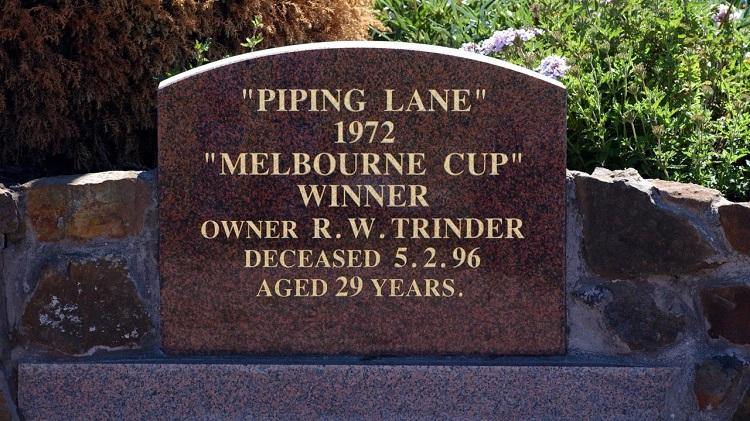 The Trinder family buried Piping Lane in what was the front lawn of their East Devonport property.
When the jockeys started mounting up, Letts asked the strapper of the horse carrying saddlecloth 16 to leg him aboard.
With no advice from the owner or trainer, Letts sidled up to veteran jockey Harry White and asked what tactics he should use.
“Just put it to sleep,” White, a man of few words, mumbled.
“And wake it up at Chicquita Lodge.”
Letts imagined Chicquita Lodge to be a prominent high-rise hotel complex.
“I spent most of the race looking for a hotel complex,” he said afterwards.
Unable to see a high-rise building, Letts followed Roy Higgins when the champion jockey hustled forwards on the crowd’s favourite, champion grey Gunsynd, the fabled “Goondiwindi Grey”.
In the crowd of 103,000, Ray and Nelly Trinder, their son Michael and daughter-in-law Anne all had difficulty seeing the race.
Ray was a small man and couldn’t see over the people who stood in front of him as the horses flashed past the winning post.
Ray clambered down the grandstand steps asking, “What won? What won?” A voice replied, “The Tasmanian, Piping Lane, did you back it?”
“No, but I own it,” Ray said chirpily.
Meanwhile, Michael Trinder had tripped on the grandstand steps and had fallen head over heels.
Embarrassed, he jumped to his feet and almost fell over again when he was told that Piping Lane had won the race – by just over a length from the favourites, Magnifique and Gunsynd. Piping Lane became the only Tasmanian-bred horse to win the Cup during the 20th century and he remains the only Cup winner that was bred and owned in Tasmania.
At the presentation ceremony Letts got to meet the owner and trainer, and the jockey learnt that Chicquita Lodge was a training stable in the back straight, well-known to local racing folk.
 Ray Trinder riding Piping Lane.
After the last race on 1972 Cup Day, Ray and Nelly lined up for a taxi to take them back to their city hotel.
Ray stood in the long queue with the gold cup hidden in a wooden box, shielded by his suit coat.
A motorist pulled up and asked the 69-year-old what he had in the wooden box. When Trinder explained, the disbelieving driver laughed.
Ray opened the box and the driver immediately volunteered to take them wherever they wanted to go.
Back at their hotel, the Trinders were given their first congratulatory telegram – it was from Ned and Molly Peterson.
When the Trinder family landed home on the day after the Cup, they were given a huge reception.
Devonport Council promptly renamed the street in which they lived Piping Lane.
The front-page headline on The Launceston Examiner was WE WIN CUP.
Nelly Trinder was the only family member who had bet on Piping Lane. Ray, Michael and stable foreman Cyril Simpson were all non-gamblers.
The horse had started at bookmakers’ odds of 40/1, but paid 68/1 on the Melbourne TAB, and Tasmanian bookmakers had to pay out to punters at the Melbourne odds.
Thousands of Tasmanians had placed bets on the local hope, especially because the Trinder name was very popular in the Apple Isle.
Piping Lane’s win was a huge windfall for once-a-year Tasmanian punters.
But the state’s bookmakers were grief-stricken – they suffered huge losses, a few were sent deep into debt, and some lost their homes.
Rick Prevost, who had bred Piping Lane to be a stockhorse, won the Tasmanian breeders’ trophy in 1971-72 and 1972-73, due to the results Piping Lane had produced.
Letts rode a Melbourne Cup winner again in 1980, Beldale Ball, but it was the Piping Lane story that changed his life.
 John Letts with the Melbourne Cup on the 40th anniversary of Piping Lane’s win.
That victory gave the loveable “Lettsy” a start on the speaking circuit and he built a career as a colourful racing personality.
Fifty years after that Cup, he still travels the country, entertaining thousands of people as an ambassador on the Victoria Racing Club’s Lexus Melbourne Cup Tour.
For many years after Piping Lane’s Cup win, bus tours often stopped outside the Trinders’ home and stables, near Devonport aerodrome.
The Cup trophy was always on display, and Ray and Nelly obliged every request for photos. “The Cup belongs to Tasmania,” was Ray’s mantra.
“Pipo is Tasmania’s horse.”
Cyril Simpson laughs when he recalls the crowds of enthusiastic people who piled off tourist buses hoping to pick up a souvenir of Tasmania’s Melbourne Cup winner.
“We had apple boxes full of horseshoes and I paired them off and cleaned them up. The people from the buses thought they were all Piping Lane’s shoes. I didn’t spoil their excitement. I got rid of all the shoes.”
Cyril also cut pieces of hair from horses’ tails, tied them in ribbons, and gave them to souvenir hunters, who believed the hair was from Piping Lane.
Piping Lane was invited to race in Western Australia soon after the Cup and on New Year’s Day 1973, he ran third to Dayana in the Perth Cup.
The horse returned to Tasmania after he injured a tendon, resulting in a 12-month spell in the paddock.
Piping Lane returned to Flemington for the 1974 Melbourne Cup and ran an unlucky fifth in the Great Race.
After Piping Lane’s racing days were over, Ray took his old mate into the show ring, hacking him at country shows around the island state.
Pipo became the only Melbourne Cup winner to end his career as a modest hunter, riding to the hounds with the Northern Hunt Club.
For several years the Trinders took Piping Lane to Melbourne to appear in the Cup-eve parade down Swanston St.
 Adam Trinder, the grandson of Ray Trinder, with Mystic Journey after winning the inaugural All-Star Mile in 2019. Picture: AAP
In 1992, the year that the much-loved Subzero won the Cup, Ray’s 13-year-old grandson Adam rode Piping Lane to lead the Cup field onto the Flemington track.
The horse behaved beautifully in front of the heaving crowd.
In 1993 Ray, then aged 90, rode the then 27-year-old Piping Lane in the Cup eve parade of champions.
In their twilight years Ray and his mate Pipo went for long strolls every day around the farm, and through the bush.
Ray didn’t even need to attach the horse’s lead.
According to his granddaughter, Lisa Buckby, who has chronicled the Piping Lane story, the two were inseparable.
In May 1994, Ray died at the age of 91 and Piping Lane went a few months later at 29.
The Trinder family buried Piping Lane in what was the front lawn of their East Devonport property.
The horse’s headstone and a flagpole can be seen from the road signposted Piping Lane.
Ray’s son Michael and grandson Adam are both top Tasmanian trainers.
A former leading jumps jockey, Adam trained the mare Mystic Journey, who set
Australian racing alight in the autumn of 2019 by winning the Group 1 Australian Guineas and the inaugural All-Star Mile, both at Flemington.
Mystic Journey had been bred by the Whishaw family at Armidale Stud, Carrick, Tasmania, and was sold as a yearling for a modest $11,000.
She won more than $4m in prizemoney.
Ray would have been delighted that his grandson transformed an unheralded horse into a big-race winner at Flemington, just as he had many years earlier with the parrot-mouthed foal that was bred to be a stockhorse and had changed hands for a paltry $100.


Wright Treble, Puller Double, De Melo Double
The Alyson Wright yard continued their tremendous recent run by landing a treble on the Hollywoodbets Greyville polytrack today.
Two of them were ridden by Keagan de Melo.
Garth Puller also landed a double.
Wright goes to 16 winners for the season at a strike rate of 16.33%.
De Melo goes to 87 wins at 23.20%.
Puller has had 20 winners at 9.90%.
Puller leads the KZN Trainers CHampionship on 20 wins and is followed by Peter Muscutt on 17 and Wright on 16 with Kumaran Naidoo and Wendy Whitehead on 15 each and reigning champion Gareth van Zyl on 14.


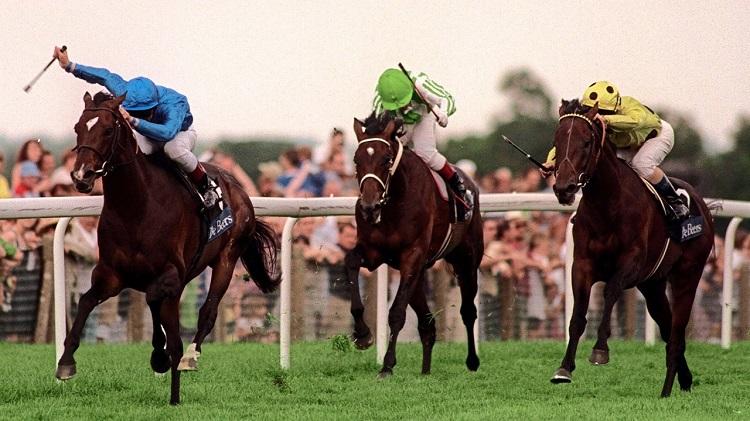
Today’s Question
What would popularly be considered Frankie Dettori’s worst ever ride?
Answer at bottom of newsletter.
Vaal Classic Fields


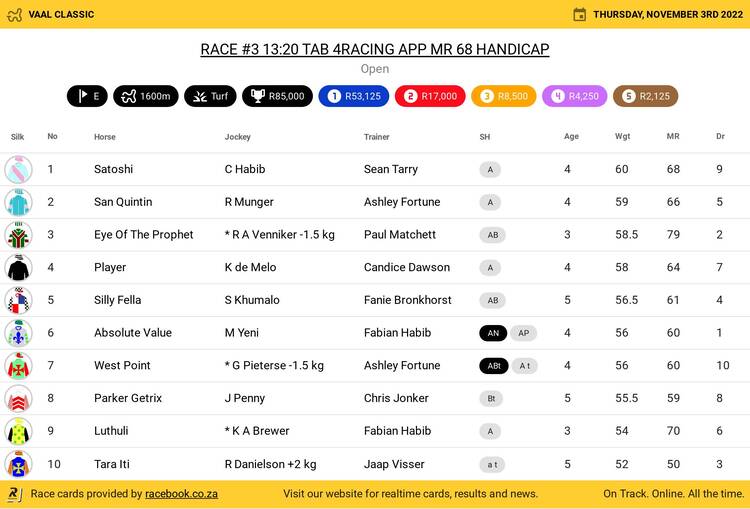


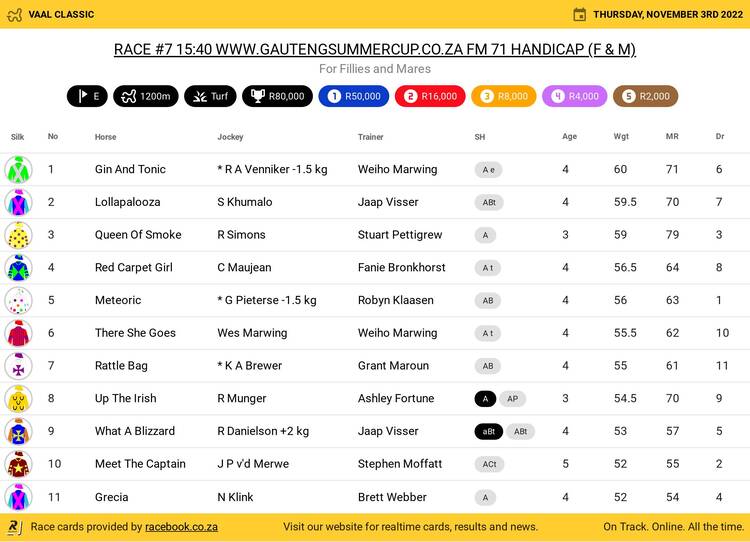

Today’s Question Answer
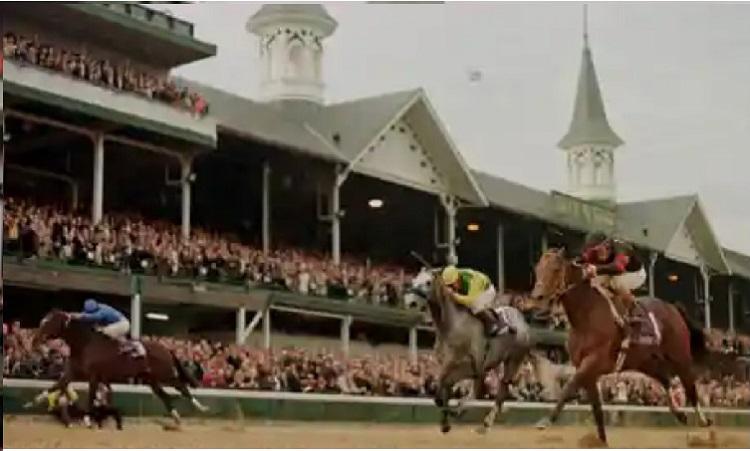
Dettori was severely criticised for his ride on Swain in the Breeders Cup Classic in 1998.
This extraction below is from an article by The Guardian’s Chris Cook about races that should have been won and it sums it up.
Here is a one-race rebuttal of the case for ditching your regular jockey in favour of Frankie Dettori. The right man for the big day, is he? So how do we explain the way he completely lost his self-control in the straight at Churchill Downs, whipping a game and honest horse until it reeled across the track. Swain came third, a length behind Awesome Again and a neck behind Silver Charm, and there are plenty of people who believe that he’d have won if Dettori had kept him straight instead of battering him.
