



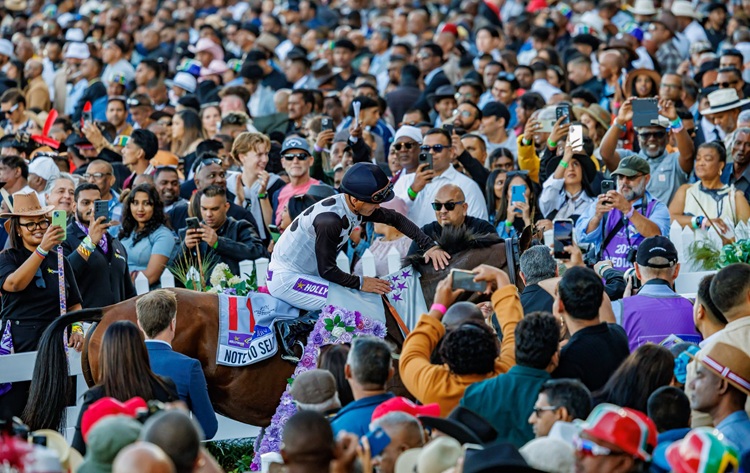
Racing fans welcome the 2026 Hollywoodbets Durban July winner Note To Self and should welcome the unifying efforts of the Operators (Picture: Candiese Lenferna)
While thoroughbred horse racing in South Africa dates back over 165 years, recent moves by Race Coast and 4Racing to align and synergise grassroots programming and related processes across the board on a national level are unprecedented and are set to facilitate momentum in a time of rebuilding, as the sport faces a range of dynamic challenges, both locally and globally.
Racing in South Africa is hosted by 4Racing in Gauteng and the Eastern Cape, while coastal operator Race Coast manages the sport in the Western Cape and KwaZulu-Natal.
In a joint statement issued earlier today, the two operators announced sweeping changes to a variety of race-related processes, aimed at creating greater levels of uniformity and alignment across the industry.
A positive step in the best interests of racing!
A national reversion to programming traditional MR Handicapping styling of race categories, the standardisation of race conditions and rules and procedures governing eliminations, as well as uniformity in the criteria and procedures relating to the cancellation of races, are just some of the changes to be introduced on 1 November 2026.
Included in the revised practices that have been announced are the standardised conditions for the reduction of stakes in cases of reduced fields, which will be applied consistently across the country.
Supplementary entries, which are currently available in KZN and the Western Cape, will be introduced in Gauteng and the Eastern Cape for minor races, providing trainers with an additional opportunity to enter horses after the initial entry stage.
While the changes will be implemented nationally, consideration was also given to the unique position and equine demographics of the Eastern Cape Racing population.
“Each region has its own unique characteristics, and Gqeberha in particular has a large population of lower-rated horses. They also ideally have to open entries two weeks before declarations as their jockey group is sourced, to a large degree, from out of the province. Therefore, more notice is needed to engage riders, with associated travel arrangements,” explained 4Racing’s Colin Gordon, who added that he was pleased with the spirit of co-operation between the operators.
As is currently the case in the Western Cape, the barrier draws for minor races will be conducted at final field stage – and not at entry stage, as is the current process – for Gauteng, Eastern Cape and KZN fixtures.
After being introduced just under seven years ago in KZN, and subsequently extended to the Cape, carded saddle-cloth numbers will now reflect the barrier draw of the relevant runner in all racing centres countrywide.
In a shift from the traditional top-weight-down or alphabetical order in 4Racing regions in recent years, all South African races will reflect runners carded according to barrier positions, regardless of the allocated weights.
While this not only means a standardisation of the South African racing product to an international audience, it also makes it easier for newcomers and racing fans in general to follow their selections from the saddle cloth number and colour, through to the starting stalls, where the number and colour will be clearly displayed.
Reserve runners will no longer be allocated a barrier draw, but should there be a scratching, the reserve will automatically take up the barrier of the scratched horse that it replaces.
Race Coast Chief Operations Officer Dean Sawarjith said that a more uniform approach to fundamental racing and programming protocols had received the buy-in of both operators, and was an important step in the right direction for all stakeholders.
“Racing faces many challenges in the competition for the customer Rand, and simplifying an understanding of the mechanics for the racing public and all stakeholders, in fact, made sense. Having the racing operators on the same page and working together means less complications for all, in an environment where we encourage trainers to travel to optimise earnings opportunities for their owners. The benefits to the broader SA racing industry must always be our collective first consideration,” added Sawarjith.
The changes are well timed with imminent stakes increases on the horizon for both 4Racing and Race Coast.
Race Coast recently announced a significant increased investment across both the Western Cape and KwaZulu-Natal through enhanced stakes that will benefit participants throughout the industry.
Unlike previous years, the end of the SA Champions Season did not herald a reversion back to ‘out-of-season’ purses. The current stakes structure and Race Coast Incentive Scheme (RCIS) will remain in place until 31 October and a new stakes structure will take effect on 1 November, coinciding with the start of the Cape Summer Festival of Racing. RCIS falls away on the same date; however, it is important to note that every Rand has been redirected to the stakes pot.
Race Coast has boosted their combined stakes investment to R270 million, an increase of 20% on the past year.
4Racing also announced a substantial increase in stakes across both the Eastern Cape and Highveld regions, as part of a renewed investment in the growth and sustainability of horse racing in South Africa.
This significant out-of-cycle increase, to be applied until end February 2027, totals R22 million, with the Eastern Cape stakes pot increase effective 1 October, and the Highveld programme boosted from 1 November.
Detailed information regarding all the changes and implementations will be published on www.sahorseracing.co.za on Monday, 21 September 2026.
For more information please contact:
Kirsti Lyall, Race Coast: kirsti@racecoast.co.za
Robyn Louw, 4Racing: robynl@4racing.com
