



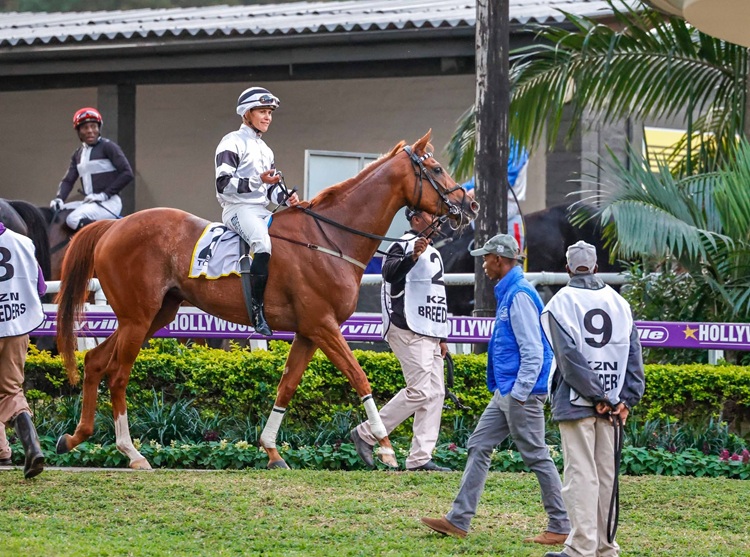
The five-time winner Happy Fortune (Pathfork) is one of the horses who have benefited from Glyn Redgrave’s schooling (Candiese Lenferna Photography)
Summerveld-based horse whisperer Glyn Redgrave has become a local legend in the way he can turn a horse’s fortunes around and he explained how methods used on polocrosse horses had helped him in his work with thoroughbred racehorses.
He said, “South Africa have won the polo crosse world cup three times. They used to get their butts kicked until it was decided to focus on our horses. When we first played this game we had running reins and gags and all kinds of horrible devices on horses. Now you will just find a snaffle. Our level of horsemanship has gone through the roof. If you want a good polocrosse horse you should be able to pick up a polocrosse ball anywhere around it, which is 358 degrees if you take out the blindspots. The horse shouldn’t have an issue picking up the ball from its front left foot, its front right foot, from the back feet, from around its belly, around its head etc. So that horse has to be educated to pressure all the way around it and it is then not going to dump a rider.”
He continued, “Most thoroughbred racehorses will whip to the left, because most of the interaction happens on the left of a horse. So, I specialise in taking left-handed horses and educating their right side. So, all I am doing is using polocrosse schooling to make racehorses, showjumpers, polo horses, any horse for that matter more educated. Riding it becomes safer as it doesn’t have a favourable side or doesn’t have a dodgy left side or a nervous front right foot etc. The horse has to understand what it has to do, otherwise you are going to be taking shortcuts like using the hood to load a horse, although it is sometimes necessary when a horse is inconsistent in nature and renders his or her strength against us. The methodology also helps farriers etc just by desensitising horses and calming them down to have halter manners. And that’s all loading the horses into the pens is about. If it doesn’t listen to the pressure from the halter, then it’s not going to go in and it’s the same as being led into a horse box or across a puddle etc.”
Glyn is known as “Checkers” or “Plastic” by Grooms at Summerveld as he carries a plastic packet around with him when schooling horses.
He said, “The only time you know whether there is a problem with a horse is when there is pressure. So the starting pens, for example, is big pressure. Furthermore, because most people are right handed, most horses lunge better to the left, but I am left handed, so I do the opposite. That is also how I find in life, by not listening to people and finding your own way, you get further ahead than by repeating other people’s mistakes. So, I have come up with my own way of helping horses understand pressure on the right. You will find that when you do start lungeing an insecure horse on the right it won’t take long before it wants to stop and turn and go left, because that is what it knows … it knows pressure on its left. But that is our fault, because we walk up to the left hand side of a horse and from that side we put the halter on, put the bridle on, put the saddle on, put the jockey on and in every ring in the morning you will see every horse walking a left circle.”
He continued, “In actual fact we should be doing everything with them from both the left and the right. There is just a tradition of what we should and shouldn’t do with horses and that is how horsemanship gets stuck in a hole. Instead of the methodology of educating the horse, there is just this one approach … and if you listen to a horse it is going to tell you what to do.”
So the plastic packet he carries is firstly used to find out where the pressure sides are and then to educate the horse that there is nothing to fear.
He said, “Often people ask me what are you doing with that packet, swatting flies? No, I am swinging that packet to see if that eye is going to be set off, I’m looking to see if it has any trouble with what I’m doing and if it does then it will tell me and react and then I will know it’s likely going to have trouble at the pens and we can work on it before going to the pens.”
He said, “I herd them around with a plastic packet, then I do join up with the plastic packet, then I get them to accept the packet from the ground, to up and above it, to sitting on the fence on the rails with the packet and then by sitting on its back and swinging the packet. The excercises with the packet always start on the left, because that is where the horse is used to pressure coming from. All those excercises you do in the ring with the packet, you will eventually be doing in the pens with the horse to desensitize it.”
He continued, “Everything done is about educating a horse to pressure. You wouldn’t bring the packet out for the first time at the pens, that would be stupid as it would then be scared of the packet and could then hurt itself in the pens. At the pens you should also let horses rear etc and say to them ‘okay I am not as big and strong as you so rear if you want to’, let them get the immaturity out of them and eventually the penny drops and they realise there is nothing to fear around the pens.”
One of the most rewarding cases of Glyn’s work was the Darryl Moore-trained Happy Fortune, who refused to jump when first going to the pens and has now won five races and R470,000 in stakes.
Happy Fortune’s problem was she used to be head shy and when the gates opened she used to sit back on the back gate.
He said, “That was wierd because normally with the herd mentality and with a line of horse jumping it usually pulls most horses out. So the ones that don’t want to jump there is a problem with the feet, because the brain goes ‘no” and the feet freeze. ‘Sticking Up’ is a normal respone too for horses who don’t want to go into a float. However, once you educate them with that plastic packet they will finally accept the thing they don’t really want to accept. Then teaching them at the pens with the packet makes it mentally, emotionally and physically easier for them to get through it. So there are things they have to understand under pressure, mentally understand what’s going on, emotionally be happy about doing it, which most horses aren’t, and then physically be able to move their feet to accept the excercise of going into the pens.”
He concluded, “Happy Fortune overcame her fear by us jumping her out of the gates with a lead. She then realised she could pop her head out of the gates when the gates opened. Once she had overcome that fear we used to just put her head in the V and her head was then free as soon as the gates opened, unlike when she was sitting back.”
Glyn gives trainers of such horses excercises to do to prevent them from ever sticking up.
Horses do need to be reschooled if something untoward happens at the races.
