



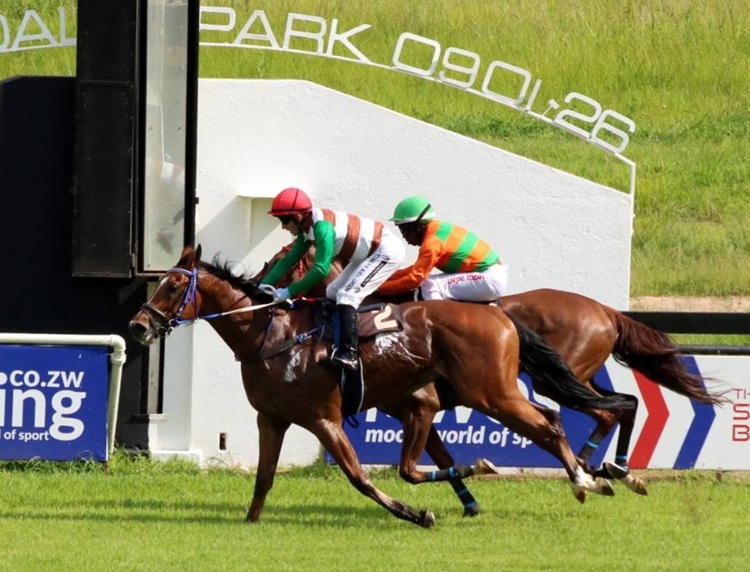
Mathew Thackeray pictured winning a race at Borrowdale on the Thomas Mason-trained Pocket Watch, who went on to win the country’s most iconic race, the Gr 1 US$50,000 Castle Tankard, although Mathew was not aboard him for the latter race (Picture: Tomcat Racing)
Zimbabwean racing was miraculously kept going through Covid and some other challenging economic situations, thanks to the passion and commitment of the racing fraternity in the country, and it now looks to have emerged from the worst and is on the up.
Mathew Thackeray is a regular rider up there and said they were actually looking to increase the stake for maiden plates to US$10,000, which is the equivalent of about R160,000.
During Covid the emphasis was just on getting enough income to feed the horses and the jockeys took a cut in payments, as they were not as badly hit as the trainers.
However, it has now picked up and payments for jockeys, after about five years of taking lesser fees, is now back to normal.
The field sizes for Sunday’s racemeeting tell a story as there are 36 horses running in the six race meeting, which is an average of six runners per race.
That is not a lot, but is big compared to what it was at one stage.
On Sunday there is one race for US$2000, four for US$3000 and one for US$4000.
“The stakes are getting better and if you win the Tankard you can walk away with the equivalent of a R40,000 cheque,” said Mathew.
The Gr 1 Castle Tankard is the richest race in the country and carries a stake of US$50,000.
Mathew continued, “The stakes are not where they want them to be yet, but part of the Borrowdale racecourse, just behind where the current jockey room is, is being sold for a huge amount.
The racecourse itself, as far as Mathew understands, is going to be shortened from about 2800m to 2000m, although the 2000m and shorter races will be on exactly the same course as in the past.
Mathew said, “There is also farming in the middle and a Woolworths shop and I understand they are getting something like US$50,000 rental for the shop per month.”
Betting also brings some income.
Mathew continued, “Zim racing is definitely getting better.”
He added, “Our pay per ride compared to South Africa is a little bit less, but it is not that bad. The club pays half and the trainers pay the other half when they are paid their stakes. They are good with the payments.”
He continued, “For their sake I hope what they plan to do with the course works out for them, because Borrowdale is still one of the best courses around. A lot of people still say it is one of the best courses to ride on.”
He added, “But the fact that racing kept going is amazing. They are tough people, because at one stage they were racing just to feed the horses and keep themselves going. They have been so resilient and have done very well.”
He said, “I don’t think the changes being made are a bad move as long as they don’t destroy the course.”
Borrowdale in the old days used to be rolled with tobacco leaves and scarified often and it is still well maintained.
Mathew remembers on one occasion it “bucketing” down before a meeting, but it was still fine to race on.
He said, “The course’s pen meeting was something like 38 and we finished the whole meeting without a horse going wrong. It was consistent the whole way.”
The trainers at Borrowdale at present are Debra Swanson, Bridget Stidolph, Thomas Mason, Gavin MacLeod, Mike Mallett and Amy Parham.
If the stakes do go up as expected it might be worth it for South African owners to send horses to race there.
