Ravi Naidoo Philosophical About HDJ Favourite's Shock Scratching
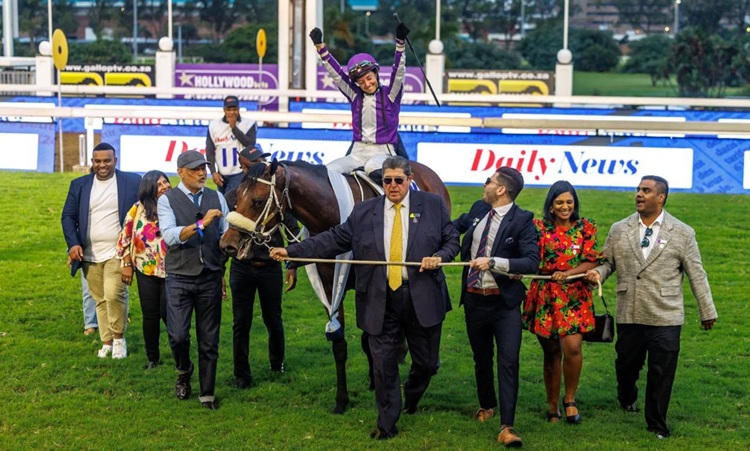
The connections lead in Star Major after his Gr 1 Daily News 2000 victory (Ravi Naidoo left of horse with cap on) (Picture: Race Coast)
The South African racing industry fraternity reverberated with shock and disappointment shortly after lunchtime on Tuesday when news filtered through that the Hollywoodbets Durban July favourite Star Major had been scratched due to an elevated temperature.
This was a blow to trainer James Crawford as well as to owners Ravi Naidoo of Kalinga, Neville Isdell, Jonathan Bloch and Prakashni Pillay.
However, Ravi later looked at it philosophically and said, “I’m ambivalent about it. Part of me thinks it’s a blessing in disguise. We can chart a more purist route with our entire. If he is in outlandishly good nick, come month end, we could have a tilt at the G1 Champions Cup in open company, at weight for age. Otherwise, like James said, we have accomplished our goal this season. We aimed for the Daily News. Mission accomplished. I feel privileged to be racing a horse of this calibre. He’s been a revelation. We must just catch our breath, recollect and refresh.”
As a Durban-born racing fan Ravi has long dreamed of winning the July and looked to have another fine opportunity with Star Major after being narrowly denied with Cousin Casey two years ago.
Jonathan Bloch still has two more chance this year, because, amazingly enough, he is also a part-owner of both of the two new joint favourites, Wish List and Note To Self.
However, it would have been a bitter blow to Star Major’s jockey Mickaelle Michel, who had an opportunity to make July history and continue a remarkable fairytale story.
Ravi voiced his sympathy for the talented French rider.
The scratching would have been greeted with different emotions in other quarters.
It means the first reserve, the Erico Verdonese-trained Choisaanada, comes into the race and gets an opportunity to prove a point as there was controversy after he was left out of the top 18 by the final field panelists.
Ironically, Rachel Venniker now steps into the plate vacated by Mickaelle Michel, because she is booked to ride Choisaanada.
Rachel has already made July history, becoming the first female to ride in the July in 2024, and she now gets the opportunity to be the first female jockey to win the iconic race.
The second reserve, the Mike and Mathew de Kock-trained SA Derby winner Curious Girl, is now one step closer to getting in.
There must be another scratching before 08H15 on Friday for her to get in, although she is fancied for the Gr 3 Durban Gold Vase over 3000m and would have a very tough task at the weights in the July, being officially a whopping 6kg under sufferance. The 2200m trip of the July might also be a bit on the sharp side for her too.
The new joint favourites for the race are the Justin Snaith-trained pair Wish List and Note To Self, who are now both 5/1 with the sponsor. In fact Snaith, who has five runners in the race, now has the top three in the betting as his charge Regulation is joint 6/1 third favourite will the well-backed Viva’s Liberte.


Choisaanada Gets In After Roller Coaster Week For Connections
Choisaanada was controversially omitted from the final field of 18 in the Hollywoodbets Durban July, but as the first reserve he now gets an opportunity to prove a point after the scratching of Star Major (JC Photos)
“James Crawford is a gentleman and a sportsman. And this is definitely not a nice way to get into the Hollywoodbets Durban July.”
Trainer Erico Verdonese has been on a roller-coaster ride in the past week and spoke to the Sporting Post on Tuesday afternoon after news that his Querari gelding Choisaanada would get a run in the big race following the shock withdrawal of, coincidentally another son of Querari, in the favourite Star Major
After the disappointment of having his first ever Hollywoodbets Durban July runner consigned to first reserve runner status, the wheel has turned full circle for the veteran and his owners Brian Jossell and Isabella Lombard, who will now be making their way to Durban for the big race on Saturday.
“Nobody wants to benefit from anybody else’s misfortune but James Crawford did the sporting thing by scratching now, rather than leaving it after the Friday morning 08h15 cut-off. Full marks to him and his connections,” added the man who started out 48 years ago with Richard Stranger, with his mentors and coaches along the way including Syd and Alec Laird, Henry Eatwell, Stanley Ferreira, and the late Michael Roberts, to mention just a few.
So while he has worked for the best, this is his first tilt at the prestigious prize for his own account.
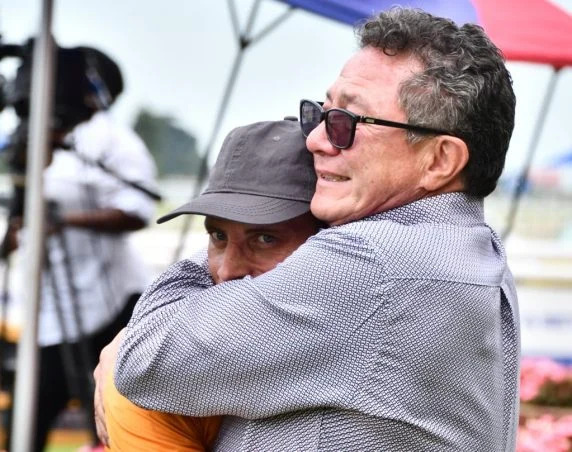 Erico Verdonese – rollercoaster week! (Pic – JC Photos)
“I had two winners from three runners on July day – I think it was 1997. We have travelled a few times, with success,” adds Erico as he says that he is keen to get down to Summerveld by Thursday.
“We haven’t travelled Choisaanada before, and one always prefers a 24 hour buffer. So we are aiming for Thursday and Adam Azzie just called to say his box is ready and waiting. So, while I would have chosen a more low-key entrance for my maiden Hollywoodbets Durban July runner, than all the media attention we have received, we will be there and ready – and what an honour and privilege it is for all of us!” he added.
Choisaanada will jump from the 4 gate and will be ridden by Rachel Venniker.
He is currently priced at 16-1, with the Snaith pair of Wish List and Note To Self joint favourites at 5-1.
The Sporting Post asked Erico about his July outfit to fit the Country Allure theme?
“Oh no, fashion’s not my game. Let’s focus on Choisaanada!”

Possibility Of "House Full" Signs At Hollywoodbets Durban July
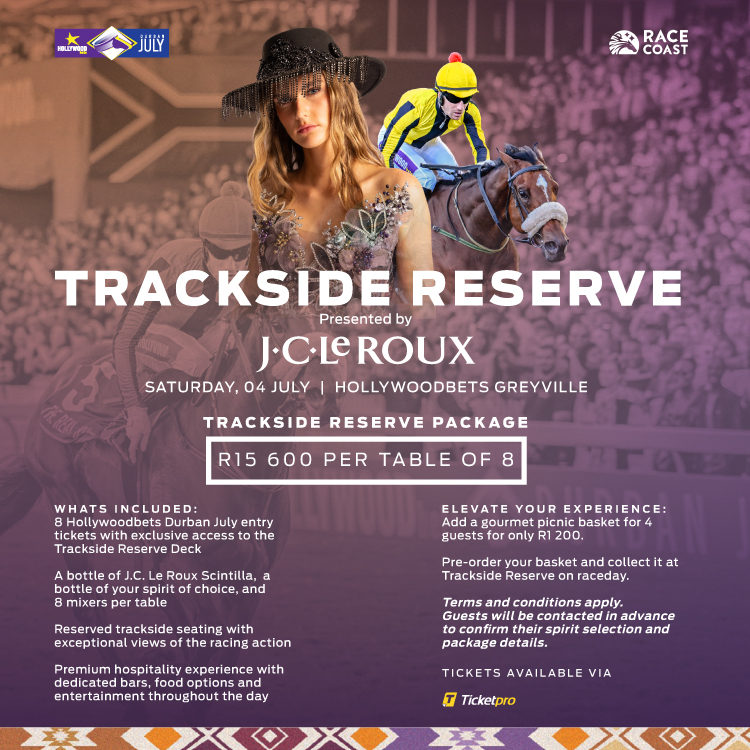
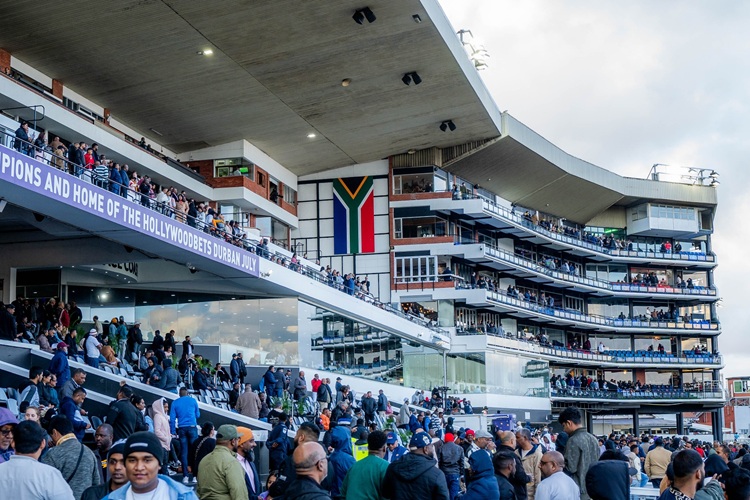
Picture: Dave Mollett is predicting a capacity crowd at Hollywoodbets Greyville (Picture: Candiese Lenferna Photography)

Dave Mollett
Such is the media blitz for the Hollywoodbets Durban July – they have set the advertising bar at a new high – that it’s possible the “House Full” signs could go up at Greyville next Saturay.
While tickets are still available, there is every chance of a last minute stampede as people realise a great day of entertainment is on the cards.
Devin Heffer and his team will have been planning for the big day for months – possibly as early as January.
They have identified new platforms this year – in April my eyebrows rose with a July ad on Sky News and – the following day – there was also one on BBC.
Devin’s aim that each year “must get better than before” looks like being realised as this mass advertising will have reached every corner of the country.
With arguably one of the most open fields in years with punters backing a wide range of runners, a record tote WIN pool looks a distinct possibility.
Hopefully, the Hollywood team will have also ensured there are enough food outlets at that track – racegoers need food and drink to sustain them throughout the meeting.
The betting market, after the scratching of Star Major, have Wish List and Note To Self as the leading fancies 5/1 apiece. Personally, I feel it’s likely the prices on the top runners will go out as we approach “off” time.
So what’s this column’s fancy? I believe one must always stay with a horse that has been good to you – and – in my case – that horse is Zeitz.
His latest win shows he’s come right at just the right time and – with a talented rider in the saddle – he can throw down a challenge to his more fancied rivals.
When it comes to the final gallops, all it usually proves is that none of the field passed away overnight!
Not a lot can be gleaned from the sectional times but – all the same – I checked the 400m to finish and was pleased to see Zeitz clocked the third fastest (21.92) behind Isivivane and Native Ruler both 21.91.
Now Turf Talk editor, David T, recently wrote an article on one of Justin Snaith’s main hopes, Regulation. He was going to be my other floating banker in the quartet, but I changed this for two reasons.
Justin mentioned “breathing issues” and then there is the booking of up-and-coming youngster, Zac Lloyd.
Having written countless stories on his father, I’m delighted Zac is on the ladder to success, but the fact remains he has zero experience at Hollywoodbets Greyville.
Richard Fourie pointed out at the gallops that Note To Self would be two kg better off with Star Major and this brings the pair close together.
Despite a wide berth, I feel King Pelles could be the “joker in the pack” as he’ll be staying on when others have cried enough. I mentioned this to Nico Kritsiotis when he visited me in hospital. His reply: “I suspect you have some of the Scottish stuff in your bedside drawer.
Erico Verdonese is one of the most likeable characters in Highveld racing and – don’t worry – he can land a coup or two.
With his top horse Choisaanda three slots ahead of The Ultimate King in the July log, Erico had to be gobsmacked that his horse didn’t make the final line-up.
He now has the chance to prove a point as Choisaanada was first reserve and comes in after the scratching of Star Major.
One of the most interesting aspects of the big race is whether Andrew Fortune can win this famous event at the age of 59.
When I spoke to him at the Yearling Sales his preference was for Note To Self – but presuming he didn’t get the choice – he’ll be aboard the Legislate filly, Wish List. He’s reportedly happy with her well-being but would probably still rather be on Note To Self.
However – if Wish List wins – the on-course presenter better prepare for 10 minutes of mayhem with the possibility of a few expletives.
In a story in The Citizen racing writer Mike Moon interviewed three well-known personalities at the gallops and they identified nine – yes nine – who had shaped well. This is further ammunition for my belief that the betting is too tight.
While Owen and Devin Heffer know their meeting can never match the pageantry of Royal Ascot, what they do know is that a great day of entertainment awaits those making the trip to Hollywoodbets Greyville.
With five weeks in hospital, I’ve had time to structure my bets and here they are:
1. Zeitz to place (first four) and France to win the World Cup.
2. Quartet double float 11 and 12 with 2, 7, 8, 13, 15, 16, 17, 19 (cost R672)
3. Boxed exacta 2,7,11,12,15,16,17.
Selection:
1. Zeitz
2. Note To Self
3. Regulation
4. King Pelles
Bon Chance!

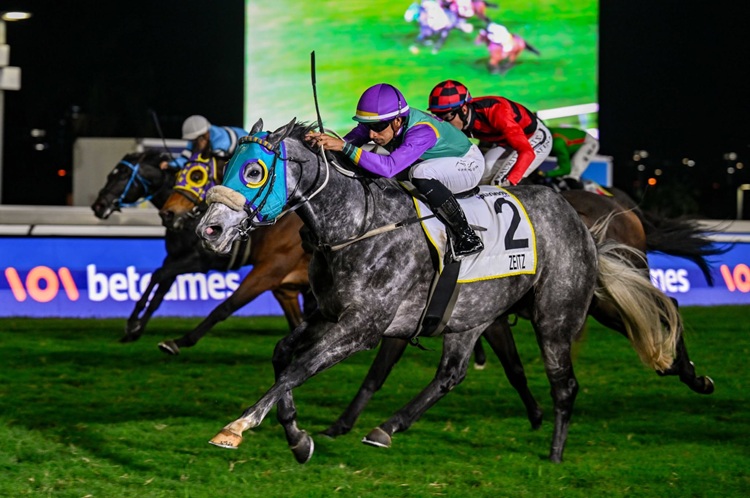
Mike Moon Among Many Pundits Going For Zeitz
Mike Moon is one of a number of pundits who is tipping Zeitz to win the Hollywoodbets Durban July (Picture: Race Coast)
It’s been yonks since a grey horse won the July – 18 years ago, to be exact. Good news for multitudes of punters with a soft spot for pigment-challenged ponies is that 2026 has a credible candidate to break the drought.
The runner’s name is Zeitz. He is number 12, drawn OK at 12, and carries the magical July-winning featherweight of 53kg. He’ll be ridden by Durban’s own Serino Moodley. Though he is trained on Western Cape’s beautiful West Coast by Andre Nel, he seems to prefer running in Kwazulu-Natal.
Importantly for the cognoscenti, four-year-old Zeitz is a fast-improving maturer with a notably quick turn of foot – essential for Greyville racecourse’s short straight – as shown recently by his victory on the very same stretch of turf in the 1800m Grade 3 Cup Trial.
At the dawn of July week, Zeitz was priced at 14.29 to win the July (and 2.14 a place), which makes him as a borderline outsider and reflects the usual “wide-open” look about South Africa’s most famous horse race.
The grey does face very stiff opposition from brown rivals, as one might expect of a fabled, Grade 1, R10-million contest.
The worthy favourite at 4.00 was Star Major (but he has now been scratched).
If one dreams hard enough, you can see the grey and fighting out the finish of the great race.
Dreams, hopes, bone-throwing, clairvoyancy, numerology, name-conjuring and the like are an essential part of events of the first Saturday in July. Some of the magical thinking does come true, much of it doesn’t. Whatever; we’ll be hearing quite a lot about horses with names like Wish List, Note To Self, Aladdin’s Lamp and Isivivane.
Others we might want to toss into the mix because of their racing credentials include Viva’s Liberte, King Pelles, Gladatorian and I Salute You.
For the record: the last grey to win the Durban July was the filly Dancer’s Daughter, who dead-heated with Pocket Power in 2008. Before that, only four greys had won the race in more than 100 years: Silver Phantom in 1942, Jamaican Music in 1976, Jamaican Rumba in 1982 and Right Prerogative in 1989.
Beaten grey favourites have included Thunder Sky in 1961, when outsider Kerason won, and Bodrum in 1985. the year of Gondolier. Greys Inn triumphed in 2005, but was grey in name alone, being a dark bay colt.
In terms of name, Zeitz is a town in Germany and the word derives from Slavic for “water” or “stream” – or, alternatively, “hare”, which the horse is unlikely to be living up to as he prefers galloping on late from near the back of the field.


Kannemeyer Has Some Chances On July Day
Princess Of Gaul won the Gr 2 World Pool With Race Coast Debutante at the end of last season and now contests the Gr 2 Post Merchants over the same course and distance (Candiese Lenferna Photography)
Dean Kannemeyer will not have a runner in the Hollywoodbets Durban July on Saturday, so will be unable to defend his title, but the
four-times July-winning trainer has a number of interesting runners on the day.
Dean runs Palace Of Avernia, a Vercingetorix full-sister to Gr 1 SA Classic winner Grand Empire, in the Gr 2 Amusnet Golden Slipper over 1400m where she has unfortunately landed a wide draw of 13 out of 14. She led from start to finish on debut over 1200m on the Hollywoodbets Greyville turf from a tricky draw of nine and second time out in the Gr 1 Allan Robertson Championship over 1200m at Hollywodbets Scottsville she showed plenty of resolve when running on from near the back for a commendable 4,85 length fourth. She is obviously going to relish the step up in trip on Saturday. However, the draw is the problem. Craig Zackey is up for the third time and will have to make a plan.
Dean said, “I will leave it up to Craig. You don’t want to chase from that draw and sit in the first two or three because if you are well drawn you are there for nothing, but you don’t want to drop out of your ground either, because if you are in last place the others will be skipping away when you are swinging for home. So you want to try and drop in and get lucky. It becomes a bit of a stampede in the first two furlongs of that race, it’s quite rough. Nine out of ten times you are not going to get lucky. But she is doing well and hopefully it will pan out well.”
He runs Keukenhof in the Gr 1 Ridgemont Garden Province Stakes over 1600m and as a deep thinking racing man he might have recalled the 2021 renewal of this race, which was expected to be fought out by the top class trio Captain’s Ransom, War Of Athena and Princess Calla, but instead was won by the 75/1 shot Zarina, or the 2018 renewal, in which the 22/1 shot Redberry Lane upset the 13/20 favourite Snowdance. This year the race is excpected to be won by the odds-on favourite Double Grand Slam with Quickstepgal and Mon Petite Cherie the dangers, but Keukenhof is a hard knocker who could pick up the pieces if they fluff their lines.
The 8/1 chance Keukenhof is by the United States and his dam Dawn Calling is a Gr 1 runner up over the Garden Province course and distance having finished second in the Gr 1 Thekwini Stakes. Furthermore, Dawn Calling (Trippi) is a half-brother to Gr 1 SA Classic winner Confederate (Fire Away).
Keukenhof has a tricky draw of eight with Zackey up and Dean said, “She is holding her form well, she deserves her place there, she has never run a bad race in her life. She ran a great race in the WSB Fillies Guineas (0,55 length third to Wish List, whom she had actually beaten when third in the Gr 2 Western Cape Fillies Championship over 1400m) and she ran a very good race in the Woolavington 2000 the other day. We dropped her out in the Woolavington, because we didn’t know whether she was going to go the trip. She turned it on well in the straight and was following the right horse through, but she had had enough in the last 75m over the 2000m trip. Back to a mile this is more her game. Of course there is Double Grand Slam and some top fillies in the race, but she will be right there at the finish. She is drawn eight out of eleven, but she can sit up handy or come from off the pace. In her 1400m race at Hollywoodbets Greyville (Gr 3 Umzimkhulu Stakes) she sat up handy and Craig just pulled her out and she won. We just have to ride her as we find her when they come out of the gates.”
In the Gr 3 Post Merchants over 1200m Dean is drawn well with Outlaw King in barrier two and Princess Of Gaul in three.
He said, “It’s a merit-rated band handicap of sorts and Outlaw King (carries 62kg off a 122 rating) has earned his stripes and has a bit of pudding to carry. He has been a wonderful horse for the syndicate. Its never going to be easy with that weight’ but he won the Merchants at Hollywoodbets Kenilworth with 54kg and he came the next year with topweight and won it again and he then ran third in the Gr 1 wfa Cape Flying Championship. It won’t be easy, but he’s doing well and he’s well drawn.”
Stable jockey Craig Zackey rides Princess Of Gaul and Dean said, “She’s doing exceptionally well. She has proven to us her maximum trip is 1400m. Over a mile in the classics she ran up to them and then had had enough in the last 75m, so 1200m to 1400m is her game. She’s well drawn and at the weights she’s a runner. There are some very good spriters in this race, but she ran a top race in the Gr 1 SA Fillies Sprint and she’s won Group races over this trip and over 1400m. She won a Gr 2 over this course and distance as a two-year-old. She gets a female allowance and I think it is the right race for her. I seldojm run fillies against colts, but looking at the weight structure and the draw I said I’m going to give it a go.”
Buffalo Storm Cody is well treated in this race and both Outlaw King and Princess Of Gaul are officially 5kg and 3kg under sufferance with him respectively, but on the other hand it might be a preparation outing for Buffal Storm Cody ahead of the Mercury Sprint.
Outlaw King carries 62kg under Ant Mgudlwa and Princess Of Gaul carries 55,5kg.
In the Listed Premier Gateway Handicap over 1600m Dean runs the three-year-old Gimmethegreenlight gelding Green Gateway, who has won won three out of six starts, although all three of his wins have been over 1200m.
He said, “I’ve never run him over a mile and he’s got a high rating (109), but I’m convinced he will get a mile, although of course the race will tell. But he’s a lovely horse. The first time I ran him in his KZN campaign was under lights at Hollywodbets Greyville and he jumped out and didn’t know what to do and he was never in the race. He wasn’t enjoying it under the lights at all and that can happen to an inexperienced horse. I then ran him at Holllywodbets Scottsville over 1200m and he won with 61,5kg on his back in a Middle Stakes event and that was a very, very good performance. He always comes from off the pace and then turns it on in the last 400m. Over 1200m at Hollywoodbets Greyville you can’t swing for home eight lengths off them, but this is a mile and his style of running I think he will get a mile, but the race will tell. On pedigree he should also get a mile. He’s got a bit of pudding to carry, but he’s doing very well.”
Dean also runs the Gimmethegreenlight gelding The Green Glow in the first over 1600m on the poly under Craig Zackey from draw six and he has won on the poly before, so if repeating the form of his penultimate start when a narrow third over this trip on the Hollywodbets Greyville turf then he must have a chance as he is a point lower in the ratings since then after a below par effort at Hollywoodbets Scottsville last time out.

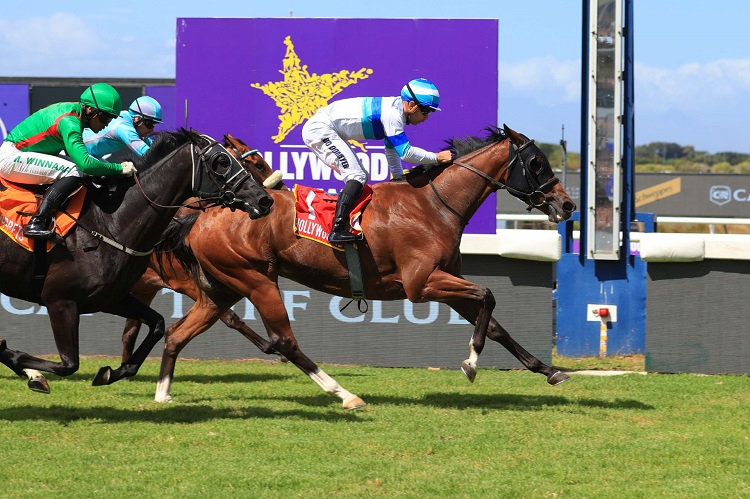
Heliotrope Can Follow Up On The Poly
Heliotrope, pictured winning at Hollywoodbets Kenilworth, won well on the poly last time and can follow up despite being raised seven points (Picture: Wayne Marks)
Trevor Reid’s formguides and selections for Fairview Poly Wednesday
RACE 1
An interesting race as some of these make their local debut and are trying the Polytrack. SOUNDSOFSYMPHONIES ran in two decent maiden fields in the Western Cape so would not be a surprise winner on local debut. LOVE FROM AFAR was not disgraced last week when trying the Polytrack and could go one better. GEORGE REX makes his local debut for an in-form trainer and is capable of improvement. ALLEYAH’S ROCKET is knocking on the door and is proven on this surface so must be respected. GOOD SHINE, NORSE WARRIOR and LADY OF FATE all need to do a bit more to win but might earn minor money.
RACE 2
A very open race with most of them well suited to this course and distance. STRANGE MAGIC runs prior so that run needs to be looked at but she has been holding her form well and could win a race of this nature. SWEET JULIA is better than her last two runs suggest and does well over this shorter distance. ICY LANCASTER is capable of improvement and could be a threat. WORDSWORTH is not reliable but is also not out of it. WINTERONTHEGREEN looks capable of going start to finish if allowed a soft lead. CHIEF RUNNER could be ready to spring a surprise.
RACE 3
RARE EARTH was consistent without scoring in the Western Cape and that form should be good enough at this low level. SABRAGE put in a career best performance last time out and could have more to offer. PLAYMAKER has struggled but has a place chance on best form. DEAD POETS SOCIETY has shown improvement of late and is not out of it. BUGLE is consistent but is battling to get a first victory. RUN JOHNNY RUN seems a bit better than his local debut would suggest and could make the frame.
RACE 4
KIM KAY is improving. She looked an unlucky loser of her latest start and could go one place better. GREEK HEIRESS is a long-time battling maiden but makes her local debut and would not be a surprise winner. PRICELESS TREASURE did not show her best last time out. She was very consistent before that and can contest the finish again. DEE DEE’S DELIGHT showed improvement last time out and has a place chance. SALAGADOOLA and WORLD OF DIAMONDS are not reliable but can play minor roles. TOUCH THE SWORD and GUTSY BABY are improving and must be respected.
RACE 5
HELIOTROPE was a disappointment when trying the Polytrack first time out. She certainly learnt from that experience with a solid win last time out. She picked up a penalty for that win so it should be closer this time. HOMING PIGEON ran right up to that rival last time out but failed to go past her. She might do so in this race with the change of weights. LANA VIEW continues to improve and could be third best. HAT MONTERA did not show her best last time out but can make the frame. BACK FOR MORE is not reliable but might earn some money.
RACE 6
A very open race and it might be best advised to go very wide in this leg of all the exotics, especially the Pick 6. ICED MARMALADE has not been beaten far in her recent runs and could make all this time. DAFFODIL DELIGHT runs in a better race than this on Friday 26 June so could be a threat if appearing for this race. JAPANESE GARDEN has shown improvement of late and could be ready to score. TRULY MAGICAL picked up a confidence-boosting victory last time out and could be a threat. WALTZING DOLL, GREENLIGHT DANCER and CAPE CAPRI are others that are clearly capable of scoring at this level.
RACE 7
SUSURRANDO is improving and should make a bold bid for victory in a race like this. EUGENIUS won nicely enough on local debut and the second horse was an easy winner of his next starts. EL CAPITAN was not disgraced last time out and should contest the finish. WHATEVER NEXT has not been showing his best for some time now but has a place chance. TOKYO PRINCESS makes her local debut and could improve. CAPTAIN CLEVER showed improvement last time out but is badly drawn. POWER OF TIGER seems better than a modest last performance.
RACE 8
BLUE PALACE is knocking loudly at the door and could go one better but it is a very open looking race. KAMAKAZI is unreliable but quite capable of scoring. ENDEARED quickened up nicely to win her latest start and could be a lively danger. AMANATTO had some good form before fluffing her lines last time out. WHIRLYBIRD might be better on the turf but that is not certain. QUEEN OF JAZZ likes the Polytrack and could challenge for top honours once again.

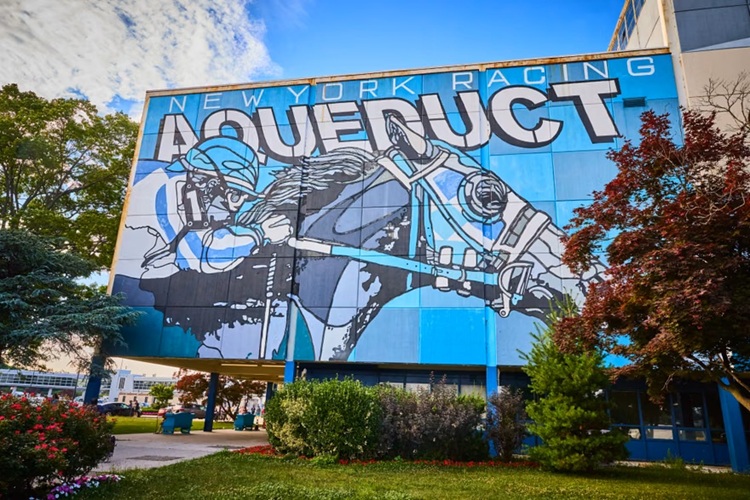
Aqueduct Bids Farewell After 132 Years As New York City’s Racetrack
A towering 60ft-by-80ft mural depicting Secretariat, painted by renowned Los Angeles street artist David Flores, has welcomed visitors to Aqueduct for years. (Picture: Lauren Caulk)
The last thoroughbred racetrack in New York City went dark after its final races on Sunday, closing the book on 132 years of history and one of the city’s last great communal spaces
By Bryan Armen Graham in South Ozone Park, New York (The Guardian).
For the better part of a century, the subway ride to Aqueduct Racetrack followed a familiar rhythm. The closer the train drew to Ozone Park, the more animated the conversations became. Men with folded racing forms debated trip notes, overlays and bombs. Regulars swapped tips while newcomers eavesdropped, hoping to catch a profitable whisper. By the time the doors opened at the Aqueduct-North Conduit Avenue stop, thousands of New Yorkers had arrived at what many considered the city’s most democratic sporting venue.
That ritual took place for the last time on Sunday. After 132 years, Aqueduct hosted its final day of thoroughbred racing before closing for good, marking the end of the last racetrack within New York City limits and a fixture of city life that had endured since the Gilded Age.
The New York Racing Association is consolidating downstate racing at the newly rebuilt Belmont Park in the suburban Long Island hamlet of Elmont, scheduled to reopen in September after a $455m redevelopment. The move has been long expected and reflects the economic realities of a sport reshaped by off-track and online wagering. Yet for generations of horseplayers, trainers, jockeys and racing fans, Aqueduct’s shuttering feels less like a business decision than the loss of a neighborhood institution.
A towering 60ft-by-80ft mural depicting Secretariat, painted by renowned Los Angeles street artist David Flores, has welcomed visitors to Aqueduct for years.
“Aqueduct has always been New York City’s racetrack,” former jockey Richard Migliore, the track’s all-time leading rider with 2,238 victories over a 31-year career, told the Guardian. “It’s part of the boroughs. It’s in Queens.”
Unlike Belmont Park or Saratoga, he said, Aqueduct never felt removed from the city. The patrons there earned a reputation throughout the sport for their candor as much as their expertise. “There’s a grittiness to Aqueduct that you don’t get at Belmont, certainly don’t get at Saratoga. At Aqueduct, you get the real fans. They’re hardcore. They know the game,” Migliore said. “If you made a mistake, they’d let you know about it. But that’s kind of part of New York, right?”
On Sunday’s final day, Aqueduct pulsed with an energy it had not known for years. Longtime patrons, curious first-timers and lapsed fans returning for a last look queued outside hours before the 1.10pm first post, a four-piece band greeted them at the gates and retired track announcer Tom Durkin returned to the microphone for one final call. Lines for the concession stands and betting windows snaked through the concourse as 6,866 people gave the weathered grandstand a fleeting glimpse of its former self. It was a poignant reminder not only of what the Big A had been, but of how much of it had already vanished into the past.
When Aqueduct opened on 27 September 1894, drawing a crowd of about 700 spectators and eight bookmakers for an unsanctioned six-race card, it gave no hint of the long, colorful life that lay ahead. Built on former farmland in what was then a sparsely developed corner of Queens, it lacked the polish of the fashionable Jerome Park and Morris Park racecourses, where New York’s social elite gathered to see and be seen. Early visitors could still glimpse cabbages and potatoes growing in the infield. The original grandstand seated barely 2,000 spectators.
The track was the unlikely creation of three men with no previous ties to horse racing: a Harlem deputy fire chief, an Albany lobbyist and a Brooklyn hotelier, who leased 23 acres of pasture that had once formed part of the old Brooklyn Water Works. The fledgling course took its name from an aqueduct that cut across the property, carrying fresh water from Long Island into Brooklyn and Manhattan.
Future Hall of Fame trainer James “Sunny Jim” Fitzsimmons, then just 20 years old and attending Aqueduct’s opening meeting in 1894, later joked that the place “looked like a shanty on stilts”. Spectators standing closest to the rail balanced on wooden planks to keep from sinking into the mud. Yet over time, Aqueduct evolved from what some contemporaries dismissed as an “outlaw track” into one of the sport’s most recognizable locales.
Man o’ War raced there. Secretariat made his debut there on the Fourth of July. Cigar launched his record 16-race winning streak there. Seabiscuit, Kelso, Buckpasser, Dr Fager, Forego, Ruffian, Seattle Slew, Easy Goer, Smarty Jones and countless other champions all passed through the Big A.
Manuel Franco poses for a portrait after riding Close the Loop to victory in Sunday’s second race, an $80,000 New York-bred maiden special weight.
For five years Aqueduct staged the Belmont Stakes, the third jewel of US horse racing’s Triple Crown, while Belmont Park underwent reconstruction in the 1960s, welcomed the Breeders’ Cup in 1985 and hosted Pope John Paul II’s Mass before an estimated crowd of 75,000 in 1995. Film and television came calling, too. Aqueduct is where Ralph Cifaretto’s star-crossed filly Pie-O-My raced in The Sopranos and where Eddie the Mush spoiled a perfectly good afternoon in A Bronx Tale. It was also, as so many horseplayers will tell, the site of racing’s only triple dead heat in a North American stakes race, when Brownie, Bossuet and Wait A Bit crossed the finish line together in the 1944 Carter Handicap.
Yet Aqueduct’s importance was never measured solely by the equine athletes and revered jockeys who passed through, repeatedly finding itself serving purposes beyond racing. After Superstorm Sandy in 2012, its parking lots became a Red Cross staging area for relief efforts, while parts of the facility sheltered displaced New Yorkers from the underserved South Brooklyn and Queens communities. Nearly a decade later, much of the grandstand was transformed into one of New York’s largest Covid-19 vaccination centers, where more than 300,000 doses were administered during the pandemic.
Migliore, now 62, grew up eight miles away in Brooklyn’s Sheepshead Bay neighborhood and remembers riding the subway to Aqueduct with his father on opening day of each spring meet after the winter break. By the time the sweeping four-tier grandstand came into view, he recalled, the anticipation became almost unbearable.
Arriving at Aqueduct, Migliore said, felt like his first trip to Yankee Stadium as a boy. “You’d get off the train, walk up to the track apron, and suddenly there was this beautiful expanse of green and tobacco brown,” he recalled. “Then the majesty of the horses, the tradition of it all, the jockeys and the colors they were wearing. I was just enamored with the entire scene. It immediately captured my attention.” By the age of 10, he knew he wanted to become a jockey.
Unlike Saratoga, with its summer glamour, or Belmont, with its manicured suburban expanses, Aqueduct built its reputation on accessibility. It sat at the end of the A train line, the last stop before JFK airport, about 12 miles from Times Square. For years, New York City’s transit authority even ran special “Daily Double” express trains directly to the races. Admission was inexpensive when it wasn’t free and the track unmistakably belonged to the outer boroughs.
On any given afternoon, the trackside apron reflected the city itself: retirees from Ozone Park, Richmond Hill and East New York; Caribbean immigrants from southeast Queens; lifelong Brooklyn horseplayers who had ridden the A train for decades; airport workers stopping in after a shift; finance guys escaping Wall Street for the afternoon; and seasoned bettors who knew every trainer and jockey by name. They arrived speaking English, Spanish, Jamaican Patois, Guyanese Creole and a dozen other languages, carrying racing forms under one arm and coffee cups in the other. For many of the regulars, Aqueduct was one of New York City’s last great third spaces: neither home nor work, but an in-between place where people came to gamble, exchange intel, yell at the elevated banks of simulcast screens and catch up with the same familiar faces day after day. It belonged to the same vanishing New York as old lunch counters, corner diners and neighborhood bars: unglamorous institutions that quietly became part of the city’s social fabric.
Stanley Wint, a 69-year-old Canarsie resident who emigrated from Jamaica decades ago, had been coming to Aqueduct for more than 30 years. He fell in love with the sport long before he arrived in New York. As a boy, he followed British racing, idolizing riders like Lester Piggott and Joe Mercer before his mother and uncle introduced him to betting. Aqueduct, he said, eventually became part of that same lifelong routine.
What would disappear, Wint believed, was not simply another racetrack but the community that had grown around it.
“I’m going to miss this place,” he said. “Just the atmosphere and the people, the down-to-earth people. They come. They get upset when their horses lose. They cheer when the horses win. They curse the jockeys, but it’s all fun. The people that are here today, they’re fans, but they’re not here all the time. I’m here Thursdays, Fridays and Sundays. I can’t come Saturday because I got something to do.”
Wint said that broad mix of everyday people was what separated Aqueduct from almost anywhere else. “This is the only sport that you’ll see a guy with a walker coming on the train, a guy in a wheelchair or with a cane,” he said. “It’s not just the horses. I love the horses, the jockeys, the whole environment.”
Sunday’s crowd extended well beyond Aqueduct’s regulars. Cori Boudreau, a 72-year-old retired university administrator from Gloucester, Massachusetts, had only visited once before, making the four-hour drive several years ago only to discover the day’s card had been abandoned because of high winds. This time, she and her cousin rode down determined not to miss their last chance. They arrived three hours before post time to claim one of the commemorative mason jars of track dirt promised to the first 1,000 people through the gates.
Boudreau had seen this story before. She watched Suffolk Downs outside Boston and Rockingham Park in New Hampshire close their gates, each another reminder of horse racing’s steadily contracting presence across the northeast. “Every track that closes kind of signals that horse racing is not the sport it once was,” she said. “But it’s probably less bittersweet knowing that there’s a reason for it.”
Like most people, she understood why it was happening. Belmont Park’s redevelopment made little sense alongside another major racetrack just a few miles down the road. What saddened her was everything else that would disappear. “There are people who come here every week and have all their lives,” she said. “It’s a very accessible track. It’s kind of melancholy. It’s a tradition that is going away.”
Aqueduct never let you forget where you were. Every few minutes, an airliner crossed low overhead on final approach to JFK, briefly drowning out the track announcer and any nearby conversation. Seagulls drifted over the infield from nearby Jamaica Bay while pigeons wheeled through the cavernous interior of the grandstand. The faint odor of marijuana often hung over the picnic tables near the one-sixteenth pole, mingling with the smell of cigarette smoke, hot dogs and stale beer. There was no signature cocktail here. Everyone knew the social contract: tuck a newspaper into the seat slats before heading to the windows and your seat would be waiting when you got back. The grandstand itself belonged to another era: a hulking slab of mid-century Brutalist architecture whose exposed concrete, austere lines and unapologetically functional design suited a racetrack that prized utility over ornament.
For Robert Bourget, a 75-year-old retired horseman from Far Rockaway, it simply felt like home. He made the trip to Aqueduct for 62 years, ever since he arrived in New York as a young stablehand from Vermont. He remembers his first day at the track, when he bet $2 to win on one of the horses from his barn and collected $5.20.
“There are people born and raised here who’ve never seen the Empire State Building,” Bourget said, nodding toward the crowd at trackside. By the end Aqueduct belonged to a New York hidden in plain sight, stitched into the routines of generations while remaining largely unseen by the city around it.
That blue-collar identity became part of the track’s mythos. Even as racing attendance declined nationally and New York lost other tracks, Aqueduct carried on. It became a winter home for the sport, most notably after the introduction of the inner dirt track in 1975, which helped make year-round racing in New York possible. On grey frost-hardened afternoons from January to March, Aqueduct became the place horseplayers went simply because the races were running, who came for as much for the company as the $1.75 oxtail soup or clam chowder from the second-floor soup bar. The surface became central to the growth of the state’s breeding industry and provided opportunities for generations of New York-bred horses, trainers and jockeys.
Bourget remembers when that wasn’t possible. Before Aqueduct became New York’s winter home, he said, horsemen routinely packed up each autumn and headed south to Florida or Maryland once Belmont closed. “Aqueduct was really the winter track,” he said, recalling how the venue changed the rhythm of New York racing by allowing the sport to continue through the colder months.
Winter racing also created opportunities for young jockeys. “Aqueduct was always a proving ground for young riders,” said Migliore, now a popular analyst on Fox Sports’ coverage of NYRA racing. “It was a chance for you to get your foothold.”
That role as a proving ground extended well beyond the jockeys’ room. For many participants, Aqueduct was where careers were built rather than showcased. The New York Thoroughbred Breeders recently described the track as a foundational pillar of the state’s breeding program, arguing that no venue played a greater role in establishing New York-bred racing as a sustainable and successful enterprise.
“Aqueduct was never a way station,” Migliore said. “New York racing was always a destination.”
The Big A also served as racing’s constant as the sport was changing. It had reinvented itself before. Between 1955 and 1959, the original track was demolished and rebuilt in a $34.5m renovation, becoming what observers hailed as the most modern racing facility in North America. The Associated Press called it “the world’s most modern and luxurious horse plant”, while the New York Times dubbed it “New York’s Circus Maximus”. The rebuilt track drew 42,473 people for its reopening in September 1959, with an opening-day betting handle of $3,430,765 (nearly $40m in today’s dollars), a monument to racing’s post-war confidence and the belief that ever-larger crowds lay ahead.
As other urban racetracks disappeared, Aqueduct remained. During the 1980s, it was still promoting itself with a heady series of TV commercials including one with Jerry Orbach, reflecting a time when horse racing was still marketed as quintessential New York entertainment. It survived the city’s fiscal crises. It survived the decline of racing’s mainstream popularity, hastened by changing leisure habits, animal welfare concerns and new ways to gamble. Off-track betting gave way to television simulcasts, which in turn led to mobile wagering, steadily reducing the need for many bettors to come to the track at all. It survived repeated redevelopment proposals and even benefited briefly from the collapse of New York City’s off-track betting corporation in 2010, when displaced horseplayers returned through its gates.
But survival came at a cost. By its final years, the grandstand built to accommodate 80,000 spectators often belonged to just a few hundred regulars. Rust streaked the roofline, cracked windows looked out over rows of empty seats and paint peeled from the walls and the underside of the grandstand. Long before the formal closing announcement, the building seemed to know its time was nearly up.
Inside, the vast grandstand seemed to have folded in on itself. Only a handful of seating sections remained in use; beyond them stretched a liminal space of abandoned restaurants, padlocked lounges and dim corridors lined with faded carpeting and distended ceiling tiles. Old tube televisions still clung to the walls under coats of dust, waiting for closed-circuit broadcasts that would never return. What had been designed to absorb crowds of tens of thousands had become a warren of backrooms, as if the building were slowly disappearing from the inside out. The farther you wandered from the occupied areas, the more the building resembled the forgotten interior of a dead shopping mall rather than one of America’s great sporting cathedrals.
Yet Aqueduct’s fate was sealed not by decay alone. Belmont Park’s roughly half-billion-dollar rebuild has created a modern facility capable of hosting racing nearly year-round. In many ways, Aqueduct’s future was determined the moment New York committed to redeveloping Belmont rather than maintaining two major downstate tracks barely nine miles apart. The transition began years earlier: Aqueduct’s backstretch closed in 2019, with all stabling and morning training consolidated at Belmont, leaving horses to ship the short distance to Queens only on race days. Most employees, horsemen and fans will simply shift east when the new facility opens in September. Unlike the closures of Arlington Park in Illinois or Golden Gate Fields in California, Aqueduct’s disappearance will not leave a region without racing. It will simply leave America’s biggest city without a racetrack of its own for the first time since the 1821 opening of Union Course in what is now Woodhaven, Queens.
Not everyone plans to make the move. Bourget, who has spent more than six decades coming to Aqueduct, doubts he will become a regular at the new Belmont. “Probably not,” he said. “They’ll charge too much to get in.”
To Bourget, the problem wasn’t horse racing. It was that horse racing no longer needed the racetrack. “Now the handle isn’t here,” he explained. “People sit at home in a recliner with a cocktail and make bets on their phones. That’s where the money is now. If they do a million on track, they’re doing four million off track. It costs them nothing. Here they’ve got to maintain a facility.”
Yet Bourget never confused the decline of the track with the appeal of the game itself. He could still recall being trackside for a Fountain of Youth Stakes at Gulfstream Park years ago, when a field stacked with Kentucky Derby hopefuls ended with all five favorites out of the money and a single 10-cent ticket paid off $128,000. He liked to think the winning ticket belonged not to a professional bettor or syndicate but to an ordinary fan. That possibility, he believed, was the dream at the heart of parimutuel betting and what had kept generations of people coming to Aqueduct: that every bettor had a chance to be the smartest person at the track. For two dollars, anyone could still buy a little hope.
“There is no better fucking game than this,” he said. “You’re not betting against the house. You’re betting against everybody else.”
What Aqueduct will leave behind is a substantial piece of real estate awaiting a new purpose. Under the legislation that funded Belmont Park’s $455m redevelopment, the NYRA agreed to relinquish its lease on the roughly 100-acre property. New York governor Kathy Hochul’s administration has already begun planning for a mixed-use redevelopment of housing, retail, community facilities and open space. The racetrack may disappear, but plans for what comes next are already taking shape.
“As we work to address New York’s housing crisis and create more vibrant, inclusive communities, it is critical that we fully utilize state-owned land,” Hochul said in a statement. “The Aqueduct site represents a significant opportunity, and through this community-driven process, we will ensure its future reflects the immediate priorities of Queens residents while expanding housing, economic opportunity and public amenities for all New Yorkers for years to come.”
But for one final Sunday, Aqueduct became the attraction once again.
The mood was equal parts celebration and wake. Outside the main entrance, racegoers stopped to take selfies in front of the towering 60ft-by-80ft Secretariat mural that had welcomed visitors for years. Commemorative programs and cups became keepsakes, videos highlighting Aqueduct’s history played between races and even the post parades were greeted with rollicking applause. It seemed like every third person had a point-and-shoot camera hanging from their neck.
“In the old days, this was a typical Thursday,” one racegoer said from a loose ring of folding lawn chairs before yelling toward the starting gate: “Focus! Mommy needs a new pair of shoes!” Moments after, Highway Harmony rocketed to the lead under Edgard Zayas, never looked back and stopped the clock in a course-record 1:06.44 to win the final stakes race ever run at Aqueduct.
Then as the buglers played Auld Lang Syne before the final race, the crowd spilled into every available vantage point. Fans crowded the box seats above the stretch, stood shoulder to shoulder along the grandstand and overflowed onto cracked asphalt at trackside, holding their phones aloft to capture the last few moments.
At 5.50pm, with the front stretch bathed in late-afternoon shadow, a field of 10 broke from the gate for the ninth at Aqueduct, a $100,000 starter allowance over 1⅛ miles on dirt. The 8-1 shot Assume Nothing, ridden by Jaime Rodriguez, went straight to the lead, turned back the late challenge of Sara’s Shaman in the stretch and crossed the wire in 1:51.21, a length and a quarter clear of Tizmarkus. The winner paid $18.42 to win, $9.70 to place and $7.92 to show.
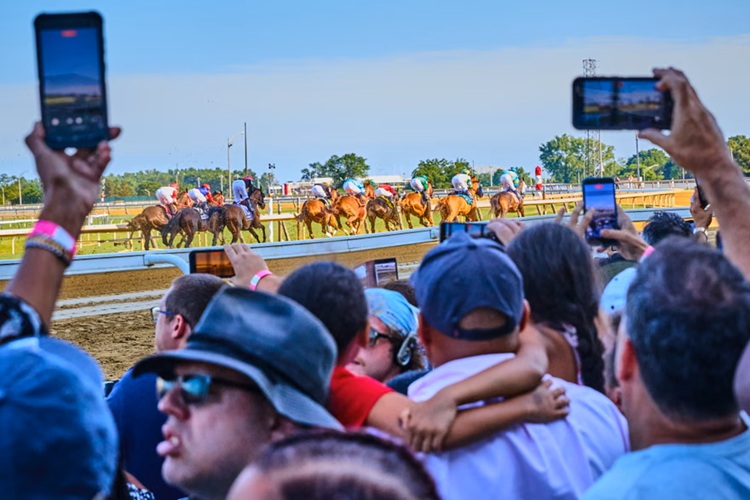 Pictured above: The field of 10 breaks from the gate for last ever race at Aqueduct, a $100,000 starter allowance over 1⅛ miles on dirt.
When it was finished there was no rush for the exits. Jockeys lingered by the paddock, trading high-fives and fist bumps, posing for photographs and embracing racegoers who had followed them for years. One man held aloft a homemade sign that read: One more day! Give me a chance to win it back! Then Kendrick Carmouche, a fan favorite who won more than 1,000 races at Aqueduct, hopped the rail alongside several fellow riders, disappearing briefly into a sea of outstretched arms. It was a fitting and emotional final image for a track where the line between spectator and participant had always been blurred.
Even as the grandstand emptied and the horses were loaded onto vans for the short trip to Belmont Park, several hundred people remained on the asphalt littered with losing stubs while Love You ‘Till the End by the Pogues played over the public-address system. Nobody seemed eager to leave.
Bourget can still picture Aqueduct at its 1960s peak, when it averaged more than 6m fans annually. “You couldn’t even get into the parking lot,” he said. “They had valet parking. There was even overflow parking over by Kennedy Airport. The crowds were enormous.” On its final day Aqueduct conjured the atmosphere, if only for a few hours, of the place he remembered.
It was never the most beautiful racetrack in the United States, nor the most fashionable or glamorous. But for 132 years Aqueduct was a place of subtle charms that occupied a singular place in New York life: a racetrack reachable by subway, sustained by ordinary people and inseparable from the city that was always changing around it.
“Aqueduct’s woven into the fabric of my life,” Migliore said. “It’s where it all began for me.”
For Bourget, the ending was harder to measure.
“It’s sad to think,” he said. “It’s just like everything else in America. They can ruin something people don’t even realize they have.”
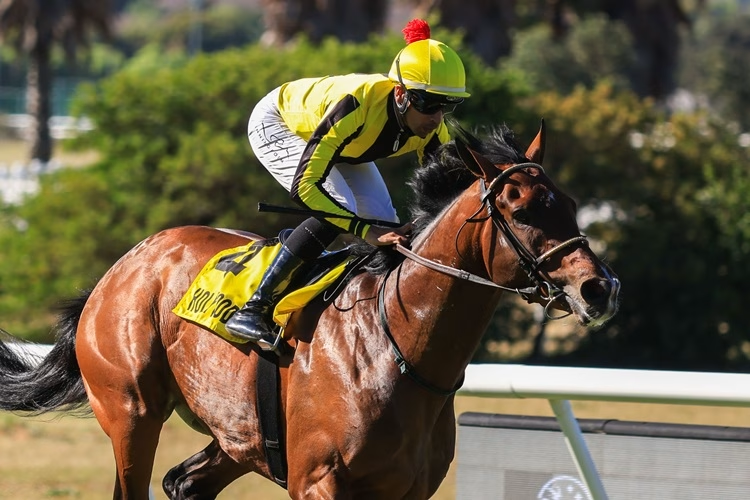
Today's Question
What rare feat will have been achieved if Viva’s Liberte won the Hollywoodbets Durban July?
The picture is of the Candice Bass-trained Viva’s Liberte (Picture: Wayne Marks)
Today’s Question Answer
Lady Christine Laidlaw’s Khaya Stables, who has Viva’s Libertas engaged, is out to become the third owner this millennium to win back to back Julys with different horses following Sheik Mohammed Bin Khalifa Al Maktoum (Bold Silvano, Igugu 2010-2011) and Chris van Niekerk (Pomodoro, Heavy Metal 2012-2013). Others in history to do it are: J Osler (Verdant Green, Apollo 1900-1901) and Fred Murray (Lombard, Caged Bird 1912-1913).