



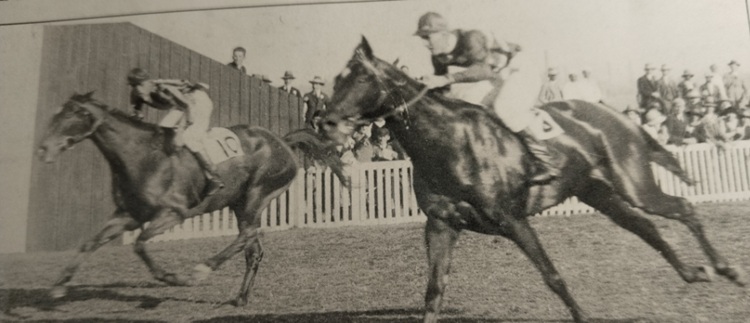
Caption: Moosme, far side, was controversially awarded the 1926 July at the expense of the hot favourite Narrow Gauge, whom all and sundry believed had won the race
The 1926 Durban July was the most controversial in the race’s history up until that point, but conversely the “Great Winter Meeting” of that year was so financially successful that it led to some important new structural changes being made to the Durban Turf Club’s Greyville racecourse and the buildings within it.
It is fitting that the Hollywoodbets Durban July of 2026 with it’s milestone stake of a staggering R10 million falls on the 100th anniversary of one of the July’s most famous and unforgettable renewals.
The 1926 July story starts in Johannesburg.
The Benoni Guineas run at Gosforth Park was originally one of the legs of the South African Triple Crown, the other two legs being the SA Derby and the Benoni St. Leger.
The Benoni Guineas of the 1924/25 season had been won in impressive style by a horse called Narrow Gauge, who was by the 1923/24 Champion Sire Brown Ronald, who was seldom out of the top three on the Sires list.
Narrow Gauge was described as “brilliant” and when he won the Clairwood Winter Handicap in July 1925 his career record had improved to seven victories and nine places for earnings of close to £3000, a fine return on a horse who had cost 70 guineas as a yearling.
His Benoni Guineas win followed a runner up finish in the Met and his Clairwood Winter Handicap win followed just two weeks after finishing runner up in the July.
Those two runner up finishes in big races were fine achievements for a three-year-old.
In August 1925 Narrow Gauge won an important race called the Champion Plate and by the time the 2026 July had come around he was so popular that it was clear he would be the hot favourite.
Jockey Granville Gorton had actually been offered a ride in Argentina at the time of the July, a good opportunity, but he turned it down as he was convinced he would win the July on Narrow Gauge.
The big horse thrilled spectators in his trial gallops and jumped as the hot 3/1 favourite.
That was despite having to carry 8 stone and 3 pounds, which was second topweight behind the Sir Abe Bailey-owned Jubilant II, who carried 8 stone 5 pounds.
In 1925 Bird Of Prey had given the diamond and gold tycoon Sir Abe Baily his first win in the July, denying Narrow Gauge by a length.
The weights the horses carried were a sign of the time as 8 stone 5 pounds is actually just 53kg, whilst in the 1926 July three runners carried bottom weight of 6 stone, which is a feather light 38kg.
Interestingly, one of the riders of the bottom weights in 1926 was Ernie Duffield, who must have been about 15 years old (In those days the apprentices started at about the age of 12).
It was Duffield’s only July ride and he finished last on 25/1 shot Picture Frame.
However, he later became a pioneering racing commentator, starting out in 1945.
In the field of commentating Duffield went on to become a legend, who is still talked about today.
Duffield was known for his machine-gun like delivery and became part and parcel of the July. He delivered the July’s first on course commentary, relayed over the course’s public address system, in 1947. Between then and his retirement in 1977 he commentated on the great race 29 times, a record eventually surpassed by Craig Peters, who will commentate his 40th July this year.
There were commentators before Duffield as the first broadcasted July actually happened in 1927, done for the African Broadcasting Company by JT Wallace, who stood on a box platform ercted for him near the Gold Ring scratchings board.
However, Duffield was the first to do it for the benefit of people on course and his voice booming over the public address system added a lot to the atmosphere of the race.
Duffield also started a formguide called Duff’s Turf Guide, which was a forerunner to today’s most popular South African formguide, The Computaform.
But back to the 1926 race and hot favourite Narrow Gauge entered the straight with a commanding lead.
However, the 5/1 third favourite, the Irish-bred five-year-old Moosme began slowly making up the ground.
Moosme was carrying just 6 stone and 12 pounds, meaning he was receiving a stone and 5 pounds (8.5kg) from Narrow Gauge, and his jockey Teddy Jacobie was cleverly sticking to the inside rail.
Narrow Gauage was still clear crossing the road, which today is a subway, but in those days was known as an infamously decisive spot where a lot of Julys were either won or lost.
Moosme was urged forward by Jacobie after crossing he road.
Soon the pair were neck and neck with Moosme on the inside rail and Narrow Gauge towards the outside.
They flashed past the post at the same time and the unenviable decision was left to Harry Solomon, who had been invited from Johannesburg to be the judge for the meeting.
A period of intense silence followed as Solomon prepared to signal to the man at the number board.
A storm of protest broke out immediately when the number of the George Lee-owned Moosme, trained by WW Knapp, was hauled on to the board.
Most spectators on course had been convinced that Narrow Gauge had won.
There was some nasty scenes as the angry crowd poured scorn on the visiting judge.
The protest raged into the next week and ultimately into July folklore.
It was the most controversial incident in the history of the July up until that point.
The letters to the editors in the Natal newspapers were inundated with complaints with one of them declaring, “If Narrow Gauge did not win, and by a long neck at that, then the sun, which has never let us down, is a liar.”
Presumably, his meaning was that the shadows of the two horses had also told a story.
However, the financial success of the day, in which there was a return of a record £49,476 (including a record £13,838 on the July itself).
July day was one day of a three day meeting called the “Great Winter Meeting” back in those days and the record returns helped the three day meeting reach figures which were almost unprecedented, beaten only by the 1918 and 1919 meetings whose returns had reached £118,258 and £121,301 respectively.
This encouraged the stewards to go ahead with much needed building expansion plans.
Dougal and Munro’s tender of £17,500 was accepted to build a new stand and land was acquired from the Durban Corporation in Sixth Avenue. In addition the club bought land in Seventh Avenue for £1,500 and paid the golf course £3,000 so that they could lay a track along Mitchell Crescent (north side of the course).
Nevertheless, Narrow Gauge has gone down in history as one of South Africa’s unluckiest horses, a runner up in the Met and twice runner up in the July with many convinced he had won the 1926 renewal.
However, Granville Gorton was able to rid himself of the monkey on his back within a year, because he won the 1927 July on a top class horse called Hussein.
Hussein was a British-bred whom the great South African trainer Jim Russell had spotted on a trip to Argentina in 1926.
Hussein was duly imported by one of the most knowledgeable racing men in the country at the time, Willie Langerman, after whom today’s traditional Gr 3 two-year-old race in Cape Town, The Langerman, is named.
Hussein, who was trained by CE Wade, went on to become the first horse in history to win both the July and the Met and he is today one of only seven horses to have achieved the feat.
Granville Gorton’s family became a famous racing dynasty in South Africa.
Other Gorton family success in the July came via Arthur Gorton, who rode Kipling to victory in 1940, Jack Gorton, who trained the 1962 July winner Diza, and John Gorton, who is accredited with one of the all time greatest July rides on the lightweight Jollify, who dead-heated with the immortal Sea Cottage in 1967.
John was champion apprentice for three years and became the first South African to win a British Classic, riding Sleeping Partner to victory in the Epsom Oaks in 1969.
In summary, the July of 100 years ago was a groundbreaking one, with its financial success enabling the stake to be raised to £5,000 for the 1927 July.
This year’s Hollywoodbets Durban July is also going to be a groundbreaker with the R10 million stake energising the race unusually early in the season.
“July Fever” this year is going to be something to behold!
