



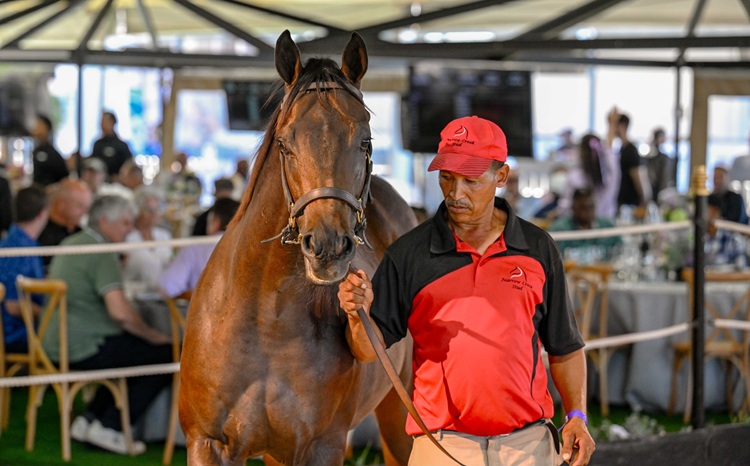
Narrow Creek Stud was only founded in 2011 and continue to have progressive success on the racetrack and at the Sales. The above picture is of lot 237 at the Race Coast Sales Premier Yearling Sale, a Rafeef colt sold for R1 million (Picture: Chase Liebenberg)
John Everett’s Narrow Creek Stud had a fine Race Coast Sales Premier Yearling Sale and only the big guns Klawervlei Stud, Maine Chance Farms and Drakenstein Stud were ahead of them on aggregate.
Their 12 lots sold returned R 10,225,000 and they also achieved a fine average of R852,083.
“Hard work” is the chief reason the stud is where they are today, but that has to be coupled with a good breeding philosophy.
Before getting on to what makes the stud farm tick, John spoke about the Sale itself.
He revealed that the SA Fillies Sprint-winning mare Singforafa, whose Rafeef colt fetched the highest price of R4 million on day one of the two day Sale, actually belongs to Terry and Annabel Andrews, although the colt was born, bred, raised and prepared on Narrow Creek’s farm at Wolesley in the Breede River Valley.
Narrow Creek had three seven figure lots and all three were colts by Rafeef.
John only owned one of the mares of those three though.
He said about Rafeef, “I have always liked Rafeef and I was one of the few fortunates who managed to get hold of a share in the beginning. I send about ten or 12 mares to him, but it’s getting harder and harder as the service fee goes up.”
He said about the seven figure Rafeefs on this Sale, “The big one out of Singforafa I thought would definitely get a million but I then thought maybe another bid or two and up to R1.5 million, but I had never been thinking R4 million. To me anything over and above a million in a yearling’s value depends on whether two people want it. But he was also a beautiful colt and the other clinching thing was he moved so well. It was actually hard to show horses after him, because there was nothing who could walk like him. The other two seven figure Rafeefs I estimated at around R700,000 to R800,000.”
John owns the three time-winning Gr 3-placed Dynasty mare Indaba, whose Rafeef colt went for R1.3 million. This half-brother to Gr 2-winning sprinter Cold Fact (What A Winter) was purchased by the ASSM Racing Syndicate and Mike and Mathew de Kock.
Narrow Creek’s other seven figure Rafeef colt, bought by Justin Vermaak, is out of the Jackson mare Freed From Desire, a six time-winning Listed-winning sprinter.
John does not own Freed From Desire, but nevertheless had a fine personal Sale because he does own Querari mare Ferrari Red, whose Jet Dark filly was bought by Jonathan Snaith for R900,000, and overall the progeny of his mares did very well.
John was “not really surprised” by Jet Dark’s sensational stats and said, “The right people were always going to be all over them. My filly was a magnificent filly and I thought she would be about a R600-R700,000 horse, but when I saw what I was bumping, and there were 30 of them and a lot of them from Drakenstein female lines, I did get nervous. I bred her for that January Sale … when I bred her that Sale was still going and I knew she was a mare who threw nice big horses, she was a forward horse and there would have been a lot less competition at the January Sale, but she was a beautiful looking horse though.”
John advised a client who stands his mares with him to withdraw another Jet Dark filly who was out of the speedy mare Sarah (What A Winter), because the intention was just to get her into a Sales race, but it would not have been worth the excercise if she was going to be a seven figure horse, which he believed she might have been.
He himself was disappointed to have to withdraw a Real Gone Kid filly, who bumped a knee three days before the Sale.
Narrow Creek bred the current highest rated horse in the land, the Gr 1 Mercury Sprint winner Buffalo Storm Cody, but although his dam Musical Romance (Trippi) no longer stands at Narrow Creek, John still likes Buffalo Bill Cody as a stallion and his colt on this Sale went for R400,000.
John also bred the dual Gr 1-winning sprinter Isivunguvungu (What A Winter), who races in the USA at present.
Isivunguvungu’s dam Miss Tweedy (Tiger Ridge) is still at Narrow Creek and has a Malmoos (Captain Al) at foot and she is back in foal to Malmoos.
John is a big fan of Malmoos and his pair of Malmoos colts on this Sale went for R300,000 and R400,000 respectively, both purchased by Justin Vermaak.
John Said, “I like Malmoos a lot, he throws a very nice type and he’s got off to a very good start, I think he has had six runners and three winners, including a Listed winner.”
He had a What A Winter colt and filly on the Sale and got R275,000 and R400,000 respectively. He said he had always liked What A Winter, but admitted he was “getting on a bit now.” The R400,000 one was out of a Querari half-sister to Isivunguvungu.
John felt buyers were a bit “sticky” towards Hawwaam.
He said, “They underpaid for the Hawwams I thought. I am not sure why because he was never going to be a sire of two-year-olds. They are all classic types and then on Saturday his son Diogenes comes and win the Listed Hawwaam Stakes over 2000m. That showed they are going to need a trip. I won’t knock him until the end of his progeny’s three-year-old careers.”
Narrow Creeks’ pair of Hawwaam colts went for R500,000 and R300,000 respectively.
The farm’s Erupt filly went for R450,000.
John said, “That was a very nice price. I have had a share in Erupt and used him a lot, but it will be more difficult now as he has moved further away (to Riethuiskraal Stud). It will be difficult to use a stallion like him that far away because there are so many like him close by, but I’ve done well with Erupt over the years including breeding the exciting Heath House, who is two from two. I heard he will be coming back soon.”
John has vast experience in thoroughbred breeding having spent three years with Allem Brothers in Viljoenskroon and nine year stints as stud manager with both Odessa Stud and Wilgerbosdrift Stud before going on his own.
He said his core breeding philosophy besides sheer hard work was to feed and medicate properly.
He said, “Never cut corners on feed and treatments. For treatments I am not talking about a scratch here and a cut there, I am talking more about the fundamental medicines, like deworming, the important things. It’s a hard game, hard work and you have to buy good quality food and feed it to them, it’s no good buying food and keeping it in the bag.”
What he meant by the last statement was that although he likes to let horses run out in paddocks and gives them very little stable time, and does not like pampering them, he never skimps on the feed he provides them with.
He said, “I am more of the old school in that I like to know what I am feeding them, rather than them feeding on something out of the ground where I don’t know what they are getting. It’s not that I don’t have some grazing, but it’s not grazing that I take into account when it comes to how much food they get a day. The grazing is just there to keep them occupied. So whether they are in a big paddock or are in one the size of a tennis court, the volume of food I give them from the bale or the bag is the same.”
Another interesting concept for the layman is that the horses are not fed separately.
John said, “They must fight for their food.”
Presumably that builds toughness and a winning attitude into the horses.
John uses Tesio a lot to help him with matings, but he likes to follow his own ideas too.
He said, “I like inbreeding a bit and there are certain crosses that I like that don’t have any scientific proof to them. I would never advocate my system to anybody, it is just a personal thing. Broodmare sires for me are an important factor. When picking young stallions before they are two expensive, I will only commit to one of these stallions after I have seen their foals. I have been fortunate as I have been right more than I have been wrong. There are no hard and fast rules and I don’t like some of these theories where they say a mare from stallion ‘A’ crossed with this stallion will work because of this horse, this horse and this horse, because it is often obvious that the cross will have a lot of success only because those stallions stood on the same farm as the mares and stallion ‘A’ stood there before them too, meaning there will be a lot of those crosses occurring.”
He continued, “On the broodmare sire line, I like to look at the first three dams and I also look at the female line.”
He added, “There are occasions when going a few generations back I will find something I like.”
John said about conformation from a breeding angle, “You have to know the conformation of your mare and of your stallion. For instance if you have a mare with a long back, then for me you don’t want to send her to a stallion with a long back, but rather choose a close coupled stallion. So you look for matches that can iron out faults or breed in good assets. i.e you try and get rid of a mare’s negatives through a stallion’s positives.”
He said trainers were big on conformation at the Sales, but he added, “If you go to a big race day with ten races of which about six are features and you stand at the winner’s enclosure and look at the victorious horses, you might be horrified if you are a big conformation person. They run with all types of legs and shapes. Obviously you try and breed out conformational problems, because you know otherwise you are going to get a hiding at the Sales.”
He continued, “The back end to me is a lot more important than the front end. The front end keeps them up, but without the back end pushing them forward, it doesn’t matter how good the front end is.”
He said, “I breed much more for the hind end than the front end, but I do need to look at the front end because then I wouldn’t be able to sell the horse.”
John reckoned asking anybody which race they would like to win would return answers like the Met and the July and yet the incentives at the Sales through Sales races invariably necessitate a push to breed horses which will have early speed.
However, he reckoned the classic type might be making a comeback and said, “If you look at some of the stallions that are coming in they have more classic type pedigrees than before, like Ridgemont’s new stallion Hit The Road (More Than Ready), Jet Dark too and a few others. I think it might be coming back to the Met and the July rather than the Nursery’s.”
John himself likes to ideally breed a horse who will have some early speed and will be able to go on to win the big races.
