



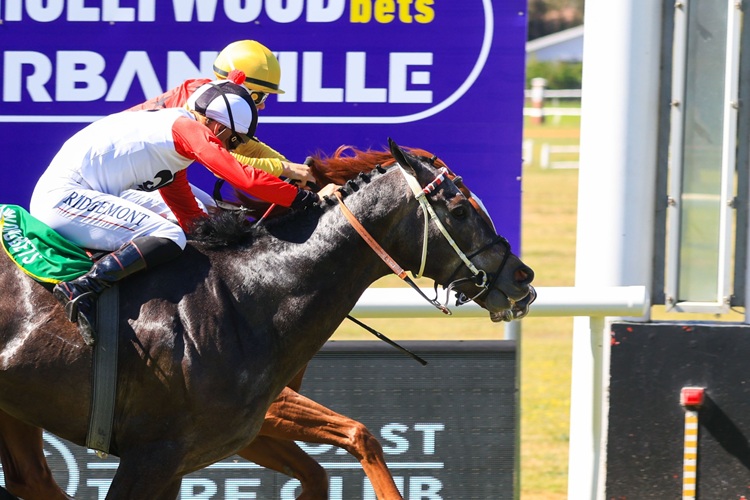
The judges had little option but to declare a dead-heat between Saudi Cat (closest) and What A Fortune at Hollywoodbets Durbanville on Monday due to the circumstances that transpired (Picture: Wayne Marks)
The judges had little option but to declare a dead-heat in the fifth race at Hollywoodbets Durbanville today (Monday), because one of the horse’s nose was obscured and the mirror image could not be used as evidence because it was clear that it was not properly aligned with the positive image.
The fifth race over 1250m at the nine race meeting was particularly intriguing, because it pitted a trio of relatively highly rated three-year-olds against some seasoned older handicappers. As it turned out the topweight Boogiefield was bettered by the Richard Fourie-ridden favourite Saudi Cat late in the race only for 4kg claiming apprentice Dezahn Louw to bravely drive the 6/1 shot What A Fortune between the pair and this brought the judges into it.
The judges deliberated for an unusually long time in an attempt to separate the Vaughan Marshall-trained Saudi Cat (Hurricane Cat) and the Candice Bass-trained What A Fortune (What A Winter) and in the end they were forced to declare a dead-heat.
The mirror image on a photo finish can be used as a guide for the judges to assist when a horse’s nose is obscured in a close finish.
However, in this case it showed that the same horse was not on the same line in the mirror image as it is was on the positive image (as is displayed in the photo finish below).


All of the horses who could have a line placed on their nose in the positive image have their noses through the line on the mirror image which proved that the latter was not correctly aligned.
This was also the case for the third and fourth-placed horses
The mirror image could therefore not be reliably used to make the judgement.
The rules about photo-finishes are shown below:
65. JUDGING AND PHOTO-FINISH FILMS AND PHOTOGRAPHS
65.1 A judge or his assistant or his authorized substitute shall be in the judge’s box at the time of the start and shall remain in the box until the HORSES have passed the winning post, the result has been declared and the ALL CLEAR given.
65.2 Notwithstanding anything to the contrary in the RULES, during the running of the RACE and until the judge has given his decision, no PERSON or individual other than the judge and/or his assistant and/or his authorised substitute shall be permitted to enter the judge’s box, nor, save for the SB, shall any PERSON or individual have any contact with the judge and/or his assistant and/or his authorised substitute.
65.3 No PERSON or individual other than the photo-finish camera operator and/or his authorised assistant shall be permitted to enter the photo-finish operating room until the judge has put the numbers of the winner and placed HORSES in the frame. When a photo-finish picture has been called for by the judge, the door or any other opening in the room shall remain closed until the judge has declared the result of the RACE and has exhibited the numbers in the frame.
65.4 As soon as possible after the RACE, the judge shall name the first 6 HORSES past the finishing post or such further number as the SB may instruct him to do, and his placings shall be final unless an OBJECTION to the winner, or any placed HORSE, is made and upheld, provided that this RULE shall not prevent a judge from correcting a mistake, where such correction is made before expiry of the time allowed for the notification of intention to object under RULE 68.2.
65.5 Except where a HORSE’S nose is not visible, the judge shall base his decision exclusively on the HORSE’S nose and if there is a discernible difference, he shall not give a dead heat.
65.6 A judge shall satisfy himself as to the correctness of the placings from the photograph. If there is no photograph available due to a failure of the photo-finish camera or if, in the sole opinion of the judge, the images on the photograph are indistinct, then the judge may have regard to the race film to satisfy himself as to the correctness of the placings. If there is no race film available, the judge shall, to the best of his ability determine the placings as his personally observed them. The judge’s decision shall be final and binding
In accordance with rule 65.5, the judge was only able to use the positive image to make the judgement. He could not use the mirror image as a guide due to the alignment error.
A question which could be asked is whether the judge could have used Rule 65.6, which allows some discretion, to apply logic? After all every horse on the day that could have a line placed on its nose on the positive image was through the line by the same margin on the mirror image and What A Fortune’s nose was not through the line.
However, there is no place for “reasonable doubt” in the racing rules as is also shown in the objection rules whereby a third-placed horse successfully objects against the winner, but is then officially placed second whereas logically it should be placed first – in racing the argument is there is no way to prove the third-placed horse would have otherwise beaten the second-placed horse.
There were actually a plethora of close finishes on the day at Hollywoodbets Durbanville, but the race five photo finish was the only one that had an obscured nose.
A historical similarity happened at the now defunct Clairwood Park on September 12, 2007.
Read the article written below at the time:
Clairwood judges, Warren Eisele and Robert Moffatt, faced a problematic photo finish recently and had no choice but to revert to the racing rules.
In the first leg of the PA on September 12 a horse called Eradikate, who was contesting third place, finished very close to the horse on his outside and had his head down. Despite the photo finish camera being positioned high up in the grandstand above the judge’s box in order to create an angle that can easily separate horses, Eradikate’s nose was still hidden from view.
The mirror placed on the far side of the finish line is there specifically to accommodate such an occurrence but, most unusually, Eradikate’s nose was hidden from view from that side too by a horse close to him on his inside.
Rule 65.5 states, “Except where a HORSE’S nose is not visible, the judge shall base his decision exclusively on the HORSE’S nose and if there is a discernible difference he shall not give a dead heat.”
Although it seemed probable that Eradikate had finished fourth, stipendiary stewards and judges have for a long time abided by an interpretation of the law that makes no place for “reasonable doubt”. In the case whereby the nose is not visible a dead-heat must be awarded.
