



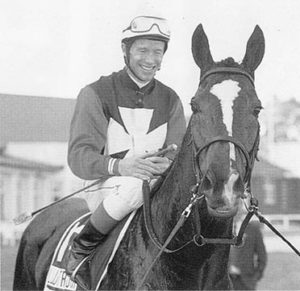
Felix Coetzee on 1990 July winner Illustrador
Lucinda Woodruff fittingly had a fine Champions Season campaign as it was in fact 35 years ago in July that her legendary grandfather Terrance Millard had the last of of his six July wins in what was known as “The Millard era”.
Millard’s stalwart stable jockey Felix Coetzee recalled Millard’s dominance, in which he won six Julys in eight years and had an unerring ability to peak a horse at the right time.
He said in an article about 12 years ago, “Mr Millard had us all very committed. There was a terrific amount of discipline in the yard, but his best quality was that as well as being a great winner, he was a very good loser. Once he trusted you he didn’t put pressure on you and this allowed us to ride positively and confidently.”
One of the toughest aspects of being Millard’s number one jockey was choosing the right horse.
In 1983 Coetzee chose Arctic Cove for the July and he was beaten into third. He recalled, “I had gone close on Arctic Cove as a three-year-old and he had won the Met, so I chose him on his proven ability.”
However, the stablemate ridden by Mark Sutherland, the Argentinian-bred filly Tecla Bluff, gave Millard the first of his six famous victories in the big race.
Felix said about this grey filly, “Tecla Bluff had been improving at the time and had a very good pedigree.”
The following year the mighty imported mare Devon Air gave Felix his all important first victory in South Africa’s premier horseracing event.
There is a good story behind her purchase told by the man who found her, Durban Bloodstock Agent Andy Williams, who was also behind the great stallion Foveros’ import to SA.
Williams had attended the Prix de l’Arc de Triomphe with a number of SA industrymen in 1981 and on that same trip they attended a meeting at Ascot which featured the Group 3 Hoover Fillies Mile, a two-year-old event which is a Group 1 held at Newmarket these days.
The Queen’s huge filly Height Of Fashion won the race to remain unbeaten as a two-year-old and she went on to win the Group 2 Princess Of Wales Stakes in record-breaking fashion before producing the great Nashwan at stud as well as the like of Unfuwain and Nayef.
However, the horse who caught Williams eye in the Fillies Mile was a big bay maiden called Devon Air who ran on strongly to be beaten about 2.5 lengths into fourth. This contradicts previous reports that Devon Air’s UK form had been “dismal”, although she did not build on that form and remained a maiden throughout the following season.
Williams attended a sale at Newmarket a year or so later and noticed Devon Air going through the ring unsold.
He recalled, “She was trained by a guy called Jack Cann, who was largely a jumps trainer and had not trained a winner on the flat for over a year.”
SA breeder Robin Scott of Scotts Brothers was at the Sale and Williams approached him advising him to buy the filly.
Williams said, “In those days breeders Mick Goss and the Scott Brothers etc were attempting to improve the quality of SA-bred broodmare and had certain criteria. Females who did not have a black type dam or who were not black type themselves did not qualify and you couldn’t bring in a maiden.”
Robin was initially sceptical and Williams recalled him saying ‘But her timeform rating is only 69.’”
However, Williams knew this horse was better than her recent form suggested and persisted.
Robin’s brother Des, who has always been more interested in racing than breeding, was ultimately contacted on the telephone from the Sales grounds.
Williams continued, “Des asked me what her rating was and I replied 96. He said ok then buy her.”
Williams was questioned by colleagues about the white lie and he replied, “If he ever asks me I will just tell him I’m dyslexic!”
Des and Robin sent Devon Air to Millard in the Cape.
Her first SA start was in a B Division event over 1900m at Milnerton on July 16, 1983, and carrying just 49kg she won by eleven lengths.
She arrived in Durban for the 1984 winter season with a further two wins under her belt, including a 13 length demolition of the opposition in a 2400m Listed event. She followed the latter race with a third place finish in the Met, beaten just 1,75 length by the great Wolf Power with Spanish Pool second.
In Durban Devon Air kicked off a fine winter season by winning the Grade 2 Republic Day Handicap over 1900m at Greyville by 3,25 lengths.
Now the July.
Felix said, “She was a massive, bold mare and was a strong galloper, with a high cruising speed. I felt if they took me on she would wear them into the ground and if they didn’t they wouldn’t get to me.”
Coetzee dictated at a solid gallop and she had them all off the bit turning for home. “The last 200m seemed like an eternity. With 50m to go you realise it’s going to happen and you just want to reel in the line. The feeling when you cross the line is difficult to put into words, it’s jubilation, relief, triumph, and the congratulations from the other jockeys adds to the feeling.”
The Scott Brothers had previously bred July winner Politician and Des made it three July wins in 1990 as part-owner of the great Millard-trained Illustrador.
Devon Air later made it a famous Greyville hattrick by winning the Gold Cup by 4,5 lengths.
At stud Devon Air produced two stakes winners with her first two foals but then went off the boil and was sold to Zimbabwe in 1996. However, her daughter Bushgirl, born in 1999, has produced Grade 1 winner August Rush (Var) and stakes winner Miss October (Var) and the latter has produced Grade 1 winner Tempting Fate and the Gr 1 winner October Morn, so Devon Air’s influence lives on.
In 1986 Coetzee rode another magnificent imported horse, Fools Holme, but admitted he was beaten by a better ride as the outsider of Millard’s one-two-three finishers, Occult, won under Bartie Leisher.
“Bartie dictated and I fell into the trap. I wasn’t as sharp in those days with my pacing and Bartie had ridden internationally. He rode a smashing race.”
In 1987 Coetzee had a scare when his mount Potomac stepped into a hole, stumbling badly and costing him any chance. In 1988 Coetzee had a tough choice between the speedy Royal Chalice and the out and out stayer Tensing, but he chose the right one. “I knew I had to switch Royal Chalice off and idle around the turn. The plan fell into place perfectly. He used no energy for the first 1 800m, so was able to use his explosive acceleration in the straight.”
In 1989 Coetzee felt that the favourite Castle Walk had not enjoyed the heavy going.
Coetzee regards the 1990 winner, the three-year-old Illustrador, as the best Terrance Millard-trained horse he ever rode.
This Argentinian-bred won at the highest level from 1 200m up to the 3 200m of the Gold Cup.
However, Coetzee still had a tough choice picking the right one, considering the weights, and was swung by his agent Alan “Snowy” Reid’s words, “This horse knows how to win.”
That was the second of Millard’s one-two-three finishes.
At the end of the following season he handed the reins over to his son and assistant trainer, Tony.
