



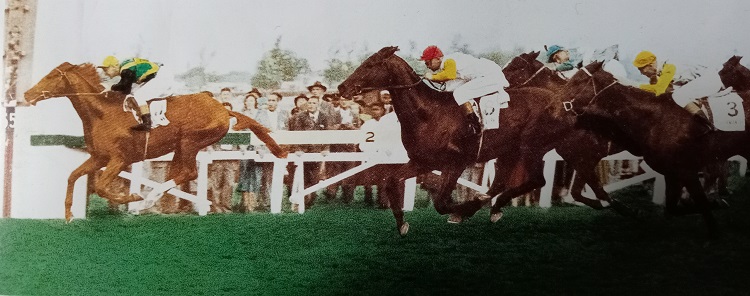
Picture: Harold “Tiger” Wright lands what was at the time a record-breaking fourth July victory on Preto’s Crown in 1955, a feat which has since been surpassed only by Anton Marcus and equalled by Anthony Delpech and Piere Strydom.
70 years ago in July 1955 Harold “Tiger” Wright became the first jockey to ride a fourth July winner when he brought home the George Azzie-trained 12/1 shot Preto’s Crown to an easy victory.
The late Jay August made some wonderful contributions to racing, including an analysis of statistics to aid with race programming and handicapping and much more, but he also kept an archive of South African racing history in a website called https://southafricanracehorse.wordpress.com/
It is an apt time to reproduce the below article which was archived within the aforementined website.
Title: Harold “Tiger” Wright (1921-1995)
By Alan Breck – SA Racehorse magazine – July 1973 – pgs 78-79
The phrase, “a legend in his lifetime”, particularly when applied to sportsmen and athletes, is used thoughtlessly and, in my opinion, can only be employed in reference to fewer than half-a-dozen who have graced the sporting scene in South Africa during the present century. And, at the head of that very select list I would place Harold William Wright who, since the death of his greatest rival, Harold “Cocky” Feldman in 1950, and his own retirement from race riding in 1964 was the dominant personality on the South African Turf.
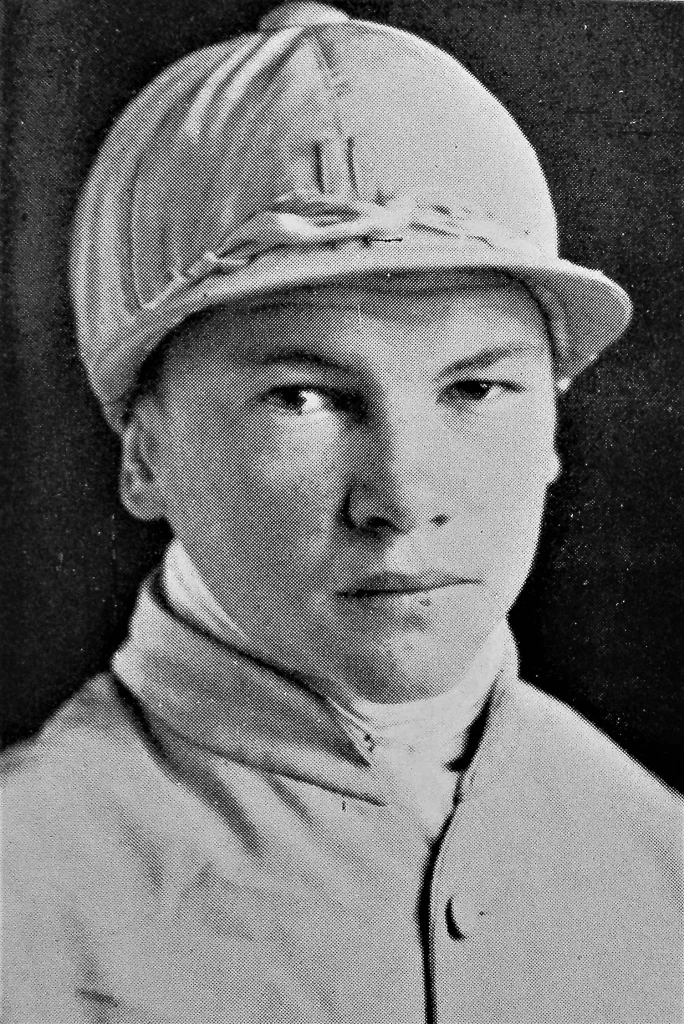
A youthful Tiger Wright as an apprentice
Toss in an ejaculation like “Benny” or “Graeme” into any sporting conversation, and it would be necessary to add Osler or Pollock before the significance of the reference penetrated the full awareness of the listener. But just mention the word “Tiger”, even in a company of present day racegoers, the younger of whom may never have seen Wright in the saddle, and I’ll wager that not one would ask for an explanation of identity.
In the course of a career which extended over some twenty years Wright rode well over 2 000 winners. This magic figure, which possibly only Charlie Barends and the still active Stanley Amos have also attained on South African tracks, was hoisted when “Tiger” got the filly Effort first past the post at Turffontein on March 14th, 1959. He was champion jockey on eleven occasions, not only in opposition to the seven times champion H. Feldman, but against colleagues of such calibre as Charlie Barends, Johnny Westwater, Bert Sage, George Patmore, the late J. “Snowy” Martin, A. de la Rey, the then much younger Johnny McCreedy, Joe Byrnes, Stanley Amos, H. (Johnny) Cawcutt, Duncan Alexander, Harry Berry, Basil Lewis and Vic McMurtry.
It was rivalry of a quality and far greater intensity than the more recent champions, Gerald Turner and Raymond Rhodes, have encountered, or are likely to encounter in the foreseeable future. Earlier such as Cyril (Bunky) Buckham, George (Ticky) Nicoll, Ike Strydom, Leslie Hammon, Fred Maisch, Teddy Jacobie, W. Rugg, Paynie Bundy, Ted Shaw, Cecil Ray, Eric McMurtry, Leon Fernandez, E. Lariviere, Cecil Bowles and, for a short spell, Syd Garrett had been leading knights of the pigskin, both here and overseas, but, taken by and large, the standard of riding in the decade following the cessation of hostilities in World War Il was, collectively, the brightest in South Africa’s racing history.
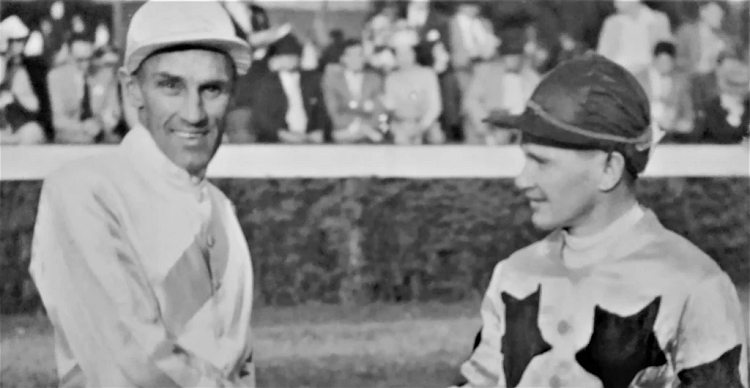
Wright congratulates Charlie Barends on his crowning as South African champion jockey in 1956.
The rivalry between Feldman and Wright was intense with both claiming a following of punters fanatical in their adherence. On balance the older and more forceful Feldman (appropriately nicknamed “Cocky”) was the more successful in that, between 1941 and 1949 he was champion six times as against Wright’s two. Between them they monopolised the championship, but with the difference that Feldman never hesitated to dash off to a minor meeting (he gained one championship by riding six winners in one day at Port Elizabeth) whereas Wright remained loyal to his employers.
Initially apprenticed to the late R. (Bob) Whiteford at a time when, in the 1930’s, the latter had private stabling near the Kenilworth racecourse in the Cape, Wright finished his apprenticeship with the late Walter Krog in Johannesburg. Bob Whiteford, father of the present highly successful Natal trainer R. “Sonny” Whiteford, was himself a jockey of considerable achievement. It is on record that he twice rode six winners in one day at Cape Town meetings.
It is also notable that, in addition to Wright, Walter Krog also had a hand in shaping the career of Charlie Barends as a fledgling jockey.
Like Feldman a year or so before him Wright was unsuccessful as a young apprentice (which bears out the contention that the quality of riding and the fierceness of the competition was particularly high in those days) and it was not until December 10th 1936 that he rode his first winner.
Appropriately this was in a feature event- the Chairman’s Cup Handicap at Germiston – and was gained on the filly Jane Hoo trained by George Azzie for the late J. H. Webster.
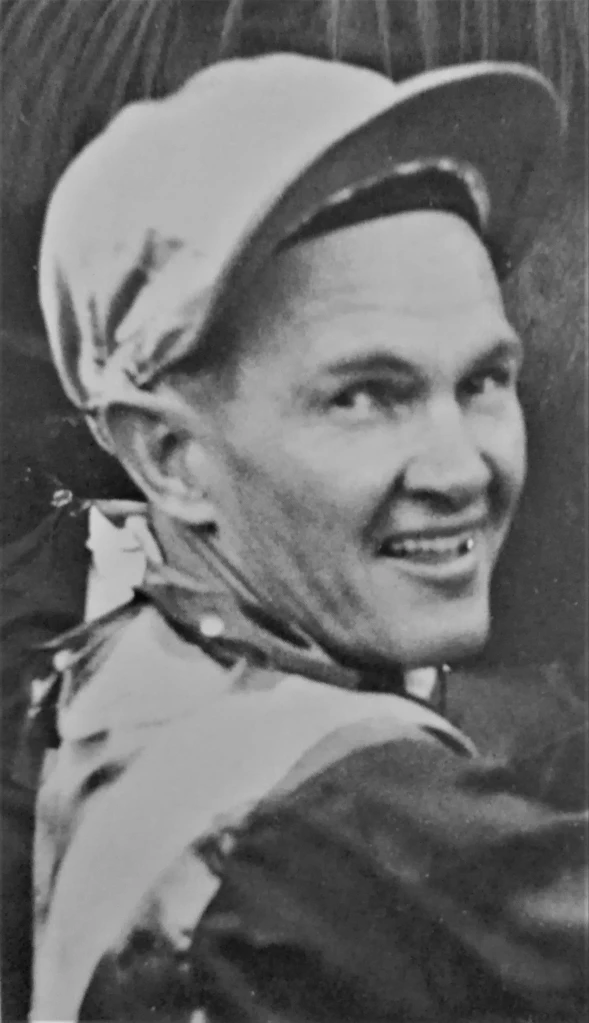 Wright in the unsaddling enclosure after another of his 2454 wins in South Africa
From that red-letter day Wright’s career pointed only one way -forward. Three seasons later he was champion jockey for the first time with, again to show the keenness of the competition, a total of only 69 winners. In six of the next seven seasons Feldman, an unremitting hunter for mounts with outstanding chances, deprived Wright of the championship.
At this point a comparison of the riding styles of Feldman and Wright is not out of place. Both were fortunate in that they were natural lightweights. Of the two Feldman was by far the more forceful, possibly the quicker thinker in an emergency, and extremely effective in a close finish. A bustling, live wire personality Feldman would, in the pursuit of victory, go for openings which a more cautious jockey would disdain.
Wright was the more stylish rider and, perhaps, a slightly better judge of pace than Feldman. Always perfectly balanced in complete co-ordination with his mount. Wright hated the use of the whip. Only as a last resort was the “stick” brought into action and, to those who knew his style of riding best, a sign that the prospects of success were fading.
Both were masters of their craft. The tragically sudden death of Harold Feldman—he collapsed after riding track work at Turffontein on the morning of April 4th 1950 – not only deprived South Africa currently most successful jockey, but made it easier for colleagues he left behind to ride winners.
As a natural corollary from then existing circumstances “Tiger” profited most. Such was the demand for his services that in the 1949-50 season he had no fewer than 731 mounts nearly 200 more than in his previous season – and from which he obtained the South African seasonal record of 175 winners.
Seven years later (1956—57) “Tiger” had 759 mounts and is the only jockey to have topped the 700 mark in one season’s work on South African tracks. His record number of winners (175) in the 1949—50 season is likely to stand for all time. So, too, is his achievement of riding 158 winners from 613 mounts an average of 25,77 per cent—in the following season.
Johnny McCreedy (1952—53) and Charlie Barends (1955-56) interrupted “Tiger’s” run of success in the championship which, after the death of Feldman, he won nine times in eleven years.
When “Tiger” retired to take up training in 1964 he had ridden not only well over 2 000 winners but had been successful in every feature event on Transvaal, Cape and Natal tracks bar one. The exception was the Gold Cup Handicap at Greyville which evaded him just as the July Handicap had escaped Charlie Barends since his one and only victory in 1938. Although he failed to win it outright Wright was placed on no fewer than eight occasions in the Cup, including a third on Brookhill who fell lame with the race apparently at his mercy in 1947.
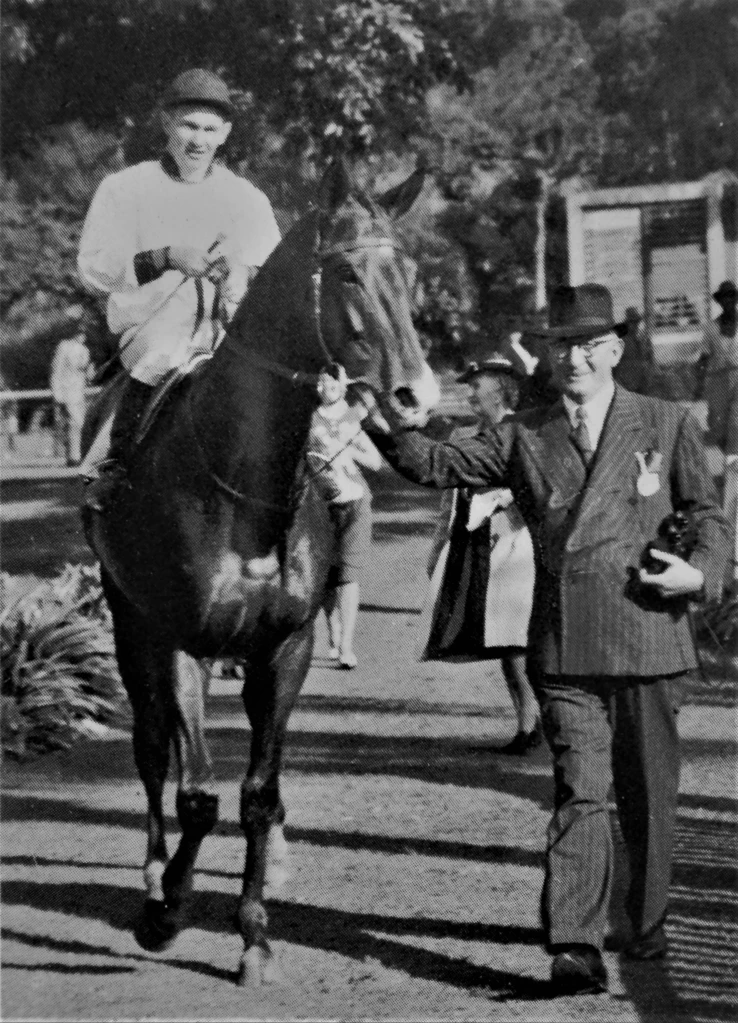 Wright and Brookhill being led in by Len Oates after winning the 1947 Durban July Handicap.
Of the three other major handicaps, the “July”, Summer and “Met” he won the Greyville race four times in the order of Silver Phantom (1942), Brookhill (1947), Milesia Pride (1949) and Preto’s Crown (1955). The Johannesburg Summer Handicap yielded him victories on Cape Heath, who deadheated with Danny Boy in 1946, Nagaina Hall in 1954, Java in 1956 and again in 1958, and White Foam in 1960.
“Tiger” won the Cape Metropolitan at Kenilworth twice and in so doing established a sequence which may never be equalled. In those days, prior to the mid 1940’s, the Metropolitan had always been run in October. In that month of 1946 “Tiger” had won the race on the filly Bovidae and within a week or two the Executive of the South African Turf Club decided to reform their annual programme and defer the Metropolitan to January. Thus, within another three months another Metropolitan Handicap came up for decision. “Tiger” also won this – on the imported colt Thorium, who was a “maiden” at the time – and so achieved the singular feat of winning the same major handicap twice in one season.
That Bovidae was the only filly to have the “Met” at that stage – and remained unique in that respect until Renounce came along twenty years later – and that Thorium was recording the first victory of his career added to the rarity of the sequence.
Another little-known anecdote concerning “Tiger” is how he just missed riding a Derby winner at Epsom. It was on the second of what I think were the only two visits he made to Britain (1947 and 1961) that he was offered the mount on the French bred and trained Psidium at Epsom. At that time under contract to the late Charles Engelhard Wright was on the point of return to the Republic when he was approached to ride Psidium. Although his presence in Johannesburg was desired for the Winter meeting at Turffontein permission for “Tiger” to remain in Britain would readily have been granted had the Derby offer been for something better credentialled than Psidium. In the circumstances Wright considered that Turffontein was more attractive than Epsom and so he declined the ride on Psidium.
It is history how, with French jockey R. Poincelet in the saddle Psidium (a half-brother to the locally based stallion Thymus) confounded the book of form, and everybody except the bookmakers, by coming from last in the straight to win at the odds of 66/1. And that’s how “Tiger” missed being the first South African born jockey to ride a winner of the Derby at Epsom.
Just before his retirement from the saddle I asked “Tiger” what he considered to be the best horse he had ever ridden. After due reflection he came up with Silver Phantom, an imported grey gelding trained by the late Ted Shaw, who gave both trainer and jockey a notable double in the July and Clairwood Winter Handicaps of 1942. Only Mowgli (A. R. Ellis and B. Lewis) in 1952 and Sea Cottage (S. Laird and R. Sivewright) 1967 have accomplished the same double in the same season.
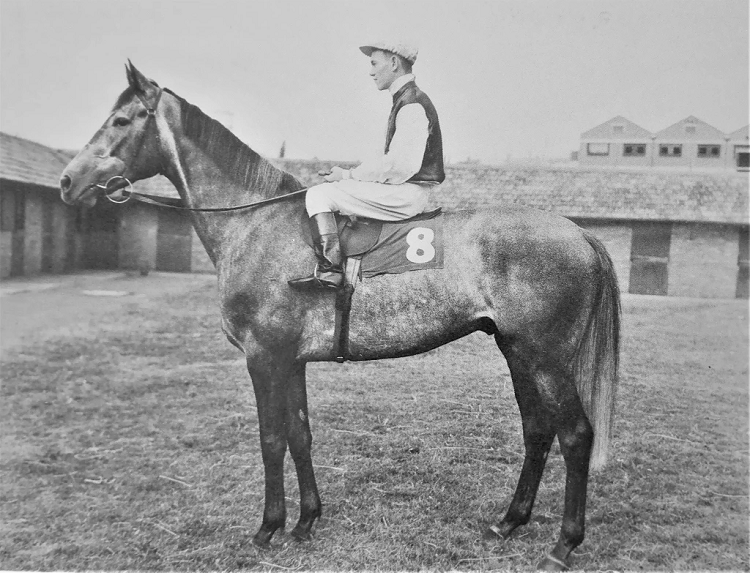 Silver Phantom, 1942 Durban July winner, and rated by Wright as the best horse he rode
Silver Phantom was undoubtedly a stylish racehorse – he accounted for the South African bred champion Lenin in both the July and Winter Handicaps – and the fact that he was a gelding was an incalculable loss to the breeding industry of this country. He was by Easton (second to Windsor Lad and ahead of the hot favourite Colombo in the Epsom Derby of 1934) from that great race mare Myrobella, who later became the dam of Big Game.
Towards the end of his riding career “Tiger”, who will be 52 in July this year, became more and more enamoured of the thought of training and breeding in Natal. To this end he leased a property at Lion’s River and took his last ride on Nagaina’s Son (unplaced) at Greyville on 7th November 1964.
His last winner was on Bright Herald at Clairwood on 17th October 1964. Two races earlier he had scored on King Bruce, and it was fitting that both winners should be trained by his ex-riding colleague Eddie Harvey in the colours of Jack Stubbs and Barry Wilson, respectively.
Like several top-class jockeys before him, notably George Patmore, Basil Lewis and Vic McMurtry, “Tiger” found that the training of thoroughbreds required a completely different approach than did the riding of them in races. As a trainer he was not a success, and it occasioned no surprise when, shortly before the sudden death of his wife Barbara in February this year he had turned their horses over to R. “Sonny” Whiteford for stabling at Summerveld.
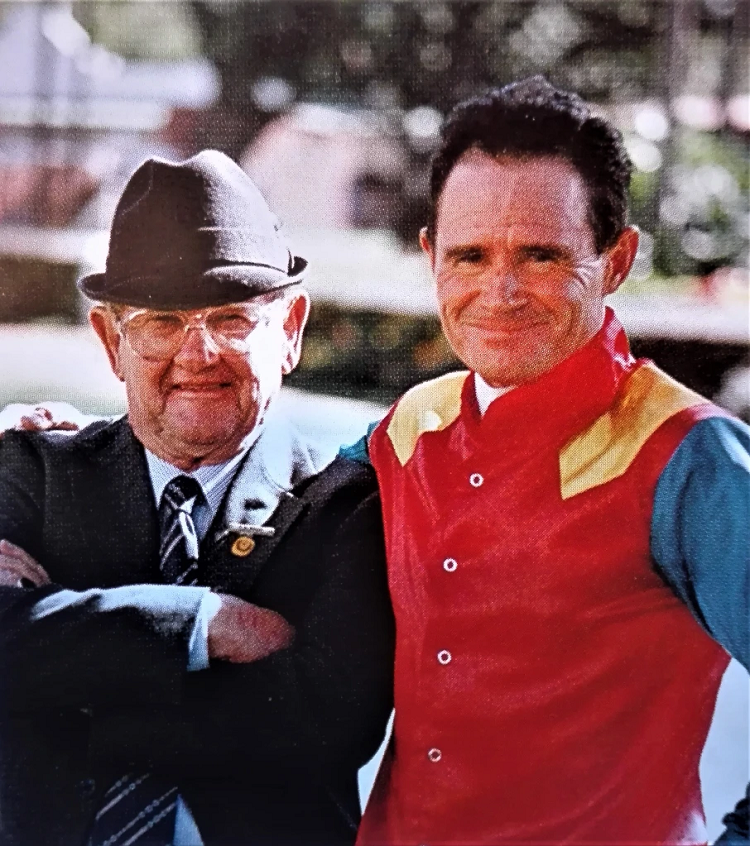 Trainer Wright with jockey Kenny Michel
Thus, the start, as an apprentice jockey, and his intimate association with thoroughbreds as an owner, began and ended for H. W. Wright with the Whiteford family.
——-oooOooo——-
