



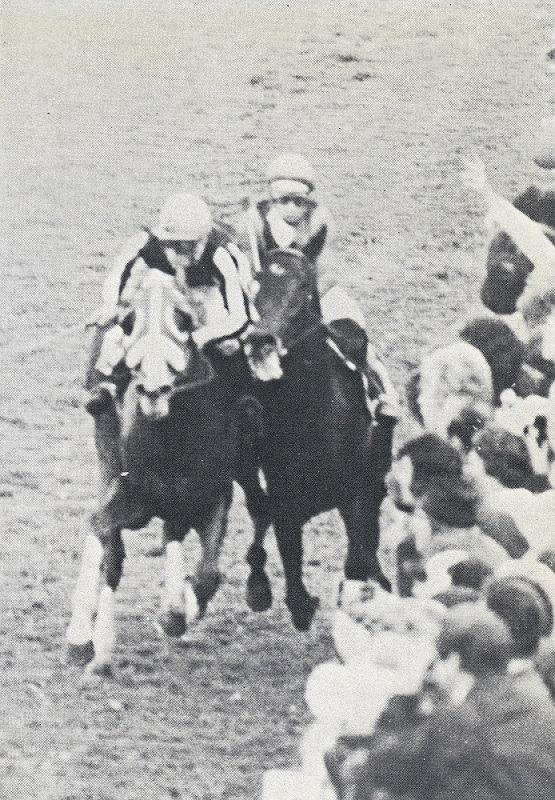
The newspaper picture showing Distinctly being squeezed against the outside rail by Gatecrasher, although Garth Puller claimed the angle that Gatecrasher appears to be running at was due to Distinctly hanging away from the crowd and hitting Gatecrasher in the hindquarters. (Picture: Newspaper cutting – Natal Mercury).
This year’s Hollywoodbets Durban July will mark the 50th anniversary of one of the July’s greatest controversies and the below article compiled over the years looks back at the details of the drama.
The 1975 July Controversy – Brown, Puller, Ferraris And Stipe Speak
When I arrived to see the recently late Herman Brown Snr about an article in late 2007 he said to me, “So you’ve come to talk about Gatecrasher, the greatest horse to ever race in this country.”
Brown had never seen Gatecrasher before he joined him and was very disappointed when the big chestnut got off the float at Summerveld. He described him as all legs and so narrow he “looked like two planks put together.”
He immediately sent him to a nearby spelling farm.
A while later Gatecrasher was given a grass gallop alongside two other juveniles.
Brown was awe-struck when he saw the colt in full stride. “He was an absolute machine,” he recalled.
“When the workrider, George Davies, dismounted he had a broad grin and said ‘Mr Brown, you have a champion’.”
Garth Puller, who rode Gatecrasher to two Grade I wins, in the J&B Met and the Clairwood Champions Stakes respectively, described him as a horse with an enormous stride who would stretch out further and further the more you asked him.
Gatecrasher had a flexor tendon problem on his near fore leg and this was his undoing on right-hand tracks as he had a tendency to hang towards the outside. However, he was unbeaten on left-hand tracks and his finest hour came when winning the J&B Met by 2,25 lengths from Sledgehammer in January 1976.
Patrick Wynne, an apprentice at the time, recalls Gatecrasher’s pre-Met gallop as he was riding the “pick up” horse, Glenever, himself a Grade 2 winning sprint-miler. Gatecrasher ran from the 1800m mark and the plan was to pick up Glenever at the 1000m mark and the latter would then give him a lead into the straight. However, when Wynne received the signal to go, Glenever, bounded off at full speed and he couldn’t control him. Mindful of the hot water he was going to land himself in, Wynne tried his hardest to rein the horse back, but to no avail. Once Glenever had hit the straight he knew he had no chance and had little option but to let him go. At the 200m mark Wynne was red-faced and contemplating his fate when to his utter amazement Gatecrasher came bounding past him. The big chestnut drew away to win the gallop by about five lengths.
Brown recalled all of the other Met trainers knew they had no chance after seeing that gallop.
The 1975 July According To Brown And Puller:
Brown watched the most disappointing race of his training career, the 1975 Durban July, in which his beloved Gatecrasher lost on an objection, from his customary spot near the top of the grandstand in line with the finishing post. He consequently had a clear view of the drama which unfolded.
He said, ““I watched every race from there as I used to make a lot of money on the photo-finish betting that bookies offered back then.”
Brown’s chief concern before the race was Gatecrasher’s tendency to hang left.
He recalled, “I had said to Garth Puller, who was riding him for the first time, ‘I don’t think you will need to pull your stick. But if you do need to hit him, do it with your left hand to try and straighten him up’.
“Garth rode a perfect race until the last 100m. Then he moved on him. He had the race won, I don’t think there was a real need to go for the stick, but this was the July. Garth was looking at the horse on the inside rail, Principal Boy, but unbeknown to him there was a horse on his outside, Distinctly.
“So what happened was Gatecrasher moved over and Distinctly had to ease slightly, but Distinctly was a beaten horse, he could never have won. The objection looked founded and I thought we would lose it.
“There was no doubt that he did go over and he deserved to lose the race on that. However on the new rules I don’t think we would have lost because there was enough room but Distinctly didn’t have it in him to go past.”
Today the rule states that an objection will be upheld only if the horse would have beaten the horse that interfered with it, but the old rule stated that the horse only had to have been cost a placing.
This was possibly crucial to the 1975 July decision as Distinctly was third across the line, 0,5 lengths behind the winner, Gatecrasher, with Principal Boy second, a head behind Gatecrasher and 0,40 lengths in front of Distinctly. The stipendiary stewards only had to decide whether the interference had cost Distinctly second place.
The rule concerning the alteration of placings after an objection has been upheld has not changed despite constant debate and Principal Boy, despite having been beaten fair and square, had to be awarded the race with Distinctly second and Gatecrasher third.
“Naturally I was terribly disappointed”, continued Brown. Having come close a few times before, I had now won the July and knew I was going to lose it. But I have always been a good loser and take things as they come.
“It was my daughter’s 21st on the same day and we had booked out the Polo Pony. The hotel manager phoned me after the result and asked me if it was still going ahead and I said we now needed the party more than ever to drown our sorrows and I ordered even more champagne!”
Garth Puller reckoned that owing to many mitigating circumstances that weren’t taken into account he should have kept the race.
He said: “In the gallops we got permission to run Gatecrasher on the inside of the dolls and he handled the turn fine. I felt that at a relaxed pace he was an easy horse to control. In the July we were coming from behind and were about to run between horses when Jamaican Music took a bump and shifted onto us.
“Gatecrasher was thus set on an outward path and in order to maintain momentum I elected to run around him. My decision was later vindicated as in the end I only got up by a head.
“In a matter of strides we were two or three horse-widths from the outside rail and at about the 150m mark I straightened him. It was a tight finish so I had naturally drawn my whip.
“It was in my right hand as I was only concerned about the horses on the inside and reckoned I had the rest of the field beaten.
“The first I knew of Distinctly’s presence was when he bumped me a stride or two before the line. In those days there was only a public rail and you had thousands of people leaning over and screaming.
“Distinctly had about two horse-widths of room to go outside of us, as a subsequent newspaper photograph proves, but late in the race he shied away from the crowd while Gatecrasher, who was wearing blinkers and was thus not bothered by the crowd, remained on a straight course.
“Almost as we hit the line Distinctly ran into Gatecrasher’s quarters sending him into a broadside and giving the impression that Gatecrasher had run right across him, but in my mind we had received as much interference from Distinctly as we had given him.”
Distinctly was being ridden by an apprentice, Tobie van Booma, who had never ridden at Greyville before and normally a jockey shouts if another horse is about to cross him.
However, Van Booma had given Puller no warning of his presence, which in all probability points to him having wanted to sneak past unnoticed and adds credence to the belief that there was room for him to get past, although the question must be asked, with all that crowd noise would he even have been heard had he shouted?
“Besides the crowds on the rail,” continued Puller, “another point that wasn’t considered was that at Greyville horses running down the outside have a natural tendency to angle in at the line, because there is a building in front of them and in those days there was a big water tower behind the building too. They will head for the daylight they see to the right which is also obviously the way the bend past the line goes.
“The objection decision was also made on just one viewing of the race through a pair of binoculars because in the film from front on, Gatecrasher and Distinctly had disappeared out of the picture and from the side on view they are virtually hidden by the crowd.
“To add salt to the wounds I was recommended for a two month suspension, the first recommendation of my career, despite having been on a horse who was notorious for hanging to the left on a right-hand track. I had ridden Arion against Gatecrasher at Greyville about two or three months earlier and before the race the chief stipe, Jock Sproule, told me something I already knew, saying to me, “Jockey Puller I just want to warn you not to go for your run outside of Gatecrasher as this horse always hangs out.”
“In the appeal against my suspension I reminded Mr Sproule of this and said that had he given apprentice van Booma, who had no previous experience of either Greyville or Gatecrasher, the same warning I wouldn’t have been sitting before him today. But Mr. Sproule replied that he had been doing me a favour (on the day of the Arion warning). I have to say I felt hard done by.”
1975 July According To Ormond Ferraris
The trainer of Distinctly, Ormond Ferraris, still regards the 1975 July as the most disappointing day of his career.
Ferraris said, “Gatecrasher had a history of hanging out on right hand tracks and I had an apprentice on Distinctly, Tobie van Booma. Gatecrasher carried Distinctly right across the racetrack and near the line van Booma had to snatch the horse up otherwise he would have gone over the rail. They were as guilty as all hell but unfortunately Principal Boy on the inside had finished ahead of us so we were only awarded second place.”
Asked on whether he felt Distinctly would have won the race but for being carried over by Gatecrasher, Ferraris said, “I don’t FEEL he would have won, I can ABSOLUTELY GUARANTEE that he would have won. I think he would have won by at least six lengths.”
The 1975 July According To Stipendiary Steward Barry Paterson
I was in a tower at the 600m mark and couldn’t see much from behind. However, I was called in to read the film. The film didn’t show much. You could see Gatecrasher coming off the false rail, just inside of the middle of the course, with Distinctly about half-a-length behind him. However the cameraman decided to follow the inside horses and Gatecrasher and Distinctly disappeared out of the picture. They were only seen again just before the line by which stage Distinctly was just about on the outside rail. We therefore had to go on the evidence given by the stipendiary stewards and the jockeys. We had very experienced stipendiaries sitting in the front-on observation towers, including Jock Sproule, and personally I believe the correct decision was made. Gatecrasher had carried Distinctly a great distance across the track and any jockey would tell you that it is very difficult to get around a horse that keeps on drifting across you especially when the rail is getting nearer and nearer. Also in the end it appeared that he had no room to get past. Given a true run, Distinctly might have been able to beat Gatecrasher, but it is one of those things that is impossible to say. I believe van Booma’s inexperience was costly. If he had more experience and had he known of Gatecrasher’s tendency to hang out, he would have switched Distinctly inside of Gatecrasher coming off the false rail.
One interesting aspect was that we received a copy of the Rhodesian TV film on the Sunday after the race. It was not great and you couldn’t see them all the way down the straight but there was more to be seen and confirmed to some extent that the right decision had been made.
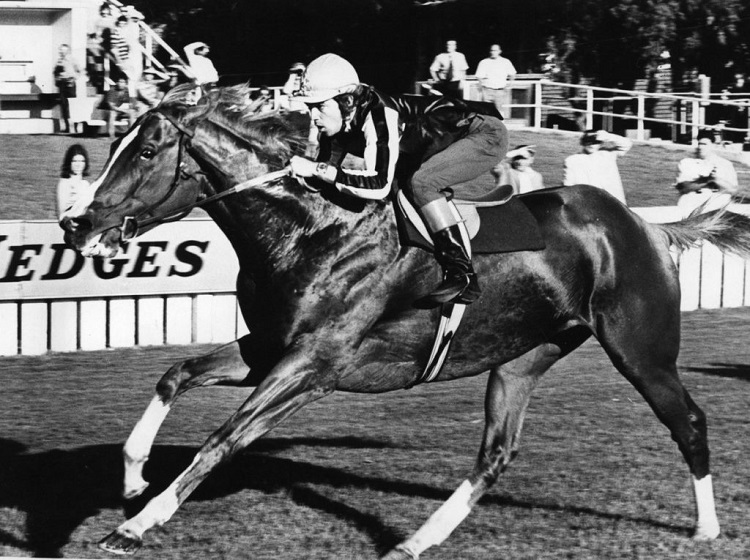
Gatecrasher putting up possibly the best public gallop in SA history before winning the 1975 Met under Garth Puller. His pickup horse, the Gr2-winning sprinter Glenever, had torn off at the 1000m mark and apprentice Paddy Wynne eventually gave up trying to hold him. Wynne was contemplating the roasting he was to be given when to his astonishment Gatecrasher, who had jumped from the 1800m mark, bounded past him and beat him by five lengths!
Conclusion
With the sophisticated camerawork at sporting events we have today, opinions can often be backed up with indisputable proof.
But even considering the reel film used on the day it seems that if there was any incompetence involved in the controversy it came from the jockey club’s imprecise filming of the race.
Owing to that it seems that unless dramatic new evidence comes to light, the 1975 July debate is likely to rage on without ever being conclusively resolved.
One good thing did at least arise from the controversy. Three weeks after the race a running rail, about two or three metres away from the public rail, was erected and remains there today.
