



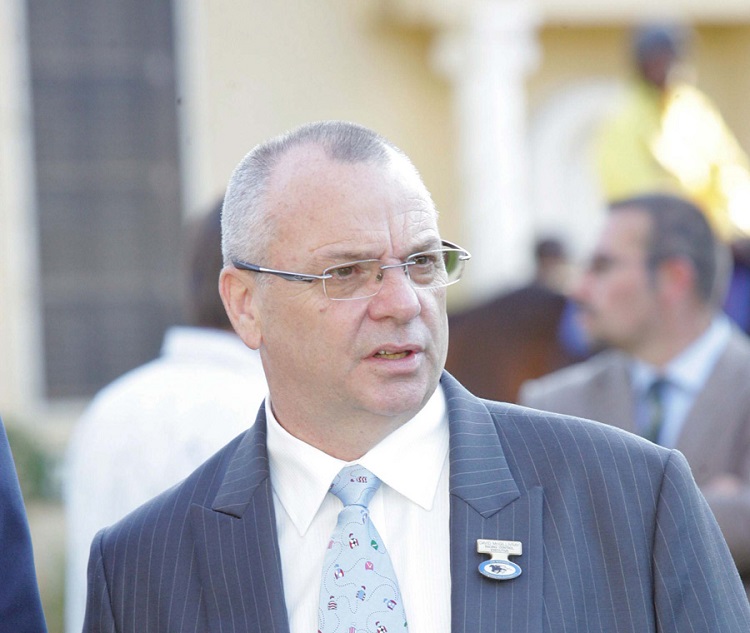
The much admired stipendiary steward David McGillivray has passed away.
He had been working as a steward in Malaysia.
In November 2014 he announced his resignation from the NHA having returned from a stint overseas in March the previous year to be Racing Control Executive and Director of the National Horseracing Authority (NHA).
The article below was written upon the announcement of the latter resignation.
It gives an insight into the impact he always made wherever he worked in the world.
Stating “personal reasons” his resignation is effective from next January and he will be taking up a new position overseas. McGillivray has over 25 years’ experience as a stipendiary steward and will be sorely missed as the NHA have without doubt upped their game since his appointment.
After returning from an overseas stint, he had noticed that standards had slipped and immediately set about reversing the trend. The stipendiary reports for each racemeeting have been much more detailed since his appointment and other improvements, such as providing information to the public as soon as possible after a race, have been implemented.
The NHA have also taken a noticeably tougher stance in out of competition testing for performance enhancing substances and on “non-triers”.
He said of the information dissemination, “It is important to be proactive. For example, if a horse bled, the information must be disseminated as fast as possible as it could put out a spark before the fire. Sean Parker (the chief stipendiary steward in KZN) has been very good at getting this sort of information out quickly. We have spoken to the television producers as we would like to get important stipendiary information out consistently between races.”
On out of competition testing, he said, “It is very important to level the playing fields and the more this can be achieved the better it is for racing. An increase in out of competition testing is definitely the way the world has been going in all sports.”
Raids on yards are being done unannounced nowadays, although in the interests of fairness and transparency the stipendiary stewards will always wait for a trainer or assistant to be present before, for example, extracting a blood sample from a horse.
McGillivray’s pet hate is form inconsistency and he has given a recent directive to clamp down in this regard.
He said, “A trainer saying that the explanation for a below form run is that the horse ‘needed the run’ is not acceptable. Saying that it was the horse’s first run after a layoff is not going to help the punter who backed it at 5/2. Maybe in this sort of case we need to watch a horse gallop before it can be allowed to run again. We have an obligation to the punting public and a horse must arrive at the races fit. We also need to determine whether the excuse is what the trainer really means. These are the sort of run of the mill things we must chip away at.”
Objections are another aspect where consistency is vital. Workshops are held every couple of months in which all of the stipendiaries around the country go through all of the recent objections in each centre together, although this was implemented before McGillivray took charge.
During McGillivray’s control, there have been some heavy penalties dished out under rule 62.2.1 which states that a jockey should take all reasonable and permissible measures to ensure that a horse is given a full opportunity to win or obtain the best possible placing. McGillivray has praised the stipendiary stewards in all South African racing centres for their support and efforts in implementing the improvements.
He said, “The NHA had been through a tough time as we have lost a lot of talent in a short period and in this field they are not easily replaced. It takes several years before a new employee in such a position can reach the required level. However, in all centres there has really been an effort to up the game and their support for the changes we have tried to implement has been fantastic.”
The stipendiary stewards of yesteryear are often remembered and reminisced about and statements such as “it would never have happened when he was chief stipe” are common place.
However, McGillivray touched upon how different the world was 25 years ago. He pointed out that two key aspects of society, discipline and respect, have changed for the worse and as a result life was generally a lot tougher these days.
He said, ”You just have to look at the way people dress to go to the races these days and you can also look at something like the July objection. There were three highly qualified stewards making that decision and that was their opinion, so you don’t have to agree with it, but it should at least have been respected. These days people have a tendency to get personal and to sling off.”
McGillivray is strong in his views on the obligations the NHA have to punters knowing that the happier they are the better it will be for the industry.
He has provided help and direction to the stipendiary stewards underneath him and the respect he has earned from the latter is one reason why his all too brief reign has made a difference.
Born in Mongu, Zambia, David Hugh McGillivray grew up in the country of his birth, as well as in Zimbabwe and Ireland.
David, who was 69 years old, had Irish heritage and attended school in Ireland before graduating from Gwebi College of Agriculture in Zimbabwe. He began his career in agriculture, specializing in land irrigation.
His journey in horse racing started in 1987 when he became a stipendiary steward in the Eastern Cape. In 1990, he moved to KwaZulu-Natal (KZN) and served as senior steward until 1993. The following year, he became Deputy Chairman of the KZN Stipendiary Board.
In 1994, David was appointed Deputy Chairman of the Central Provinces (Johannesburg and Vaal/Bloemfontein/Kimberley) and later became chairman.
The Sporting Post reported in 1994 that David McGillivray, then chairman of the Gauteng stipendiary board, had cracked down on trainers taking liniments and suchlike into the security areas at racecourses. Jockey Club rules prohibited any substances being taken into the security areas and McGillivray warned that he intended to enforce the rule strictly after two trainers were found rubbing substances on their horses’ legs before races.
In 1996 he moved to Malaysia, where he worked as a stipendiary steward until 1999 and later became Chief Stipendiary Steward, serving from 1999 to 2003. He held the position of Director of Racing Operations and Professional Racing Steward from 2003 to 2006.
David returned to South Africa as Chairman of the Western Cape Stipendiary Board from July 2006 to October 2007. He was persuaded to return to Malaysia, serving as Chief Steward from November 2007 to August 2009 and as Professional Racing Steward from September 2009 to February 2013. He returned to South Africa in March 2013 as Racing Control Executive and Director of the National Horseracing Authority (NHA).
In 2014, David moved to Qatar, where he worked until 2021. His final role was back in Malaysia as a steward until his passing.
On one occasion in Malayia David was attacked by thugs attempting to intimidate him and this left his arm disabled.
He will be sorely missed by the worldwide racing fraternity.
He had extensive knowledge and was sought for his unique capabilities by a number of racing jurisdictions around the globe.
