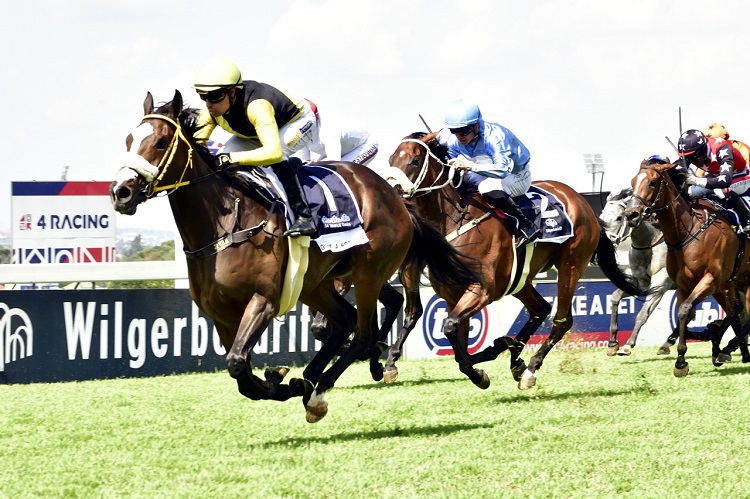
"Gimme A Nother Will Go The Oaks Trip"


Double Superlative Retired - Watch Video Of His Incredible Career
Owner Nick Jonsson congratulates Double Superlative after his WSB Cape Town Met victory (Image: Wayne Marks)
Owner Nick Jonsson said after the WSB Cape Town Met that Double Superlative had likely run his last race and added that he definitely had a future at stud.
This was made official today but Jonsson has not yet decided which stud farm the Twice Over five-year-old will stand at.
Double Superlative’s Met win was against all the odds.
He was diagnosed as unlikely to race after sustaining a serious tendon injury just before the Gr 1 Daily News 2000 as a three-year-old.
He later survived a terrible colic attack.
Justin Snaith pulled off an unbelievable training feat two Saturday’s ago with the help of Daniel Muscutt, who became the first overseas-based jockey to win Cape Town’s most famous race and it was voted by Turf Talk readers as the Emperor’s Palace Ride Of The Month.
Handicapping Updates - Gimmethegreenlight Stars Top 3yo Ratings
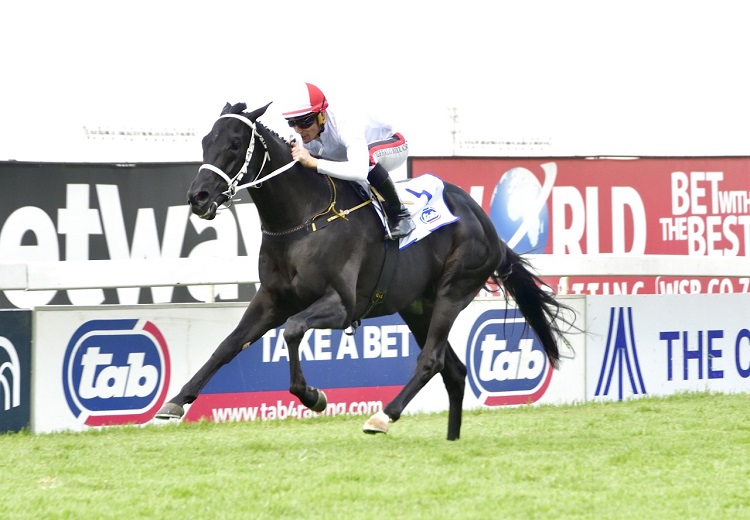
Sandringham Summmit is out on his own in the Gr 2 TAB Gauteng Guineas (JC Photos)
The David Nieuwenhuizen-trained Gimmethegreenlight colt Sandringham Summit is now the top rated three-year-old in the country on 123, while the Mike de Kock-trained Gimmethegreenlight filly Gimme A Nother, who is the top rated three-year-old filly in the country, joins the Tony Peter-trained Pathfork gelding Main Defender on 121
NHA Press Release
Tab Gauteng Guineas (Grade 2)
Top rated, SANDRINGHAM SUMMIT had his rating increased from 121 to 123 after easily winning the Tab Gauteng Guineas (Grade 2) over 1600m on the Turffontein Standside track on Saturday. The Handicappers were of the opinion that 4th placed PURPLE PITCHER made for the most suitable line horse here and his rating remains unchanged on 114. The Handicappers noted that PURPLE PITCHER did appear to replicate his Grade 2 Dingaans form here as he beat GIMMEANOTHERCHANCE and THE AFRICA HOUSE by similar margins.
2nd placed HOTARUBI as well as 3rd placed WILLIAM IRON ARM were adjusted to a rating of 116 from 98 and 94 respectively. They both beat the line horse PURPLE PITCHER rated 114 by a full length on level weight terms here which equals to a 116 performance.
There were partial rating increases for STORM BRASCO who went from 91 to 104 and NAVAJO NATION to 103 from 93. This ensures that all of STORM BRASCO, NAVAJO NATION, THE AFRICA HOUSE, MONDIAL and HOUSE OF ROMANOV are ranked correctly in the pecking or balloting order.
The following horses received ratings drops, GIMMEANOTHERCHANCE from 112 to 111 and THE AFRICA HOUSE to 102 from 103.
Wilgerbosdrift Gauteng Fillies Guineas (Grade 2)
Top rated, GIMME A NOTHER was adjusted to 121 from 120 after making it 5 wins from 5 starts to impressively win the Wilgerbosdrift Gauteng Fillies Guineas (Grade 2) at Turffontein over 1600m on Saturday. 5th place finisher EGYPTIAN MAU who was rated 110 was used as the line horse to rate this contest and remained unchanged on that mark.
The runner up, SILVER SANCTUARY went up marginally from 115 to 116. MY SOUL MATE who finished 3rd beating the 110 rated line horse EGYPTIAN MAU by 2,5 lengths at level weights was adjusted to 115 from a rating of 103. Fourth place finisher, LET’S GO NOW was adjusted to 111 from 105 after finishing ahead of the 110 rated EGYPTIAN MAU.
There were also partial increases for CHAMPAGNE COCKTAIL from 102 to 104 and MIA MOO to 103 from 90. MIA MOO had to be capped at a rating of 90 in the Grade 3 Mother Russia stakes due to the race conditions that placed a 3 points cap on placed runners in that race, she actually performed to a similar level here.
There were no drops to ratings in this event.
Enquiries:
The Handicapping Team



Future looks bright for Fourie
Jack Milner (Tab4Racing)
The association between a trainer and a jockey can often depend on past history, the volume of work that jockey will come to do in the mornings, and obviously, availability.
There are cases where a jockey and his agent will see a winning opportunity when studying the card and will then call for that ride.
Looking at Richard Fourie and Kom Naidoo, they have only teamed up with just five runners over the last 12 months and that relationship has yielded two places.
That could all change in Race 4 at Hollywoodbets Greyville on Wednesday when they team up with Future Saint in this Maiden Plate over 1900m on the Polytrack.
This three-year-old son of Futura has had an interesting start to his career, having his first three runs for trainer Dean Kannemeyer. After finishing unplaced over 1200m at Hollywoodbets Scottsville on debut, the Futura gelding was then tried on the Polytrack.
He immediately responded positively to the surface, finishing a 0.40-length second behind Lashlaroo over 1200m. Last month he was tried over 1400m but landed a wide No 10 draw and ended up at the back of the 12-horse field.
He ran on well, producing the fastest final 400m but unfortunately by the time he got going the bird had flown and Future Saint, while finishing second yet again, was still 4.30 lengths behind Kumemori at the post.
It is worth noting that two winners came from that form line.
After that Future Saint moved to Naidoo’s yard and had his first run, again over 1400m on the Polytrack. He once more produced the fastest 400m to finish but ended up in third place this time, beaten 3.55 lengths by Sweeper Keeper.
He now goes 1900m and Fourie will be aboard for the first time. The gelding should love this distance and looks very hard to beat.
Jack Milner’s selections
Race 1: 5 Elegant Act, 9 Emerald Green, 4 One Smart Cookie, 3 Littleblackvelvet
Race 2: 3 Brave Voyager, 6 Few Dollars More, 5 Circle Of Grace, 1 Time Taker
Race 3: 5 Doctor’s Orders, 4 Ingakara, 6 Columbia Road, 1 Burmese Tiara
Race 4: 8 Future Saint, 5 Vihaan’s Bomb, 7 Ocean Palace, 1 The Green Gallant
Race 5: 2 Fine Admiral, 3 Safe Space, 4 Ravens Sword, 9 Zoombomber
Race 6: 2 Trafalgar Square, 4 Griffin Park, 5 Chara Sands, 3 Drogarati
Race 7: 5 Kumemori, 6 Ibutho, 7 Sundance Kid, 3 Midnight Caller
Race 8: 9 Jazz Diva, 3 Mauritania, 5 Flight Maneuver, 1 Star Choice
BEST BET
Race 4 No 8 Future Saint
VALUE BET
Race 3 No 5 Doctor’s Orders
BEST SWINGER
Race 4: 5×8
BIPOT
R216
Leg 1: 4, 5, 9
Leg 2: 3, 5, 6
Leg 3: 1, 4, 5, 6
Leg 4: 8
Leg 5: 2, 3
Leg 6: 2, 4, 5
PLACE ACCUMULATOR
R324
Leg 1: 3, 6
Leg 2: 4, 5, 6
Leg 3: 8
Leg 4: 2, 3
Leg 5: 2, 4, 5
Leg 6: 5, 6, 7
Leg 7: 3, 5, 9
PICK 6
R1800
Leg 1: 1, 2, 3, 4, 5, 6
Leg 2: 8
Leg 3: 2, 3, 4
Leg 4: 2, 3, 4, 5, 6
Leg 5: 3, 5, 6, 7
Leg 6: 1, 3, 5, 8, 9
JACKPOT 1
R60
Leg 1: 8
Leg 2: 2, 3, 4
Leg 3: 2, 3, 4, 5, 6
Leg 4: 3, 5, 6, 7
JACKPOT 2
R300
Leg 1: 2, 3, 4
Leg 2: 2, 3, 4, 5, 6
Leg 3: 3, 5, 6, 7
Leg 4: 1, 3, 5, 8, 9

Captain Bombshell Could Be Going Places
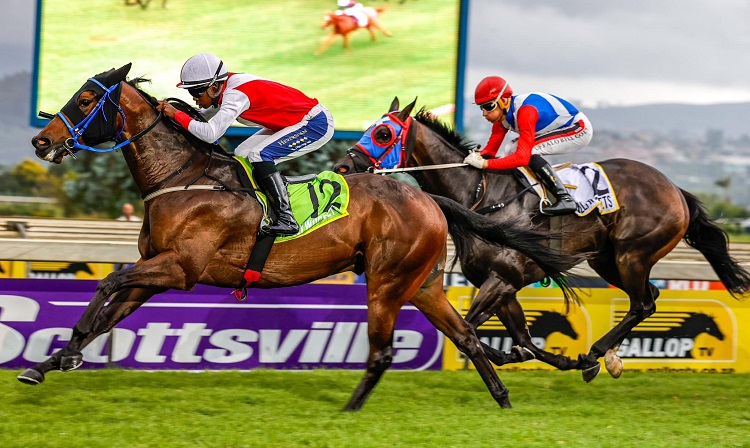
Captain Bombshell causes a 66/1 upset in the Marula Sprint on Sunday at Hollwyoodbets Scottsville (Candiese Lenferna Photography)
The Garth Puller-trained Captain Of All gelding Captain Bombshell stamped himself as a Gr 1 Golden Horse Casino Sprint candidate when winning the Non-Black Type Marula Sprint over the course and distance of that race at Hollywoodbets Scottsville on Sunday, considering he beat the top class 125 merit-rated Corne Spies-trained speedster William Robertson by 0,90 lengths despite receiving only 4,5kg.
Captain Bombshell was officially 7,5kg under sufferance with William Robertson and paid R63 for a win on the Tote, but the performance did not surprise Puller.
He said, “It was very hard to see him beating the favourite, the favourite was handicapped to win.”
Spies has taken advantage of the conditions of certain KZN races this season and was out to score a third successive victory at Hollywoodbets Scottsville, the previous two in Pinnacles Stakes races where he was as well weighted as Sunday.
Puller continued, “However, you must remember Captain Bombshell beat Royal Aussie, who ran third in the King’s Plate this year, and he also finished fourth in the Gr 1 Gold Medallion as a two-year-old.”
Captain Bombshell was bought out of the Peter Muscutt yard by Mauritius-based owner R Chintalloo at the beginning of this season. He was only having his second career start when Muscutt sent him out to run a 3,60 length fourth to Thunderstruck in the Gr 1 Gold Medallion. A few runs later at Hollywoodbets Kenilworth, running off a 95 merit rating, Captain Bombshell received only 1,5kg from Royal Aussie over 1200m and beat him by 1,25 lengths on 7 December 2022. Then on Hollywoodbets Gold Challenge day last year, he won the Non-Black Type SABC Sport Durban Dash over 1100m on the Hollywoodbets Greyville turf by 0,30 lengths off a 100 merit rating, when receiving only 2kg from the usefulo runner up, the Gareth van Zyl-trained Money Heist.
So the form was there for everybody to see and Puller added, “I told my clients my best runner on the day was Captain Bombshell. I said it was hard to see him beating the favourite, but that he is a big runner. The owner phoned me from Mauritius and asked ‘can I have a fun bet on him’ and I replied ‘you definitely must have a fun bet, he’s well’. When your horse is well, you must let them worry about you, you mustn’t worry about them. You don’t know how their horse traveled down, you don’t know how their horse is doing, you don’t know how the form of their stable is, you only know your horse is eating well and working well. So that is why I thought he had a chance … at the weights I could not see him beating Spies’ horse, but he won a nice race. He was very well, he looked well. Last time was a good run, Calvin Habib rode him and he said to me if he had got a run in the last 150m he would have been right there and then he came on from that run too. The kid (Siphesihle Hlengwa) rode a good race.”
Captain Bombshell pinged the gates from draw eleven of eleven and Hlengwa, being in the lead, was able to drift over to the perceived better going towards the inside.
Captain Bombshell strode out beautifully and stayed in front through his natural pace.
Hlengwa began niggling at him at the 400m mark and he went further ahead. He drew the stick just after the 200m mark and five rhythmical backhanders were all that was required to keep him going.
The Michael Roberts-trained Sun Blushed ran on strongly for a 1,60 length third at level weights if Rachel Venniker’s 1,5kg claim is taken into account.
The Carl Hewitson-trained Pray For Rain ran a good two length fourth, considering he was giving Captain Bombshell 4,5kg, and fifth-placed Passage Of Power, who was beaten 2,70 lengths receiving 3kg from the winner, is one to watch in a handicap next time as he is merit rated only 91.
Puller said he would take it race by race with Captain Bombshell, but admitted he would take his chances in the Golden Horse Sprint if able to qualify.
Ishnana also ran yesterday, having won for the eleventh time in his career in his previous start at the age of nine.
Garth said this old soldier was given some relief from the handicapper which had seen him come down from a 104 rating to 81 and this had allowed him to be competitive again. He said the Al Miqdaam gelding kept his condition well, but was at his best in rain softened ground.
Garth said he had 65 horses at present, but there were about ten who were ready to be retired or sold and he did not believe he had a chance of retaining his KZN Trainers championship.
Championships have never interested him and he did say the same towards the end of last season, but still won it.
The KZN Trainers championship is most intriguing this season and the top ten in the standings at present are (wins during the season in KZN): Mike Miller 26; Garth Puller, Wendy Whitehead 25; Gareth van Zyl 24; Alyson Wright 23; Peter Muscutt 22; Louis Goosen 20; Duncan Howells 19; Michael Roberts 15; Frank Robinson 14.
Punters Don’t Want Boring And Predictable, They Want To Feel The Thrill
Picture credit: Clybaunhotel.ie
When we go to gamble, we go to lose because we constantly need to remind ourselves we’re alive.
Neil Andrews (The Citizen)
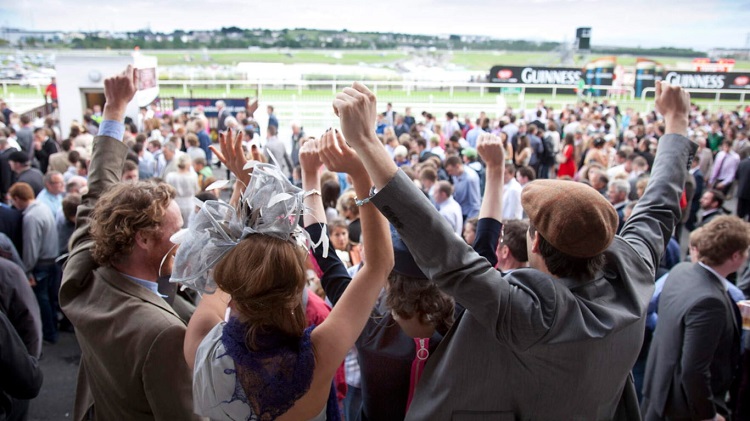
Let’s be honest, as punters we all want excitement. Whether we’re wagering on horses or humans we enjoy a bit of a thrill.
Let me set up two contrasting scenarios.
Scenario 1.
You’ve backed the favourite in a horse race to win X rand. It’s an amount you would consider to be a handsome profit. The favourite jumps well from stall gate 1 and goes into an immediate lead. Turning into the straight your horse quickens off the front and under an armchair ride from the jockey the horse wins going away by six lengths.
Scenario 2.
You’ve backed a 20-1 outsider in a horse race to win the same amount of money that we had in the first scenario. Your horse jumps slowly from an outside stall gate and the jockey has to sit at the back of the field. Turning into the straight your horse is last and has a wall of horses in front of him. At the 400m mark a gap miraculously opens up like the Red Sea and your horse quickens past the field to hit the front. With only 100 metres left the favourite begins to rally and they cross the line together.
The commentator cannot separate the two horses in a bob-of-the-noses photo finish. After an agonising wait the winning number is posted and your horse is declared the winner.
In each scenario you win the same cash and yet I challenge the majority of punters to tell me that, given the choice, they wouldn’t opt for the thrill of scenario 2.
If I asked Walter Abrams, Al Pacino’s fictional character from the 2005 movie Two For The Money, to justify (without the profanity) why it is I would chose scenario 2 he would surely look me square in the eye and spell it out as such:
“Neil, it’s because you’re a lemon. There is something inherently defective in you, in all of us. We’re all lemons. We look like everyone else but what makes us different is our defect. When we go to gamble, we go to lose because we constantly need to remind ourselves we’re alive. It’s the need to feel something, to convince yourself you exist.”
Oddly enough it wasn’t the weekend horseracing but rather the English Premier League (EPL) action that got me thinking about all of this two-bit sports-betting psychology.
After Monday night’s football match, in which defending champions Manchester City were stung early by the Brentford Bees but ultimately prevailed in a 3-1 away win, I had to reach for my son’s calculator.
An astonishing total of 45 goals were scored in the 10 Premier League fixtures played this weekend.
It’s a new record and demonstrates that, if anything, the league is delivering more unpredictable entertainment than ever before.
Whether you support an EPL team, play Fantasy Football, punt on the matches or even just try and predict the scores for free on SuperPicks, it’s not a game for the faint-hearted.
Who in their right mind could have predicted the eight-goal thriller between Newcastle and Luton Town?
That kind of scoreline makes me think I’d be better off investing in a crystal ball rather than spending hours sifting through statistics.
If ever they publish an EPL dictionary, the words “boring” and “predictable” will prove redundant.
As thrill rides go, most Premier League games give off those Walter Abrams “feel something” vibes.
To be fair so has this year’s AFCON tournament; and while the knockout phase has understandably seen less goals the drama has escalated.
I am hoping that Wednesday night’s semi-final between Nigeria and South Africa also proves to be a tight affair and that by hook or by crook Bafana Bafana can progress to the final. My heart hopes, but my little grey cells offer a reality check.
The two nations have met on 12 occasions and the Super Eagles have beaten us seven times. The four draws offer some statistical support for suggesting Bafana might frustrate the red hot favourites, particularly as Ronwen Williams has been sensational in goal, but the fact remains we have only ever beaten the West Africans once in those dozen attempts.
I will try and marry heart and mind and have a few rand on the low on total goals market.
What’s the worst that can happen?
An injury time goal that cuts my ticket. And even then, according to Walter, I’m going to know I’m alive.

Warne Rippon - Racing, Business, Philanthropy - Part 3
Off The Record with Charl Pretorius
Racing, Business, and Philanthropy:
Warne Rippon’s journey of Triumph and Resilience
Part 3
In the third and final part of the Warne Rippon story, we delve deeper into the events that shaped Warne’s love for nature, and how an injury to his star mare Sun Classique turned his life into what was to become a huge venture into conservationism with Buffalo Kloof. He also speaks about the importance of May’s general elections for racing and conservationism.
If you’d like to catch up:
***
As a boy, growing up in the natural landscapes of Grahamstown, Warne Rippon found himself immersed in the world around him. He developed an appreciation for the beauty and harmony of nature. It was during these formative years that Warne’s passion for conservation was unknowingly sparked, influenced by music that celebrated the natural world.
Little did he know that these early encounters with nature and music would shape his future, instilling in him a commitment to preserving the environment that would become a guiding force in his life.
Warne loved the tunes of American singer and songwriter John Denver, and when he was eight years old his mother bought him a guitar. “Denver’s songs appealed to me. He sang about mountains and animals and trees and plants. I played my guitar, tried to sing too and became quite good at it.”
Denver, following many US billboard hit songs in the 1969, began to focus more on sustainability causes, nature conservation projects and humanitarian work. “When I was 10, I wrote to John Denver and invited him to visit us in Grahamstown as he would enjoy the vegetation of the area, forests and grasslands. Of course, I wanted to meet him too. He never visited, but he did reply to my letter!”
***
After Warne had bought the 800-hectare property on the Kowie River in 1999, the Paardekraal (‘Horse Enclosure’), in the same area, came up for sale. This was the old ostrich farm that formerly belonged to Wendy Rippon’s family. Warne and Wendy bought the farm in 2007. Forests of natural bush found on the property contained valuable growths of sneezewood, yellowwood, and ironwood, that would later provide the necessary poles which were used in the construction of fencing. The Kowie River formed one boundary of the farm for a distance of 10 miles.
The marvellous exploits of Sun Classique in 2007 and 2008 diverted the Rippons’ attention away from the Eastern Cape and Warne told: “After she’d won the Sheema Classic in Dubai, we were on a high I cannot describe in words. We were living in a bubble of pure joy and anticipation of more to come. We owned one of the best fillies in the world, if not the best, and she was in big demand from buyers. We could name our price. But having already amassed the equivalent of R29-million, money was not an issue at all. We wanted to add the world’s major prizes to the Sheema Classic. Royal Ascot was coming up, there were major races in Hong Kong and of course the spectacular and prestigious Prix de l’Arc de Triomphe at Longchamp.”
After some discussions, we decided to aim Sun Classique at the ‘Arc’ in Paris, a race we felt she’d be well suited to. It was due for early October, 2008 and this would give her enough time to recover from her Dubai campaign and get back to peak fitness. She went into quarantine in April 2008, and arrived at Mike de Kock’s stable base in Newmarket, UK, in May, where she was given time to settle down.
Mike had penciled in the Group 1 Falmouth Stakes over 1600m at Newmarket on 7 September as a first preparation run into the ‘Arc’, and, after that, Sun Classique was likely to go to France for a final prep into the big race.
Having progressed nicely in the latter part of May and June, Sun Classique was due for a grass gallop early in July. Work rider, Gavin Howes, partnered her on the July track at Newmarket for her first stretch on this surface, alongside Trevor Brown on her accomplished stablemate, Archipenko.
Tragedy struck. It wasn’t immediately apparent, but Sun Classique had injured herself during this gallop. A few hours into that morning, she developed heat and a large swelling on her near fore. She was diagnosed with a strained tendon, something no trainer wants to hear, ever.
Warne recalled: “We were still on cloud nine after the Sheema Classic, still enthusing every day and telling our story to anyone who wanted to hear it. Life was good, business was good. Our days started with a spring in the step, in anticipation of our next racing adventure with Sun Classique. We were ready for the next chapter to be written.
“I was standing in the washroom at Allied Steelrode when Mike’s call came through. I remember the moment, because my knees buckled and I almost passed out. Mike had nick-named me ‘Elvis’ after I’d entertained them on a merry evening in Dubai and he said: “Elvis, we’ve got a problem with the filly’. I briefly thought he was about to report a minor setback, but he said, ‘Sun Classique strained a tendon in work. It’s serious. She might not race again.’”
“I’d learnt enough about thoroughbreds in my time as an owner to know that ‘tendon injury’ means ‘big trouble’ in racing terms. Horses with tendon injuries seldom, if ever, return to the racetrack. Right then, right there, the lights went off in my life. This was a quick, paralysing blow and I fell from a euphoric cloud into a bottomless pit in a matter of seconds. I sat motionless in my office for hours, contemplating what I’d just been told.”
Mike and his team at Newmarket decided, as a last resort, to send Sun Classique to a horse rehabilitation facility in Newmarket. The centre’s manager, David Chapman-Jones, was optimistic about a recovery in the first few weeks, but hope gradually faded.
Warne said: “I flew to the UK and spent five weeks with Sun Classique in Newmarket while they were giving her controlled exercises at the rehab. Those were dark days, but I learnt a lot being by her side. She was intelligent, she knew what was happening and she tried hard to help us, to help her.”
After several weeks, the team threw in the towel. The recovery process was taxing on Sun Classique and the tendon wasn’t healing to the extent that enough encouragement could be given for a full recovery. Sun Classique was retired and Lionel Cohen was quoted in the media as saying, “I don`t want to let the disappointment spoil the fun we’ve had. The bond and enjoyment she has brought to my friends and family is priceless and we are now looking at the bright side of just how blessed we have been. She has brought us the greatest moments we have ever experienced.”
Warne added: “The 2008 Prix de l’Arc de Triomphe was won by the Aga Khan’s star filly Zarkova, who beat Youmzain into second by two lengths. Ironically, Youmzain had finished fifth behind Sun Classique in the Sheema Classic, beaten 3,25-lengths. That’s how good she was. Man, oh man, if I just think what could’ve been, had our filly stayed sound.”
***
On 18 January 2024, Warne spoke from his suite at the Peppermill Casino Hotel in Reno, Nevada. He was en route to Nashville, Tennessee, for the annual Beretta & SCI Foundation Conservation Leadership Awards Ceremony on 30 January, for which he was one of six nominees. He’d travelled via San Antonio, Dallas and Reno for various meetings with relevant individuals and authorities in the fields of conservation, preservation and rewilding.
Recalling an incident in Reno, in 2019, he noted: “I’ve always skated on the seat of my pants, but I find it exhilarating, I get fired up by challenges. I came to this gambling city for meetings and one night I was in a casino, not completely sober. I took $2,000, all I had, and sat down to play blackjack. Within 20 minutes I’d won $40,000. I have no idea how I racked up the chips so quick, and the casino’s supervisor interrupted my game. They accused me of card counting. I said, ‘I scored 30% for maths at school, I can hardly count!’, but they asked me to leave, pronto. I walked to another casino on the strip, where I wanted to push my winning streak.”
“Unbeknown to me, the officials at the different casinos are constantly in touch with each other. I’d barely entered the second casino when a group of beefy guys in suits surrounded me. They were all wired up. ‘Sir,’ said the main man, ‘we want you to leave our premises immediately. That’s the exit, over there. Go now, and do not ever come back!’ My bravado faded at the sight of these big, stern-faced security officials and I carried out their instruction without pausing to argue. My daughter, Hannah, was in our hotel with me. She was stunned by the $40,000 I’d won, but equally surprised when I asked her to pack up so we could leave, in a hurry!”
There was a welcoming party in Reno this time and Warne said. “I am very friendly with the owner of this casino resort, I am safe and I’ll be at the Wild Sheep Conservation Show here for a few days, networking. The show fills 75,000 square feet of wall-to-wall exhibits designed to celebrate the great outdoors and raise money for the conservation and management of wild sheep.”
Conventions like these are a part of Warne’s life now. He travels around the world to promote his farm, Buffalo Kloof, and to raise money for his own conservation efforts.
A lot has happened since Sun Classique’s career ended in September 2008. The partnership sold the mare for $2-million and she was sent to a top breeding farm, but she sadly died of colic before she could produce a foal.
“This was an extra tragedy in the hardest time of my life. While Sun Classique had contributed greatly to our later expansion of Buffalo Kloof, her death was a serious first blow in a series of blows. Things went pear-shaped. In 2009, Wendy, Hannah and my son, Taylor, were involved in a hijacking on their way back from the children’s school in Johannesburg. Not long after that, they survived a robbery by a group of eight thugs at our house. To top it all, I was hurt in a motorbike accident.”
The family made a life decision. Within a month, they wrapped up matters in Johannesburg, packed their bags and moved to Grahamstown. Whilst safer and perhaps more content, Warne was troubled and didn’t like their new house and the commuting to his business in Johannesburg. He recalled: “Our lives were uprooted and, with Sun Classique still on my mind and her death as a catalyst, I spiralled into clinical depression for more than five years.
“We bought more racehorses and found a decent gelding called Umgiyo, raced in partnership with Arun Chadha. Umgiyo won a minor race in Dubai and was good enough to race on Dubai World Cup night in 2015 at a time when I’d reached my lowest point. Being there again, among all those memories, must have triggered something, and I was on the wrong medication to boot. I went up to the top floor of the hotel building and wanted to jump from it. It was tough, I was mentally wrecked. My best mate said, ‘Sun Classique was just a horse man, get over it!’”
Still, in her absence, Sun Classique had aided in the gradual recovery of her former owner by providing funds for the development of Buffalo Kloof. There were no plans for the farm when the Rippon family moved from Gauteng, but by living so close to nature they were soon consumed by grand ideas.

Above: Buffalo Kloof
For rewilding, Warne acquired a further 16 title deeds and joined his new land, the farmlands and areas of the pristine untouched thicket, into a large conservancy. He was also able to introduce the first white rhino to the farm in 2010, when rhino poaching was at an all-time high and rhino protection came with a lot of security risks.
“Little did we know then that rhino conservation would be at the centre of our mission today. Rhino are the heart and soul of Buffalo Kloof, as the whole project has almost formed around them. My involvement with Rhino helped me to get out of the hole I was in. The farm’s White Rhino population has flourished. Our anti-poaching teams operate with relentless dedication, 365 days a year, to create a safe space for rhinos to roam.”

Above: Some of Buffalo Kloof’s resident rhinos
Buffalo Kloof, today, is situated in a 700km long sweep of land at the bottom right corner of the continent: a biological melting pot where five of South Africa’s nine great biomes come together. The thicket biome is at its heart, a rich and mysterious world of well-armed shrubs, tough succulents and tangling vines. It offers a greater variety of plant forms, life histories and lineages than any other region in Southern Africa.
Long-neglected by naturalists, the thicket was only recognised as a biome in its own right a few decades ago, yet it dates back more than 50-million years. This thicket is remarkable for more than its ancient origins and impressive plant diversity. It is also resistant to fire, has the ability to create its own microclimate and can build up nutrients through leaf litter. This means that, despite receiving only modest rainfall, it has an impressively high biomass.
Buffalo Kloof is a veritable Eden of diverse flora, fauna and ecology; home to four different flora biomes as well as hosting four members of the Big Five – elephant, black and white rhino, Cape buffalo, giraffe and leopard. Buffalo Kloof also boasts a variety of smaller and unusual species of animals and birds.

Above: Buffalo Kloof buffalo
In 2017, Warne relocated a family group of 10 elephants from Shamwari and two bulls from Kwandwe private game reserves, both also in the Eastern Cape, to Buffalo Kloof. This marked the return of elephants to the Kowie River Valley after an absence of 150 years.
In 2019, Buffalo Kloof partnered with the World Wide Fund for Nature (WWF) and the Eastern Cape Parks and Tourism Agency (ECPTA) in joining the Black Rhino Range Expansion Project (BRREP). As part of BRREP, the farm became custodians of the first black rhino to live on community land. With a favourable habitat, stringent anti-poaching measures, and the assistance of countless conservationists, this founder population is established and thriving. The dense Kowie River thicket provides them with an abundance of food.
Since 2019 Buffalo Kloof has rewilded three captive-bred cheetah who now successfully hunt on their own. One of the females, who goes by the name of Khatu, raised 11 cubs in the first 36 months of the rewilding.
Warne said: “We will introduce lion in time. Lions are cats, they breed fast and they eat a lot, which impacts greatly on the food available for other species. They have to be strictly controlled, culled. Our mission at Buffalo Kloof is to become a leader and pioneer in proving that you can support ecotourism and photographic safaris at the same time as hunting practices. Hunting adds a financial value to wildlife and, without it, wildlife conservation would be restricted to a select few photographic or eco-tourism reserves. Adding value to wildlife allows mixed operations, game farms, livestock, and enterprises to thrive without conflict. If wildlife has value, in turn it is protected and conserved, which ultimately leads to conservation.
“Buffalo Kloof now needs support from people around the world, whether they are sustainable hunters, or people going on photographic or eco safaris. Every person who visits Buffalo Kloof ultimately becomes a part of our rewilding mission. Through this support we can work on expanding Buffalo Kloof, which in turn means protecting more thicket and ultimately creating a bigger area for additional black rhino, elephant and other wildlife. Conservation and the preservation of a place like Buffalo Kloof is tremendously important for the planet.”
Buffalo Kloof has two luxury lodges for visitors to choose from – Spekboom Bush Camp has 8 bedrooms and Rhino House has 4 bedrooms. Both offer a private and personal stay with a focus on minimising the farm’s carbon footprint. “I source new clients on my travels, and introduce them to our farm,” Warne told. “Money pays bills. Overseas visitors, paying in dollars, keeps the operation going.”
***
Warne recently returned from Rwanda and said: “Things are going so well, they have rebuilt Rwanda into a thriving hub with good governance. They call themselves, ‘A Nation of Doers’, and they truly get things done. In South Africa, we have a government of consumers. They are ‘takers’, not givers, and what they’ve done is horrific.”
“I went to the Union Buildings in Pretoria recently, the home of our government. They didn’t have working toilets and they haven’t had them for years. There are Porta-Loo’s, made available via tenders for friends. That’s an example of the culture that has been established here, and it is wrong on so many levels.”
“It is vital that we put a responsible government in place during the coming elections. Africa is the black sheep of the world. The major political and economic powerhouses are increasingly hesitant to deal with us. Our leadership’s mismanagement affects everything, and it will only get worse if they remain in power. But I have hope. I think the people have had enough.”
“Tourism in South Africa is on the brink of an explosion. It can be massive, a monumental boost to the country. But for this to happen we need the Big Five to be protected at all costs with assistance from a good, caring government. Along with that, a complete shake-up of the justice system and the police service. There are mountains and rivers everywhere in the world, so tourists come here to see animals and spend the money needed to keep conservation going. But they want to be safe. If we lose our Big Five, people will lose interest and tourism will die. Africa will become an insignificant continent.”
***
Returning to racing, Warne comments, “There is definitely some good new interest in racing in this region from all sections of the population, and we need to bring the sport to the people. I was encouraged by 4Racing and Betway’s efforts at the Summer Cup, and they’ll do so much better at a new venue with a smaller grandstand area that will house fewer people and therefore won’t look so empty. Changes like these will make a difference. Pound for pound, racing is an affordable form of entertainment. It is catching on again, and a new venue will be a foundation for a major revival.”
Most importantly, he believes, the ongoing bloodstock export problems need to be solved so that our breeding industry can grow, and the rest of the industry will flourish. “We have enemies out there. In my view, the Australians especially don’t want our horses to race over there. They are scared of us. We need lots of money to make inroads and I’m not sure we have enough of it.”
“We can’t export meat, we can’t export fruit, we can’t export horses. This is as a result of problems and hold-ups on official, decision-making levels and in government. It will get to a stage where trading partners say, ‘no more’! This is a rotten state of affairs.”
“If we can export our horses and our owners can take their runners overseas again, dreams will be fuelled, new partnerships will be formed. We will win the big overseas races again and winnings will be re-invested in our racing industry and our country. The potential is huge. We have some of the most talented horsemen- and women in the world, with horse owners who will come to the party if the conditions improve.”
***
In his spare time, and with his kids having successfully taken on management responsibilities, Warne watches some of his and partner Arun Chadha’s 50 runners in training, on the big screen in his revamped Buffalo Kloof home. He places bets all the time and said: “I love the game. It gives me a rush of adrenaline and I am good at winning. But I lose, too, and my wife doesn’t like it when I do. We have an agreement now that she takes 10% of my winnings and 20% of my losses. She’s coining it!”
Wendy also suggested a few years ago that Warne starts, ‘another project’ to keep him occupied (and perhaps away from his betting accounts). “I said, ok, and we planned and then opened a boutique butchery on the farm. The equipment alone required big outlay. We also hired a master butcher. This venture gave us so many headaches, I started calling Buffalo Kloof Butchery, the ‘F*****g Butchery!”
“The butcher’s business has turned the corner, it’s starting to do well, but it took a lot of effort and investment. Now, every time Wendy walks in on me when I’m watching races and having a bet, and she looks at me funny, I say, ‘Shall we start another project?”
The Beretta & SCI Foundation Conservation Leadership Awards Ceremony is held annually in the United States to honour those unique individuals who represent the ultimate embodiment of the hunter-conservationist philosophy and demonstrate a lifetime of commitment to wildlife conservation and education through volunteer service and philanthropy. Warne Rippon was the first nominee ever from Africa, one of six nominees this year.

Above: Warne Rippon with his Wife Wendy, children Hannah and Taylor, at the Beretta & SCI Foundation Conservation Leadership Awards Ceremony, January 2024
*In the writing of Warne Rippon, Part 3, I borrowed extensively from reading material provided by Buffalo Kloof and from their website, for which I give thanks. – Charl Pretorius.


Bass-Robinson Four-timer, Domeyer Treble, Van Niekerk Double
Jersusaleema Rain (Captain Of All) bounces back to his best under Gareth Wright to deny Dance Variety and give Candice Bass-Robinson a four-timer at Hollywoodbets Kenilworth today (Picture: Wayne Marks)
Candice Bass-Robinson sent out four winners at Hollywoodbets Kenilworth today, three of them ridden by Aldo Domyer.
Grant van Niekerk rode a double.
Bass-Robinson is now on 52 wins for the season achieved at a strike rate of 13.87% and she lies in second place on the national trainers log behind Justin Snaith.
Domeyer is on 36 wins and has the highest strike rate on the log of 21.69%.
Van Niekerk is on 47 wins at 17.54%.
Today’s Question
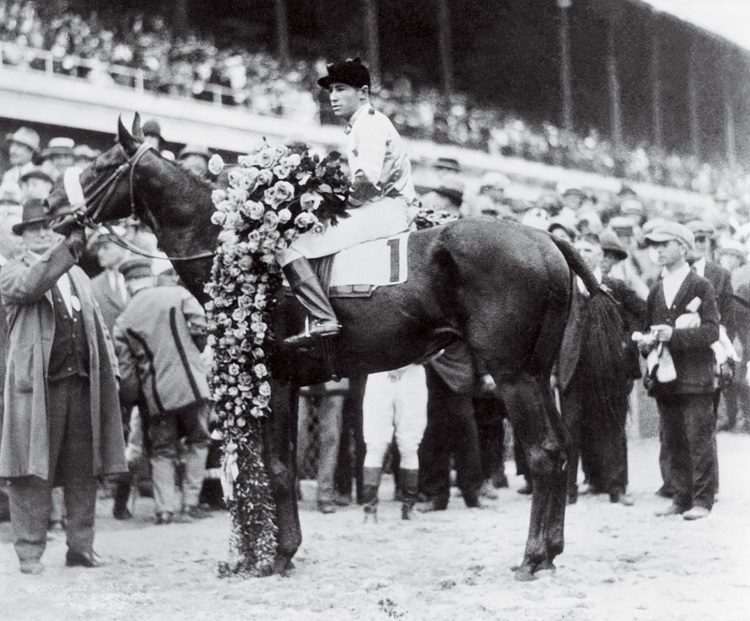
Black Gold (Photo: Via Gardenandgun.com Photograph Courtesy Of Churchill Downs Incorporated / Kinetic Corporation)
What unique feat does the Kentucky Derby winner of 100 years ago in 1924, Black Gold, still hold?
Today’s Question Answer
Black Gold is the only Oklahoma-bred horse to ever win the Kentucky Derby and he has a fascinating story behind him.
He was owned by a full-blooded Osage Indian, a tribe whose tragic story of that period is told in the recent Martin Scorsese movie Killers Of The Flower Moon.
Read the Story of the legendary Black Gold below:
Sporting South (gardenandgun.com)
The Legend of Black Gold
An unforgettable Indian horse that gave it all—and more
By Winston Groom (written in 2008)
At the fair grounds in New Orleans, where the fabled Stewball ran, two solitary markers rise in the infield down the homestretch right beside the sixteenth pole. Beneath one lies the dazzling stallion Black Gold, the “Indian Horse” who ran to glory in the 1924 Kentucky Derby, and whose owner, Rosa Magnet Hoots, was a full-blooded Oklahoma Osage. Beneath the other lies Pan Zareta, a brilliant Texas filly who never lost a race against Black Gold’s mother.
It is a saga reaching back a solid century, as poignant as any in horse racing history.
When I was a boy, my parents would take me to New Orleans during the winter season at the Fair Grounds. We’d go from Mobile by train, on the old Hummingbird of the Louisville & Nashville line, breakfasting in the dining car, with its steam-fogged windows, linen-clothed tables, heavy railroad silverware, and white-jacketed waiters serving up hot pancakes and syrup. We always stayed at the Hotel Monteleone on Royal Street, with its magical Carousel Lounge where the big circular bar still turns ever so slowly on machinery from the 1890s. My father would let me sit beside him and enjoy the ride, sipping Coke or ginger ale through a straw — despite the fact that the legal drinking age in New Orleans at that time was approximately eleven.
Out at the racetrack it was always cold. In fact, New Orleans can be the coldest place on earth when a Texas blue norther combines with the thick Delta moisture to chill you to the bone. While my mother and the other wives went shopping, I would sit in the bleachers with my father and his friends in their overcoats and soft wool scarves and felt hats, watching the races through binoculars. Sometimes my dad or one of the others would even place a bet for me. I remember noticing the two small marble tombstones in the infield and asking about them, but nobody in our crowd knew anything about them. Once we asked some other people in the stands, but they didn’t know either. It was just “some horses,” they said.
Two decades passed before I learned the story. By then I was a young reporter at the Washington Star, and one of the men working the night shift was John Schultz, a gentle and erudite copy editor from Baltimore who had graduated from the Columbia School of Journalism and who, in whatever he claimed as spare time, was an inveterate railbird, handicapping horses around the East Coast tracks. When he found out I was from Mobile, he asked if I had ever been to the Fair Grounds and whether I remembered the little gravestone in the infield. I told him that there were actually two monuments, which surprised him, and that they had always been a mystery to me.
That night he told the story of the legend of Black Gold, a small, spindly horse of dubious lineage, with the heart of a Seabiscuit and the courage of a Man o’ War. It is a tale of poverty-to-riches-to-triumph, as well as one of malfeasance and indifference — even cruelty. In fact, it is the story of two horses, of how they lived and how they ran, and how they died and came to be buried side by side at a New Orleans racetrack.
In 1907, what is now the state of Oklahoma still appeared on United States maps as “Indian Territory,” home of the once mighty Great Plains tribes as well as the so-called civilized Indians — Creeks, Choctaws, Chickasaws, Cherokees, and Seminoles, who roamed the American South before Andrew Jackson banished them across the Mississippi along what came to be known as the Trail of Tears. There, amid droughts, blizzards, and tumbleweeds the size of buckboards that spun across the windy plains, these Native Americans scratched out a living from the soil, or sold trinkets from the sides of the road until, in 1890, the federal government moved them onto reservations and opened the rest of the state to settlers.
One of these settlers was a hardheaded Irishman named Alfred W. Hoots, who knew good horseflesh when he saw it, and always seemed to have something to prove. In 1907, several things happened to affect the fortunes — or lack of same — of Alfred Hoots. First, Oklahoma began to produce astonishing amounts of crude oil, then much in demand by the U.S. Navy. Second, on November 16 of that year, President Theodore Roosevelt, the Navy’s self-styled patron saint, signed legislation making Oklahoma the forty-sixth state in the Union. Third, also in 1907, a colt was born on an Oklahoma farm, a filly with the eye-catching name of Useeit.
Useeit’s pedigree was dubious at best. Her known lineage went back to the 1860s, and though it has since been questioned, it was not at the time. That is important because the rules require that horses in sanctioned Thoroughbred racing be registered as such, which, as one might expect, makes them a breed apart.
Since the breed’s inception in the late 1700s, all true Thoroughbreds can directly trace their lineage to one of just three fleet-footed Arabian stallions that were named for their owners: the Darley Arabian, the Byerly Turk, and the Godolphin Arabian from Tunisia, who is probably the most famous. These lean, swift runners were brought to England from North Africa and the Middle East to be bred to sturdy British mares, resulting in the spectacular animals one sees on racecourses today: long, strong legs and necks, wide muscular shoulders, heavily muscled thighs and quarters. But their most important characteristics are the stamina and athleticism that it takes to carry the weight of a man (and more recently, a woman) on their backs at breakneck speeds near 40 mph around an oval racetrack a mile or more long. There are faster sprinters to be sure; a quarter horse, for instance, can outrun a Thoroughbred any day, but only for a quarter of a mile — which is somewhat like the difference between a drag race and the Indianapolis 500.
Suspicious pedigree or not, however, Useeit must have been a thrilling sight to behold when Alfred Hoots first encountered her at the Fair Grounds racetrack in 1909. As a two-year-old juvenile, she had everything he believed it would take to become a champion, and to prove his point he made a trade for her with eighty acres of the hardscrabble Tulsa farmland where he and his Osage wife, Rosa, eked out a living raising cows. Thus Hoots not only achieved every Irishman’s dream of owning a racehorse, but it turned out he had a damn good notion of what it took to make one, since during the next eight years Useeit won thirty-four of one hundred and twenty-two races on the Southwest “leaky roof” circuits, an impressive record by any standard.
Problem was, like so many mares, she could tear up the track for about three-quarters of a mile but then ran out of steam, which simply wouldn’t do for the longer distances. Among her greatest competitors during those times was the venerated Pan Zareta, who won nearly half of her one hundred and fifty-one races, and whom Useeit never managed to best.
True to the deathbed promise she had made, the widow Hoots sought out the stallion that her husband had envisioned to produce a champion
Hoots, however, convinced himself, and insisted to anyone who would listen, that if Useeit could be bred to a stallion of uncommon endurance, the resulting progeny would, of all things, win the Kentucky Derby, which was then, as now, the most prestigious horse race in the world. But a dilemma kept Hoots from proving it: First, after giving foal, a racing mare is usually no longer a viable candidate on the track; second, Hoots didn’t have the money to pay for a stud fee anyway — at least not for the horse to which he wanted Useeit bred.
Hoots tried to solve part of the problem himself in 1916 when, perpetually short on cash, he entered Useeit in a claiming race in Juarez, Mexico. Under the rules of a claiming race there is no entry fee, but a price is put upon the horse, and when the race is over, anyone who pays that price can buy the horse. Hoots thought he had the bet covered because of an unspoken rule among horsemen that when an owner enters his only horse, no one will claim it — no matter what the price. But as bad luck (and bad manners) would have it, someone did. Hoots solved that problem by brandishing a shotgun and refusing to hand Useeit over — with the predictable result that both Hoots and horse were banned for life from the racing circuit.
In Hoots’ case that wasn’t very long because the following year he found himself on his deathbed, where he extracted a promise from wife Rosa that she would try her best to come up with the money to breed Useeit to the spectacular Kentucky stud Black Toney, known for his ability to finish what he started — namely a mile-and-a-quarter-long horse race, which also happened to be the running distance of the Kentucky Derby.
For two years after Hoots’ death in 1917, the banished Useeit languished in the horse pasture until, in 1919, fortune smiled on Rosa Hoots. It arrived in the form of a sho’ nuf’ Oklahoma gusher of an oil well on some grazing land Hoots had leased from the Osage Nation before he died.
Coincidentally, the year after Al Hoots passed away, and the year before his oil was discovered, the magnificent Pan Zareta also died. Her pedigree was no less suspect than Useeit’s, but between the two they had ridden roughshod over most of their male competition in those early years of the twentieth century. Unlike Useeit, who usually raced in the Southwest, Pan Zareta (or “Panzy,” as she was fondly known — she was named after the mayor of Juarez’s daughter) heard the starting gun from Texas to Kentucky, New York, Canada, and points in between. If you leave out the cynical handicappers, fillies have always occupied a special place in the hearts of racing fans, and Panzy was no exception: Whenever people heard she was racing, they came from miles away just to get a look. In 1917 she took the Oaklawn Stakes, beating the 1914 Kentucky Derby winner Old Rosebud. Although Panzy won few of the major events, mainly because she wasn’t entered, during her exceptional six-year career she took more races than any other mare then on record, earning more than $800,000 in today’s dollars.
After seven years of racing, Panzy’s owners decided to retire her for breeding, but when it was discovered she could not foal, they sent her back to New Orleans to train for upcoming Fair Grounds events. There, she contracted pneumonia and died on Christmas Day, 1918, and because she was so beloved by the fans, she became the first horse to be buried in the Fair Grounds infield, an honor that was bestowed only once more.
True to the deathbed promise she had made, with her oil money the widow Hoots sought out the stallion that her husband had envisioned to produce a champion. In 1920 Useeit was shipped off to Lexington, Kentucky, to meet Black Toney, a descendant of the immortal British racehorse Eclipse, and the premier stud at Colonel E. R. Bradley’s Idle Hour Farm. The resulting colt, born in 1921, was named Black Gold, an Indian expression for the oil that was now making some Oklahoma Native Americans wealthy.
As trainer for Black Gold, Rosa retained an employee on her farm named Hanley Webb, who had also trained Useeit, and who has been described as “old school,” which can mean anything from no-nonsense to hard-hearted. But whatever Webb did with the new colt as a yearling, it definitely showed up in his juvenile year, when he won the Bashford Manor Stakes at Churchill Downs, placed second in both the Cincinnati Stakes and the Tobacco Stakes in Northern Kentucky, and placed third in the Breeders’ Futurity Stakes at Lexington.
From the beginning, Black Gold had as his jockey a New Orleans Irishman named John D. “Jaydee” Mooney, who was so taken with Black Gold’s personality and spirit that he often made the sacrifice of declining to ride other horses. Much to his credit, Black Gold wasn’t quirky or finicky like a lot of racing animals, and showed a willingness to run and a determination to win that endeared him to fans and handlers alike. Though many critics derided the sleek little jet-black stallion as being undersized, his record in 1923 made him a likely contender in the much-touted Kentucky Derby. Then, on January 8, to the fans’ delight, as a three-year-old Black Gold started the New Year with a bang by winning the Louisiana Stakes — his first race in the big time — by six lengths and in a driving rain, too, confirming himself as a first-rate mudder as well.
As it happened, 1924 was the Kentucky Derby’s fiftieth anniversary, or Golden Jubilee, as race officials preferred to call it, and accordingly, momentous changes were announced amid great fanfare. Not only was the race designated the Run for the Roses, but, for the first time, in the opening ceremonies “The Star-Spangled Banner” was replaced by Stephen Foster’s “My Old Kentucky Home,” a song that still causes many native Kentuckians to cry into their mint juleps even before the racing begins. Also, a spectacular new trophy was fashioned that remains the standard design to this day: a nearly two-foot-tall, three-and-a-half-pound solid gold loving cup, with a horse and jockey on the lid.
With the Kentucky Derby’s future thus fortified and “the most exciting two minutes in sports” upcoming, racing fans watched Rosa Hoots take her seat in one of the owner’s boxes at Churchill Downs — the first Native American and only the second woman to do so — ironically, in a year that saw Congress pass the Snyder Act, granting U.S. citizenship to all American Indians. Out on the smoothed dirt track, nineteen edgy horses were led to their places at the starting line — among them the sensational Kentucky blueblood Chilhowee, holder of the fastest 1 1⁄8 miles on record and with a pedigree from Great Britain that would reach to the moon.
When the starting pistol was fired, Black Gold stumbled at the rail and it got worse from there. Hemmed in but still tracking the leaders, he was bumped, fouled, and thrown off, but recovered to shoulder free on the outside and gain on Chilhowee, who seemed to have the race neatly bagged along the rail. In the stretch it was Black Gold and Chilhowee neck and neck, but Black Gold was not to be denied. Jaydee Mooney asked for more and Black Gold gave it all, bursting across the finish wire a half length ahead at 2:05:20. It wasn’t a pretty race, and a lesser horse might have faltered, but as the esteemed racing chronicler John Hervey wrote, Black Gold “won it in race-horse style after a rough race, displaying rare determination.”
Afterward, Rosa Hoots stood in the winner’s circle with her horse, wearing a gauzy printed dress and her face half covered by one of those funny little 1920s hats that look like a flowerpot turned upside down. She appears in the pictures somewhat embarrassed by all the photographers’ attention, while clutching in both hands the big gold cup that her late husband had promised her in his dying days.
In that era there was no Triple Crown, and while the Preakness and Belmont were undeniably important races, they had none of the cachet they do today. Black Gold was entered in neither of them that year, but went on to win two other derbies, the Ohio and the Chicago, making a total of four in one year — a record that stood for several decades. Moreover, his victory in both the Louisiana Derby and the Kentucky Derby went unmatched for more than seventy years. He finished in the money in eleven of his thirteen starts that year, which is why what happened next seems so puzzling, so unnecessary.
Several years ago I was asked to introduce the movie Seabiscuit at its premiere gala held in Atlanta. During a subsequent conversation with Laura Hillenbrand, author of the brilliant book on which the movie was based, I suggested that she write the story of Black Gold.
“I can’t,” she said, “it’s too sad.”
In two years of racing, Black Gold had earned $110,500 for his owner — some $1.3 million in today’s dollars — an enormous return by any measure. Still, it was customary to keep a horse on the circuit so long as he was viable, or else to put him out to stud, which is what Rosa Hoots did with Black Gold after he developed foot problems. Specifically, at the end of that grueling 1924 season during which Gold ran no fewer than thirteen big-time races, he became hampered by a quarter crack, which is a split in the hoof. It is usually brought on by an imbalance in the foot, and can cause extreme footsoreness and lead to more serious trouble down the road.
Putting him out to stud was, of course, the right thing to do, since continuing to race the horse could only aggravate such an injury. Trouble was, Black Gold turned out to be sterile, a condition not especially uncommon, but an unfortunate one considering that he was a perfect product of his dam’s speed and his sire’s stamina. So, for the next two years he languished in pastures in a kind of horse purgatory, unable to race and unable to mate. By all rights, he should have been converted to dressage, or at least to a saddle horse, so he could spend the remainder of his days enjoying romps across the Oklahoma plains. But for some reason that was not to be, and the blame most likely rests on his trainer, Hanley Webb.
In 1927 it was decided to return Black Gold to the racing circuit. Modern veterinary medicine has ways of dealing with a quarter crack that were unheard of eighty years ago, but perhaps Webb believed that it was not as bad as it seemed, or at least that it would not cause much trouble. But the fact is, racing a horse in such condition is risky: To race, a horse must be in shape, and to be in shape it must train, and training means a lot of hard running, which puts terrific strain on any racing animal — let alone one that has been idle for two years.
Nevertheless, when the 1927 season opened, Black Gold, now a six-year-old, was back on the tracks, where he compiled a record of exactly no wins, no places, and no shows — a humiliating comedown for a former winner of the Kentucky Derby. That, if nothing else, should have told his trainer and his owner that their horse had become an also-ran. What discussions might have taken place between Hanley Webb and Rosa Hoots are lost to history, but when the 1928 season rolled around, Black Gold, obviously still plagued with the quarter crack, again found himself on the starting line, this time for the Salome Purse at the Fair Grounds in New Orleans on a cold January day.
Another horse with his sort of injury might have sulked or shirked, but Black Gold did neither. He was in the running all the way, and thundering down the homestretch trying to make up ground, when his jockey heard the sickening crack that means a broken leg. Even then, he never stopped running, and in one last gallant and astounding effort he somehow finished the race on three legs. But it was too late for anything except to put him down.
Black Gold died that afternoon on the same track where he had won his first race, and where Al Hoots had fallen in love with Useeit back in 1909. He lay barely a stone’s throw from the weathered marble monument that enshrined his mother’s nemesis, Pan Zareta. They said that afterward spectators wandered onto the track, wanting to cut a lock of hair from Black Gold’s mane or tail, and the next day flags were lowered to half staff and New Orleans schoolchildren were let out to attend his burial in the infield next to Pan Zareta.
It is extraordinary when a racetrack acquiesces to such a thing, but in all likelihood it had something to do with the old Kentucky colonel E. R. Bradley, owner of Idle Hour Farm, where Black Gold was sired by his own famous Black Toney. Bradley had purchased the Fair Grounds racetrack a year earlier, and in 1924 he sat in an owner’s box at Churchill Downs along with Rosa Hoots when Black Gold whipped three of his other prized horses in the Kentucky Derby. Nobody ever said E. R. Bradley was anything but a gentleman.
In 1972 Pan Zareta was inducted into the National Museum of Racing’s Hall of Fame, and Black Gold followed her there in 1989. Since then, the Fair Grounds has had its ups and downs, having been destroyed by fire in 1993 and rebuilt, then wrecked by Hurricane Katrina, forcing its racing season to move for a year to the Louisiana Downs in Bossier City. Today the races are back in the location they have occupied for one hundred and forty-four years.
But racing fans no longer have to wonder, as I did as a boy, about those little monuments in the infield. During the winter season at the Fair Grounds, Black Gold was memorialized in a ceremony, and flowers were placed on his grave before the fiftieth running of the 5 ½ Furlong Black Gold Stakes. It was a fitting tribute to an Irishman’s dream and to the small, valiant “Indian Horse” who was mistreated at the last, but always gave whatever he could, right up to the end.