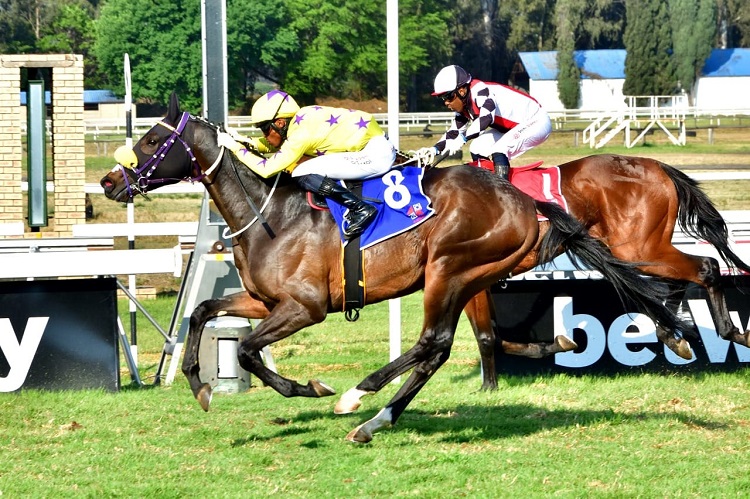
Capsaicin Among Azzies’ Cape String
Capsaicin shows off his big stride (JC Photos).


“Cousin Casey Has Not Done Much Wrong” – Tarry
Cousin Casey (Picture: Wayne Marks).
Sean Tarry’s five entries in the Betway Summer Cup are Cousin Casey, Bless My Stars, Litigation, Nebraas and Future Pearl, but Cousin Casey is the most interesting of them having been talked about as a superstar at this time a year ago.

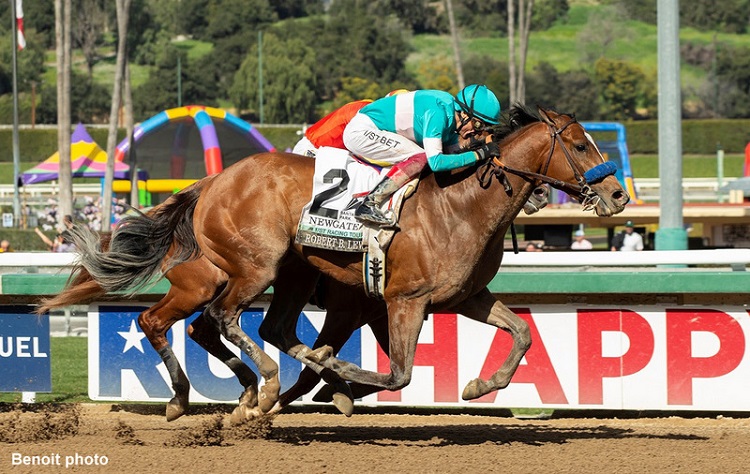
Dettori Shelves Retirement And Will Ride In America
Dettori Calls Off Retirement To Ride Full Time in U.S.
By Bill Finley (TDN)
“I want to travel, Kentucky, Florida, Saratoga, Del Mar, that’s what I want to do, that’s what excites me,” he said. “I’m going into uncharted waters.”
Tattersalls Book 2 Sales Topper From Family Of Former Bass-Trained Horse
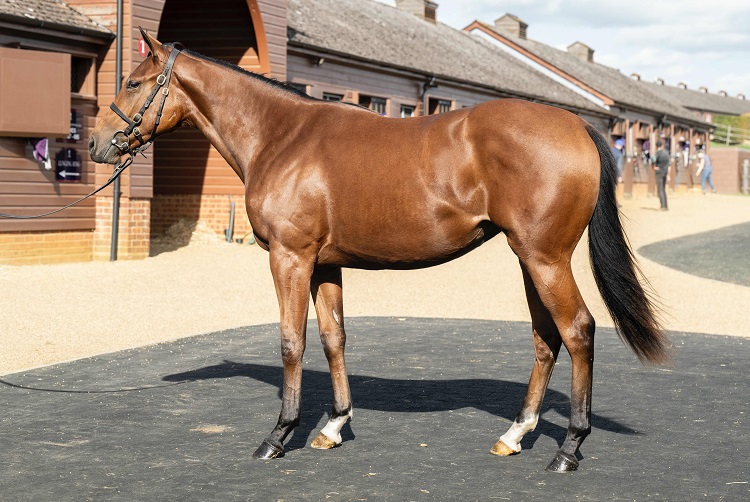
The Dubawi filly who topped the Tattersalls October Yearling Book 2 Sale (Tattersalls.com)
The sales topper at the Tattersalls Book 2 Sale was lot 552A, a Dubawi filly who was purchased by Godolphin for 725,000 Guineas, and she has the former South African-based horse Castlethorpe in her pedigree.
The Australian-bred 2007-born Not A Single Doubt gelding Castlethorpe won nine races for legendary trainer Mike Bass, including the Gr 3 Winter Guineas and he was second to Variety Club in the Gr 1 Rising Sun Gold Challenge.

Miedema Rates Gimme A Prince’s Performance Higher Than Charles Dickens’
Charles Dickens staves off Gimme A Prince (far side) in the Gr 3 Hollywoodbets Matchem Stakes (Picture: Wayne Marks)
The four-year-old Charles Dickens beat five-year-old Gimme A Prince by 0,30 lengths in the Gr 3 Hollywoodbets Matchem Stakes over 1400m at Hollywoodbets Durbanville on Saturday, but respected racing analyst Karel Miedema has awarded Charles Dickens a 113 ability rating for the effort and Gimme A Prince 114.
It can be surmised Miedema does not agree with the South African weight for age scale, which gives four-year-olds half-a-kilogram over 1400m from August right through to October.
Charles Dickens therefore carried half-a-kilogram less than Gimme A Prince on Saturday.
The British weight for age scale does not give four-year-olds any weight at any stage of the season over seven furlongs.
In fact the only distance over which four-year-olds will get weight as late as the third month of the season is over eleven furlongs.
One can only assume Miedema did not believe Charles Dickens deserved to receive half-a-kilogram on Saturday.
However, the highest ability rating Miedema has awarded Charles Dickens in his career is 117 for his Hollywoodbets Gold Challenge run, while his highest for Gimme A Prince is 114, which he has awarded him twice (the other one being for his Golden Horse Sprint victory).
However, that was only the third highest rating he awarded during last season, the highest being 120 for See It Again for his Hollywoodbets Durban July run and Al Muthana 119 for his L’Ormarins King’s Plaste victory.
Meanwhile, Miedema awarded Main Defender a 106 ability rating foir his 6,5 length annilihation of the opposition in the Betway Jo’Burg Spring Challenge. This can be compared to the 109 he gave Charrles Dickens in October last year for his three length Gr 3 Cape Classic win.

Rupert, Cunha, Cheyne Fly SA Flag At HQ On Saturday
Greg Cheyne aboard the Dylan Cunga-trained Silver Sword
South African racing will be represnted at the Newmarket feature meeting on Saturday through the Gaynor Rupert homebred Grand Providence, who is by Nathaniel out of the SA-bred dual Gr 1 winner Same Jurisdiction (Mambo In Seattle), and through Dylan Cunha and Greg Cheyne.
Grand Providence is a three-year-old filly trained by Andrew Balding and she will be ridden by Hayley Turner in the famous Cesarewitch, a Heritage Handicap event over two miles and two furlongs with a first prize of £103,080. A maximum field of 34 face the starter and Grand Providence, who is bred and owned by Gaynor Rupert’s overseas breeding operation Cayton Park Stud Limited, is 10/1 joint second favourite having won the Cesarewitch Trial over the same Rowley Mile course and distance. She runs in the same blue colours with a white square that are the colours for Rupert’s Drakenstein Stud in South Africa.
Cunha and Cheyne team up with Silver Sword in the Gr 3 Earthlight Darley Stakes over a mile and a furlong. Silver Sword won a big Heritage Handicap over a mile at the York Ebor meeting and was not disgraced last time out at Sandown when beaten 3,25 lengths by the famous horse Chindit in a Listed race over a mile. Chindit is a Gr 2 winner and gained notoriety recently when trying to bite Modern Games as the latter passed him late to win the Gr 1 Lockinge Stakes at Newbury.
Cheyne is the regular pilot for Silver Sowrd, who carries joint bottom weight of 9 stone 1 pound in the ten horse field and is quoted at 11/1.
They jump from draw seven in the one mile one furlong event down the Rowley Mile straight.
Remembering The Great Filly Allez France On RWC Quarters Weekend
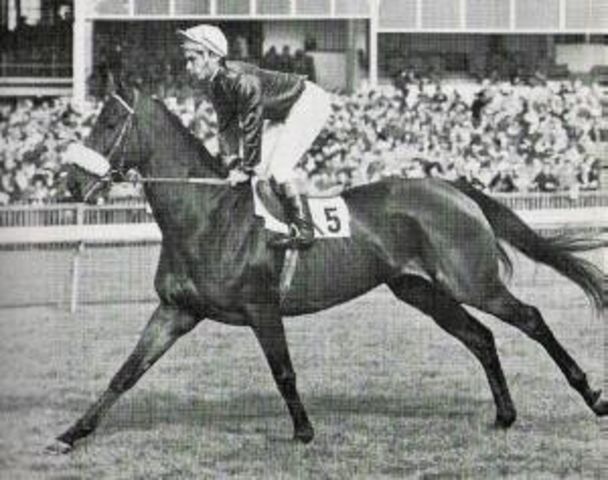
Allez France (Piniterest)
Have 4Racing got their allegiances wrong by naming the feature race on Saturday the Allez France Stakes? After all, the Boks play France in a massive Rugby World Cup quarter final clash on Sunday.
No, they have not, instead the race is named after a famous French filly.
The story of the 1970-born Allez France is intertwined with her great rivel Dahlia and the 2014 article written below by Steve Haskin for BloodHorse encapsulates it.
Remembering Allez France
- 06 July, 2014 8:43 PM
I cannot in good conscience write about Dahlia without also writing about her arch rival Allez France, who, physically and mentally, was everything Dahlia was not. As much as I loved Dahlia, I loved Allez France a little more during their racing days. The reason why will become evident in the paragraphs that follow. As mentioned in the previous column, I really fell in love with Dahlia after her racing days were over because of her connection with my daughter.
First off, Allez France was a daughter of the great Sea-Bird, who I had become enamored with when studying up on European racing and who I visited numerous times at Darby Dan Farm. Considered by many the greatest European horse of the modern era, right up there with Ribot, Sea-Bird was a handsome, elegant liver chestnut who exuded class, and his sheer brilliance was unmatched.
Allez France’s dam, Priceless Gem, had the distinction of defeating the great Buckpasser in the 1965 Futurity Stakes.
It was in 1974 that I left the shores of America for the first time, traveling to France on a charter tour, run by noted DRF cartoonist Pierre Bellocq, known as Peb. Unfortunately for Peb, only four people signed up for the trip, the others being my good friend and DRF colleague Joe Rosen and a couple from Florida, who believed Calder was the most beautiful racetrack in America and who made absolutely zero effort to communicate with the French people.
Having spent my life pretty much confined to trips to Saratoga and Kentucky, I now found myself in the South of France, having sole meuniere for lunch in Marseilles and being driven along the Cote d’Azur, or as we know it the French Riviera, which included the opulent town of Saint-Tropez. We also took in racing at several small provincial tracks.
We then flew to Paris, culminating with our visit to Longchamp for the Prix de l’Arc de Triomphe. I had an emotional stake in the Arc, with the heavy favorite being Sea-Bird’s 4-year-old daughter Allez France, owned by noted art dealer Daniel Wildenstein and trained by Angel Penna, who had left America to train for Countess Batthyany in France, eventually becoming private trainer for Wildenstein, taking over the training of Allez France after her 3-year-old season. Penna would train other top-class Wildenstein fillies Waya, Flying Water, Madelia, and Pawneese. Wildenstein also would own 1983 Arc de Triomphe winner and America’s Horse of the Year All Along, trained by Patrick Biancone.
Allez France had established herself as the best filly in France, and few would dispute her being the best horse in France, male or female. Going into the Arc, she had won nine of her first 13 starts, capturing the prestigious Criterium des Pouliches at 2 and the French One Thousand Guineas, French Oaks, and Prix Vermeille at 3 under the care of trainer Albert Klimscha, while finishing second to the top-class English colt Rheingold in the Arc de Triomphe.
In all four of those races, she defeated fellow French filly Dahlia. While Dahlia reigned supreme in England, Ireland and North America, Allez France was unquestionably the Queen of France. When Allez France soundly beat Dahlia again in the Prix d’Harcourt and Prix Ganay at 4, it was time for the latter to hit the road, where she became one of the greatest international stars of all time. She did try Allez France one more time in the 1975 Prix Ganay, but once again she was soundly defeated by her nemesis.
At 4, Allez France was unstoppable, rattling off victories in the Prix d’Harcourt, Prix Ganay, Prix d’Ispahan and Prix Foy, establishing herself as the favorite for the Arc. Trainer Maurice Zilber was not about to subject Dahlia to another futile attempt to crack the impenetrable wall that was Allez France, so he sent her back to North America, where she would make history by winning the Man o’War Stakes and Canadian International, and finishing a troubled, fast-closing third in the Washington D.C. International, a race she had won the year before.
So, here I was desperately rooting for Allez France, who by now was a national hero in France, especially being a daughter of their beloved Sea-Bird.
Unlike the gentle, feminine Dahlia, Allez France was a brute of a filly who could hammer any male into submission. Elinor Penna, wife of the late Angel Penna, recalled, “She was the most masculine female horse ever; powerful and very proud of it.”
Allez France was such a prima donna, she wouldn’t go anywhere without her pet sheep, ironically named Steve. Even though she would bully poor Steve, when Allez France eventually was sent to the U.S. to compete in the inaugural and short-lived National Championship Handicap at Santa Anita, Steve couldn’t get the proper papers to accompany her, and it was Steve who threw a major tantrum when Allez France left.
Each day, I closely followed the progress of Allez France, eagerly awaiting the race and seeing my favorite filly. Then came the news. About a week before the race, Yves Saint-Martin, the legendary rider who had ridden Allez France in all of her starts, suffered a severe injury in a spill. There seemed no way he could ride, especially in a grueling, competitive race like the Arc. Penna and Wildenstein signed up another all-time great, Lester Piggott, to replace Saint-Martin, even though the French jockey would not give up hope. Piggott remained on call with the understanding that whether he rode the filly or not he would receive the same amount of money as Saint-Martin.
Right up until the morning of the race, no one knew whether Saint-Martin would be able to ride. He was still in pain and had to go 1 1/2 miles against the cream of Europe, and in a 20-horse field.
Among those challenging him and Allez France were stablemate Paulista, an impressive four-length winner of the Prix Vermeille; The Queen’s Highclere, winner of the English Oaks and French One Thousand Guineas; Sagaro, winner of the Grand Prix de Paris and eventual three-time winner of the Ascot Gold Cup; Busiris, winner of the French St. Leger; Margouillat, winner of the Prix Dollar and second to Allez France in the Prix d’Ispahan; On My Way, runner-up to Dahlia in the Grand Prix de Saint-Cloud; Mississippian, fourth in the Irish and French Derbys; and hard-knocking stakes horses Tennyson and Recupere.
Saint-Martin insisted they shoot him up with pain killers some 20 minutes before the race. He announced he would ride Allez France and would be effective as long as he didn’t have to get down and ride her hard. The one thing he needed to avoid was a head-to-head stretch battle. He was confident enough that his filly could win comfortably, and that he could get away with not having any strength in his leg.
Saint-Martin was able to give Allez France a good ground-saving trip with cover. Just before the turn for home, Allez France was eased toward the outside and exploded, making a swift, powerful move, passing horses in a flash and quickly opening a clear advantage. Saint-Martin admitted later he was in so much pain he was unable to hold her and had to let her open up, even though there was still more than two furlongs to go. Saint-Martin, hand-riding his filly, kept pushing hard on her, maintaining the lead over a stubborn Margouillat.
Just when it looked as if he had the race under control and was on his way to a clear victory, from out of the pack came the classy filly Comtesse de Loir, who was under a series of furious right-handed whips.
Comtesse de Loir was gaining with every stride and collared Allez France inside the furlong marker. They came charging right past me, with Saint-Martin still vigorously hand-riding Allez France, and when I saw how far away the finish line still was I felt for sure that Allez France was beaten, as Comtesse de Loir had all the momentum. This was exactly what Saint-Martin was hoping to avoid.
But Allez France, even with a struggling Saint-Martin aboard, pinned her ears and dug in tenaciously and refused to let Comtesse de Loir pass her. They matched strides the rest of the way, with Comtesse de Loir, still under extreme whipping, unable to get her head in front of Allez France, who held her head advantage all the way to the wire in one of the gutsiest performances I have ever seen.
The appreciative crowd, well aware of Saint-Martin’s troubles, gave him and Allez France a rousing ovation. The filly they had come to worship over the past two years had prevailed and they saluted her upon her return. I was so moved by the courage she displayed, and was thrilled to have come all this way to witness such an epic event. And I was going to go home happy having seen a truly great filly put on a memorable show.
Allez France surprisingly returned as 5-year-old, winning the Prix Ganay and Prix Dollar. After a third in the Prix d’Ispahan, she again captured the Prix Foy in her prep for a third consecutive Arc attempt. But she had a disastrous trip in the Arc, getting roughed up in a 24-horse cavalry charge and could only manage a fifth-place finish.
As she did as a 3-year-old, she traveled to Newmarket for the Champion Stakes, but once again finished second, closing fast at the end.
It was then decided to send her to Santa Anita to make her first start ever on dirt in the National Championship Handicap against many of the America’s best horses. She was in contention early, but by now was a mere shell of herself, and combined with the long trip to California, she tired badly to finish last of 11.
Allez France did produce one stakes winner – Action Francaise, winner of the group III Prix Sandringham, but had only four foals who won a total of three races. One of her colts, Air de France, sired 10 stakes winners, including a pair of group I winners in Australia.
Allez France died in 1989 at age 19. She was born the same year as Secretariat and died the same year as Secretariat. She is buried in the Champions’ Cemetery at the Kentucky Horse Park.
European racing was not as global back in 1974 as it has been in the past 20 years, so most Americans were not familiar with Allez France’s heroics, nor are they today. But it was her victory in the Arc, along with San San’s (also trained by Penna) two years earlier that paved the way for the French filly onslaught that saw femme fatales win six of the next eight runnings of the Arc de Triomphe and four of the last six, including the last three.
Allez France in English means “Go, France!” To the French, there was never a more aptly named filly.

Today’s Question
The subject of the question: (Photo source: Sun Sentinel).
Who is the above jockey and what claim to fame did he have last year?
THURSDAY FIELDS
Today’s Question Answer