




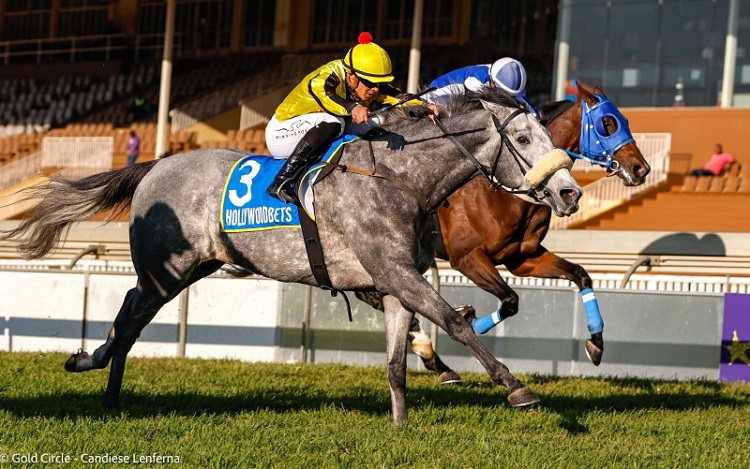
See It Again does not appear on the Equus Awards points table for the Champion Middle Distance Horse award, but he is still the likely favourite to win the award (Candiese Lenferna Photography).
Equus Controversy Averted
Potential controversy in the Equus distance categories awards will be averted by a ruling that allows the Equus Committee some use of discretion.
The Equus Awards have a rule that age specific events do not count towards the distance category awards points tables.
There is also a clause saying “Only horses included in the final points log will be voted on by the expert panel and public.”


World Pool Gold Cup favourite Future Pearl is by Furura, whose father Dynasty has sired three Gold Cup winners (Candiese Lenferna Photography).
Stamina Pedigrees Are Necessary In The Gold Cup
Looking at the sires of Gold Cup winners from 2006 onward they are Saumarez, Fort Wood, Kahal, Dynasty, Silvano, Editor’s Note (sire of Argentinian-bred In Writing), Jallad, Silvano, Mogok, High Chaparral, Ideal World, Dynasty, Dynasty, Noble Tune, Vercingetorix and Soft Falling Rain.
Soft Falling Rain would not be considered a stamina sire, but his Gold Cup winner Shangani is out of Gorongosa, who is by out-and-out stamina influence Montjeu and she herself won two Graded races over 3200m, including the Gold Bowl.
Vercingetorix does not have a reputation as a stamina sire despite being by stamina influence Silvano, but his Gold Cup winner Nebraas is out of an Archipenko mare Noor Dubai who went close once in a 2400m event.
So the first criteria to look for when studying form for a Gold Cup winner looks to be identifying horses with stamina influence sires or otherwise they must have plenty of stamina in the female line.
A quick look at this year’s World Pool Gold Cup entries shows that most are by sires with some stamina influence, so going on that criterium alone is not going to narrow it down by much.


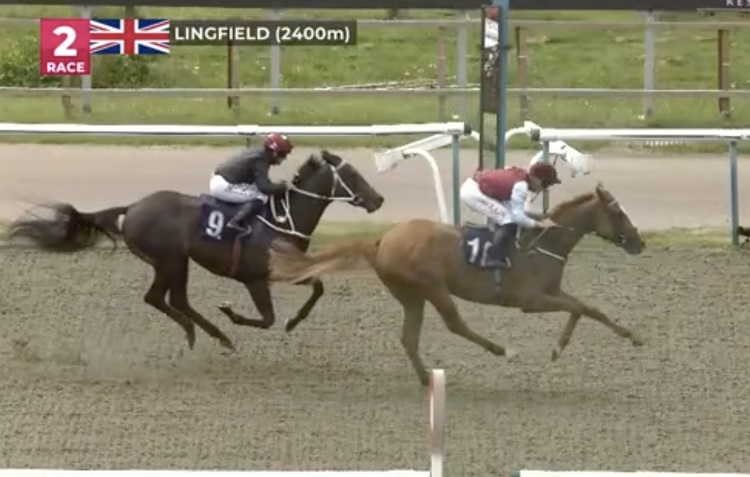
The Wilgerbosdrift (UK) Ltd-bred and Mary Slack-owned Marmara Sea (Golden Horn), not to be confused with the Wilgerbosdrift home-bred SA-based gelding Marmara Sea (Soft Falling Rain), finished second in a race at Lingfield today (Racing TV).
Mary Slack Filly Runs Promising 2nd At Lingfield
A Golden Horn filly bred by Mary Slack’s Wilgerbosdrift (UK) Ltd and owned by Slack ran second in a three-year-old Novice Stakes race over a mile and four furlongs on the Lingfield All Weather today.
The filly’s name is Marmara Sea, which interestingly is the same name as the Wilgerbosdrift homebred East Cape poly sensation, a gelding by Soft Falling Rain out of dual Gr 1-winning sprinter Alboran Sea who at one stage won eight successive races on the Fairview polytrack.
The British-bred filly is trained by Jane Chapple-Hyam and ran a good 3,35 lengths fourth in a six-horse Class 2 Fillies Novice Stakes over a mile and four furlongs at Newmarket in her previous start at odds of 40/1.
Today was her fourth career start and as it was a class 5 Novice Fillies Stakes event she started 4/1 third favourite in an eleven horse field.
She was ridden by Marco Ghiani and the Racing Post comment was, “Prominent, went second after 2f, lost position briefly over 2f out, led inside final furlong, headed inside final 110yds (op 11/2)”
Golden Horn was owned and bred by Anthony Oppenheimer, who shares a great grandfather with Mary Slack.
The John Gosden-trained son of Cape Cross was the 2015 European Horse of the Year after winning the Epsom Derby, Arc de Triomphe, Irish Champion Stakes, Eclipse Stakes, and coming second in the Breeders’ Cup Turf.
In a racing career which lasted 367 days from October 2014 until October 2015 he won seven of his nine races and was never beaten by a male horse.
On 1 August 2018, during an interview on ITV Racing at Goodwood, Frankie Dettori declared Golden Horn as his favourite horse of all time.
He has sired five Group winners and 12 other stakes winners on the flat but no Gr 1 winners and he was sold by Darley and Anthony Oppenheimer to stand as a dual purpose stallion at Overbury Stud.
Marmara Sea’s dam is an Irish-bred maiden by Desert Style.


Hollywoodbets Scottsville Wednesday July 19 Formguides And Selections
www.attheraces.com
1 12:30 PM – Download The Race Card Online www.goldcircle.co.za Juvenile Plate (2 Year-Old Fillies)
Watch out for: SAN PEDRO (3)

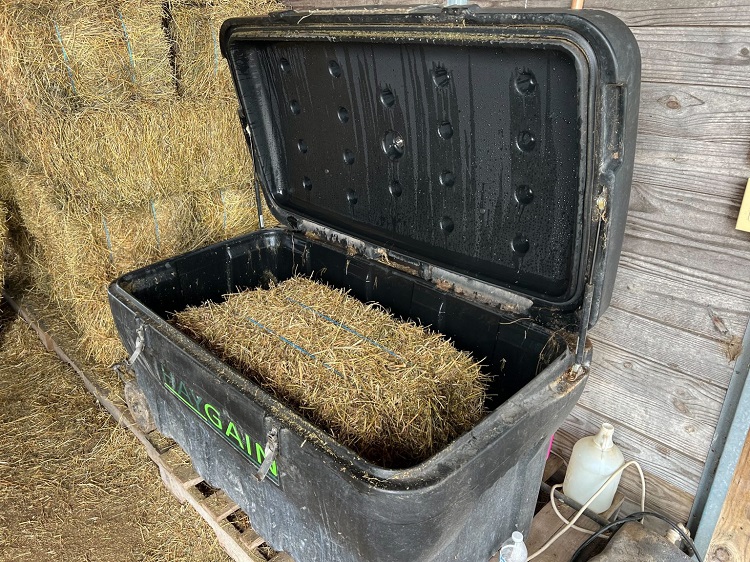
A steamed bale of hay is ready for use (Paulick Report Photograph).
Steaming Hay Before Consumption Is Beneficial To Horses
An article in the Paulick report makes a lot of sense.
Research In Action: Purdue Studies Convinced Trainer To Steam His Horses’ Hay
The horses in trainer Joe Davis’ barn at Horseshoe Indianapolis don’t just get standard hay in their nets each day. Throughout the afternoon, Davis or one of his employees opens the HayGain machine that sits at the end of his shed row and pulls out a warm, beautiful-smelling bale of freshly-steamed hay to fill their nets.
“I think it helps with bleeding,” he said. “They get so much dust with regular hay, and when it comes out of that steamer, it just smells great. And when it’s fresh out of there, they really love it. It cuts down on dust and bacteria. We’ve had really good luck with it.”
Davis said he was inspired to change the way he fed the horses in his racing string after he assisted researchers at Purdue University on a study into equine airway issues. The study was one of two led by Dr. Laurent Couetil that was funded by the Grayson-Jockey Club Research Foundation.
Couetil studied the issue through the use of bronchoaveolar lavage, in which a scope is passed down the horse’s airway into the lungs and fluid is rinsed through the lungs. The fluid is then extracted and the contents examined to measure what may be going on inside. Researchers learned that the more dust a horse encountered in its stall, the more neutrophils were found in the lavage. (Neutrophils are a type of cell associated with inflammation.) They also found that when measuring the dust particles horses encountered, it was the smallest particles that seemed to impact the most change. The most problematic particles for horses’ lungs were less than four microns wide. (The average human hair is 50 to 100 microns in diameter.) So, the irritant was so small it couldn’t be seen with the human eye but it could be sucked up deep into a horse’s lungs.
Some lung washes also showed that horses had an increase in mast cells in their lungs (a cell typically associated with allergic reactions) when they were exposed to particles of betaglucan, which is a component of cell walls in plants and fungi. For Couetil, these two discoveries pointed to hay as a potential culprit.
Couetil and his research team created a machine that included sensors mounted around a horse’s halter and pulled air into a pump attached to a surcingle around the horse’s barrel. With the help of Davis, the team fixed the pump to horses six hours after their morning work and measured what types of particles came through the pump. They also did lung washes of horses and compared their findings with the horses’ Equibase speed ratings in their race results during the time they were being measured.
“Unsurprisingly, the more inflammation in the lungs, the poorer their performance,” said Couetil.
“Importantly, when we did the lung washes and measured the inflammatory cells, we found a drop in neutrophil percentages in horses that were on steamed hay or haylage,” said Couetil. “The effect was more pronounced with haylage, even though they decreased dust exposure about the same. With haylage, they were already lower at three weeks and they were almost at normal limits by six weeks, whereas the effect with the steamed hay kind of plateaued.
“A lot of people think that the bedding or track surface are the culprits for dust exposure, but we showed your feeding program can make a difference.”
Davis found the results so compelling that when the study was over, he asked HayGain if he could hang onto the hay steamer. Even though it requires a little extra man power to take bales in and out, he thinks it’s worth it.
“We’ll steam five bales a day and then set them out and feed them morning and night,” Davis said. “I’ve got a guy who hangs around the barn in the afternoon. It takes about an hour to steam one, so he’ll put it out up and down the aisle. Then they’re good for about three days.”
Davis wasn’t as sold on the performance of the haylage; it was only available from one supplier in Indiana, and he said some of his horses weren’t interested in eating it. Couetil knew that many horsemen prefer horses to graze from a net or slow feeder, rather than use lower-dust hay pellets or haylage. Besides encouraging steaming, he wondered what else he could suggest to horse owners to help with horses who could be sensitive to airway irritants.
Couetil considered that perhaps the haylage had been successful because it’s known to be a good source for omega-3 fatty acids. This lipid is a component of all diets and is believed to have anti-inflammatory properties. Many performance horses’ diets are high in omega-6 fatty acids because they consume so much grain; omega-6s are pro-inflammatory. Horses need to have some pro-inflammatory mediators in a diet to effectively mount an immune response, but omega-3s may balance out the impacts of excessive omega-6s in a horse’s diet.
In 2020, Grayson funded a third project for Couetil’s team, allowing them to test whether fish oil, a known source of omega-3s, could have an impact on airway inflammation for horses. The team made up unlabeled packets, some of which contained fish oil and some of which contained corn oil as a placebo, and asked trainers to add them to their racehorses’ feed. This study included horses from Santa Anita, Gulfstream, Ruidoso, and Horseshoe. Again, they measured dust exposure and did lung washes.
Couetil said he’s still analyzing that data because the COVID-19 pandemic slowed down collection, but so far it seems the fish oil could have proven his theory right.
“Just those packs of fish oil were enough to decrease airway inflammation in those horses,” he said. “That’s very exciting to us because now you have alternatives.”
Davis was so compelled by these results that he now gives fish oil to selected horses he knows struggle more with airway inflammation during exercise or racing. It’s not a cheap feed additive, but the horses seem to like it (despite the smell) and he believes it makes a positive difference.
“I had one horse we put on it and he was a bad bleeder and had breathing issues anyway,” recalled Davis. “We put him on the fish oil and he ran three super races while he was on it. I could tell a big difference in him.”
The experience of working with researchers and seeing lung wash results has Davis thinking harder about EIPH or other respiratory issues when a horse turns in a disappointing performance.
“On the lung wash they diagnosed a couple horses that had bled farther in there. That helped me a lot, giving me a heads-up on a couple of them I couldn’t tell,” he said. “We do a lot more scoping when we think there may be a problem. I do more diagnostic stuff that way [than I used to].”
All of it was possible thanks to the support of the Grayson-Jockey Club Research Foundation, which funds research that benefits horses of all breeds. Since its foundation in 1940, the organization has given more than $40 million to underwrite more than 426 projects at 45 universities. Grayson-supported research has changed the way owners, farm managers, trainers, and riders of all disciplines manage horses in times of wellness, illness, or injury. Find out more about its current projects here.


Garth Puller Provides A Form Study Tip
Former top jockey now trainer Garth Puller was asked about riding the Gold Cup, the one big race in South Africa that eluded him.
He said the 3200m event was all about horses with sound legs and stamina.
He added, “In my opinion the only two distances in which times of races are significant is 1000m and 3200m. Over 1000m if a horse can get from A to B in 57 seconds another horse has to be able to go faster than that to beat him or her. Over 3200m there will be some stage of the race where they will be going at their top pace because the stamina horses will want to make it as hard as possible for the other horses, so there is usually a good pace over that distance.”


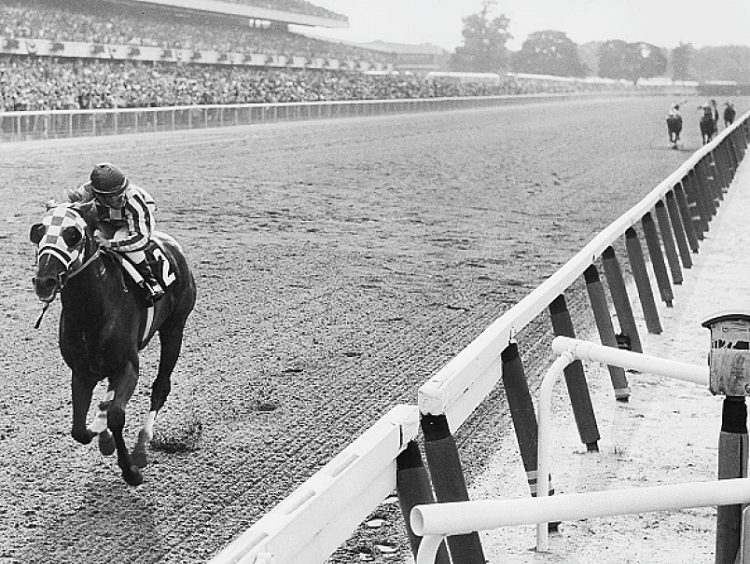
This could be the most famous, or at least recognisable, photograph in racing history but there has recently been some dispute about who took it. (The picture has always been credited to Bob Coglianese).
Racing’s Most Iconic Photo But Who Really Took It?
Tim Layden of nbcsports.com wrote the interesting piece below to coincide with the 50th anniversary of Secretariat’s immortal 31 length victory in the Belmont Stakes on June 9, 1973. He does some detective work in to finding out who exactly took the iconic photograph of Secretariat’s jockey Ron Turcotte peering over his left shoulder with the opposition seen in the distance. It is probably the most recognisable photograph in racing history. However, the person credited with taking it might not be the person who actually took it. Read on for a long but interesting analysis of the saga.
For 50 years, this image has defined Secretariat’s famed Triple Crown. Who took it?
To tell the story of Secretariat’s 50th, I chose a narrative device. We writers love terms like device, because it purports to impose order on the process, as if we are software engineers or carpenters, meticulously building something, rather than typists, desperately trying to corral facts, ideas, quotes, transitions, word length, always right on the edge of losing control of the whole thing. My device was to feature five people who, in various ways, both in life and beyond, had perpetuated the story of Secretariat’s 1973 season and Belmont. Owner Penny (Tweedy) Chenery, jockey Ron Turcotte (the only one still living), race caller Chic Anderson, journalist Bill Nack, photographer Bob Coglianese. With help, I got to the right people, collected strong quotes, added some literary flourishes and in general, didn’t mess up a good thing. The story, as we also like to say, holds up, and should hold up for a long time.
Except one part could be wrong altogether. At the very least, it’s in doubt.
The last character in the piece was Coglianese, the former New York Racing Association track photographer who died last December at the age of 88, and is credited with taking the most famous photograph from the 1973 Belmont Stakes, a picture that was instantly iconic when first published and grew in stature as time pushed it further into the haze of the past, until it became almost mythic, and which will be explosively shared and published this week, half a century on from the greatest horse racing performance in history:

So it was on that second Saturday in June of 1973, that Bob left the family home in Searington, 10 miles east of Belmont Park in Long Island’s Nassau County, and drove to work. He likely shot not only the Belmont Stakes that day, but all seven of the races that preceded it, and even the one that followed. Ten or 15 minutes before the 5:38 post time, he likely walked across the Belmont loam, climbed the four or five steps to the top of the green, wood, platform, and pre-focused his lens on a point near the finish line. He then waited until Secretariat entered his frame and punched his shutter. The horse, the other horses… lord knows, the crowd. All right there.
More practically: Bob Coglianese took one of the greatest and most meaningful sports pictures in history by going to work and doing his job.
It was a simple description, lyrically tight and sweet. The real story is almost certainly more complex – a story that is not only about the power of a picture to convey a message larger than itself and to reach into a viewer’s soul, but also about the force of a half-truth that lives across time, and the eternal riddle of who actually owns a piece of art.
Background: The photo had existed for 50 years, always with Coglianese’s authorship attached. Photo by Bob Coglianese. Sometimes a copyright symbol or NYRA reference was included, but always Coglianese’s name, and never anyone else’s. To my knowledge, it had never been publicly suggested that Coglianese did not take the picture (or that he didn’t own it, which is another issue; keep reading). I had met and spoken with Coglianese in the 1970s, and seen him in the ensuing years; he was an actual human in my experience. When the internet was born, accelerating photo sharing – and piracy – I was among those who, when the photo popped up without credit, would add Coglianese’s name to a retweet and scold the originator.
And this: In 2018, when he was in his mid-80’s, Coglianese gave an interview to the NYRA press office and that was quoted in a Daily Racing Form story at the time of Coglianese’s death. “It was a big race, it was the Belmont Stakes, and there was a photo stand over there and I was on it, shooting the race and it just so happened I got that shot,” Coglianese said. The headline said Track photographer Bob Coglianese, shot famed Secretariat photo, dies at 88. Just last week, NYRA published a story in which the second sentence of the second paragraph reads: “The iconic Bob Coglianese shot of jockey Ron Turcotte peering over his left shoulder to peek at immortality.”
Nevertheless, it’s possible Coglianese did not take the picture.
And that a man named Harry Kaplan did.
Or even somebody else altogether.
On the day after my Secretariat-50 story was posted, three Tweets appeared in my Twitter feed from two people under the names Barry Kaplan and Mike Kaplan, both claiming that the famous photo had been shot not by Coglianese, but by their father, Harry Kaplan, who apparently worked with (or for, it wasn’t clear, at first) Coglianese and in general complaining that Coglianese took credit for others’ work. (On this point, again, keep reading). The poster named “Mike Kaplan,” under the handle @AirForceMike, also posted a very long comment – a screed, really — on my story on the NBCSports website.
Like most writers working in the era of social media and comment portals, I try to hew to some sort of policy: Humbly thank or at least “like” compliments, and ignore nasty criticism. (Social media in the media space overflows with meanness, cruelty and various forms of “owning”; it’s not a nice place and sharing content there is a deal with the devil). Thoughtful criticism is a grey area, because engaging can be useful, but also a time suck. The best policy is that less is more. But something about the Kaplans’ responses had the scent of possibility, if only because in my experience a lot of bodies can lead to a single photograph. I couldn’t shake the notion that even if I had not made a literal mistake (for instance if the credit on the photo is legally accurate), I may have over-simplified a truth, and embellished it for narrative value.
I texted Adam Coglianese from a trailer in the NBC compound at Churchill Downs, on the day before the Kentucky Derby, Friday May 5. We went back and forth and I asked Adam directly if his father took the picture. His response: “Bob Coglianese was the photographer.” He also said, “Harry used to work for my father. Left on bad terms.”
On May 17, I was at Pimlico Race Course in Baltimore to cover the Preakness. Hours before the race, I ran into Leonard Lusky on the ground floor of the Pimlico grandstand. Lusky is a central figure in the Secretariat story: He has been the publicist for Penny Chenery and Ron Turcotte (for my story, he helped me arrange interviews with both Turcotte and Kate Tweedy, Penny’s daughter), and runs the website Secretariat.com, which he helped Chenery acquire. Lusky also helped Bob Coglianese sell copies of his photo, which Turcotte has signed thousands of times, and now helps Adam Coglianese do likewise. I started to ask Lusky about the Kaplans’ claim and Lusky jumped in. “I know what you’re going to say,” he said. “There might be something to that.”
Bob Coglianese started at NYRA in 1952 at age 18, working in the photo department for his uncle, Michael Sirico; Coglianese took over the department in 1962 and held that position until his retirement in 2013, when his son ascended to the job. It’s true that many photographers worked for Bob during those 51 years, and that Harry Kaplan was one of those photographers. Born Sylvan Harry to Jacob and Jenny Kaplan of Coney Island, Brooklyn on Christmas Eve, in 1927, Harry was raised in Brooklyn, briefly served in the Army at the very end of World War II and according to stories he told family members, traveled frequently to pre-Castro Cuba in his 20s while working as a bartender at a lounge in Brooklyn. Sometime in the 1960s, he landed at the racetrack, as a bettor, owner of some average horses, and eventually as a photographer, and stayed there until approximately the mid-1980s.
Official track photography is only occasionally art, and more often a daily grind. This was more acutely true in the 1970s, when photography was more labor-intensive than today. “Being a track photographer is an assembly line,” says Skip Dickstein, who has shot racing for more than four decades, much of it for the Albany Times Union, but also for many national outlets. “It can be mind-numbing work, day after day, all year.” According to people who were present, there was a clear division of labor in the NYRA photo operation in the pre-digital age of the 70s and 80s.
First, Bob Coglianese was the boss; it was his operation. Second, Coglianese’s primary emphasis was on photographing the connections of the winning horse in each race, in the winners’ circle. This was important because he could then sell those photos to owners, trainers, friends. “The winners’ circle was the most important thing to Bob,” says Chris Scherf, NYRA media relations director from 1979-’82 after starting at NYRA in ’78. “His big thing was getting winners’ circle pictures of the owners and selling them. That was his money-maker. Bob also policed the winners’ circle, very much.”
Richard Eng, who was the NYRA photo services coordinator from 1981-85 and worked closely with both Coglianese and Kaplan, says, “The winners’ circle was an ATM for Bob. That’s where he would shoot.”
Others on Coglianese’s staff would shoot elsewhere, in particular during the feature race of the afternoon. Karen (Kivel) Rice worked for Coglianese – and with Kaplan – from 1979-’87. “Eighth race, most days I would set up a remote camera under the rail, Harry would go up on the stand.”
Steve Haskin, a longtime racing journalist who was often at NYRA tracks dating back to the late 1960s and was especially present during Secretariat’s Triple Crown, says, “Coglianese always shot races from the outside rail and then shot the winners’ circle. Harry and the other photographers would shoot from inside.” (In this description, “outside rail” means on the grandstand side; “inside” means on the infield side.)
It’s clear on the most basic level that the famous Secretariat photo was shot from the infield side of the inside rail. And Coglianese said in his 2018 interview that he took the picture from a stand in roughly that position.
Karen (Kivel) Rice: “In my time in New York, personally I never saw Bob cross the track. Not once. He would be at the outside rail, and then the winners’ circle. Now Secretariat was before my time. So I don’t know about that day.”
Richard Eng: “I was not there in 1973, but in my time at NYRA, I never saw Bob up on that stand, and honestly, I would have a very hard time envisioning Bob going up onto that stand.”
Nevertheless, It is possible that on June 9, 1973, sensing a historic moment, Coglianese walked across the track and onto the stand. Clear photographs of the finish stand on that day seem to be exceedingly rare. Last Friday (June 3) I came across a wide shot of the finish of the Belmont Stakes on the website of the Virginia Museum of History and Culture. The digital image was scanned from a 3X5-inch snapshot taken at the Belmont by then-Gov. Linwood Holton from his seat above and just short of the finish line. I requested a high resolution scan of the image from the museum. This is that scan:

And this is that same photo, zoomed in on only the photo stand:

I sought analysis from two photographers: Former Sports Illustrated and Time, Inc shooter Neil Leifer, who is widely regarded as among the best photographers in history; and Simon Bruty, also a colleague of mine at SI, with more than four decades’ worth of sports photography experience at AllSport and SI, and one of the most accomplished modern-day shooters. Both have shot many major horse races. I showed both men the larger photo, the tighter version on the photo stand, the famous Secretariat photo, and one other Bob Coglianese-credited photo from that same Belmont for comparison. This one:

And I asked them to estimate, in their opinion, where the famous photo was shot from.
Leifer: “First of all, the famous picture, the black-and-white picture with the other horses in the background, that was not taken from the ground. That’s obvious. And then you have the color photo, which looks completely different (from the famous shot), and is clearly much higher, so that was probably from the top platform, which means [the famous photo] was taken from that first level. Also, in New York, the official track photographer would have had the prime position with an unimpeded view.”
Bruty: “If you look at the [famous] photograph, it’s very close to the rail. So the person shooting that image would have to been on the very inside position on the stand. And on the middle level, because from the top, you wouldn’t be able to get the other horses in the image.”
There are five people shooting from the railing of the first step on the riser. From left (furthest from the track) to right: 1) A heavyset person in dark clothing with either white hair or balding, 2) A person with bare legs, 3) A person also with either white or light grey hair or balding, in a loose-fitting orange or brown jacket and light-colored shirt, 4) A person with greying hair and a light-colored jacket (perhaps a sport coat) and 5) A person with either white hair, or a white hat, leaning out toward the railing. (There are three other people of note: Behind No. 5, a person in white pants on their knees, and further back, a person bent 90 degrees at the waist in a white shirt who does not obviously appear to be taking a picture. Lastly, there is a person with longish, flowing dark hair, halfway between the levels, either very tall or standing on something).
Based on Leifer’s and Bruty’s analysis, the most likely shooter of the famous photo is either 3, 4, or 5. (Most likely, but not certain). Leifer, Bruty, and Dickstein all said that the photo was definitely taken with a hand-held camera, and not a remote setup.
These are undated photos of Bob Coglianese:


These are undated photos of Harry Kaplan.


I showed the zoomed photo to Haskin, who knew both men in 1973. He said: “Bob is not in that picture.” I showed the photo to Rice, who knew both men from ’79-’87 and she said, “Agreed.” Eng said, “Bob C. had black hair and a stocky build. No one on either level resembles him to me.” From my perspective, knowing what Coglianese looked like just a few years later (1977-’78), in addition to knowing that at the very least he went across the racetrack infrequently, the photo creates doubt in my mind as to whether he took the picture. Is Harry Kaplan in that photo, shooting from one of the prime positions? Haskin felt that No. 4 could be Harry Kaplan. He is the right size, and in the right position. Both Mike and Barry Kaplan felt certain that No. 4 was their father, but they have a skin in the game, which is mitigating. The photo is not sharp enough to establish certainty.
On Tuesday morning, an NBC colleague found an archival photo from Getty images, which shows Secretariat just past the finish line, and the side of the photo riser, fairly sharp in the background. Person 4 is clearly visible in a sport coat.

I sent the new photo to Haskin, who looked at it and also shared with his wife, Joan Sudol Haskin, who worked at NYRA as a public relations coordinator from 1979 to 1981. “Sure looks like Harry to me, and my wife agrees it does look like him. But being from the back, you can’t be 100 percent positive. I would go 90 to 95 percent. It sure ain’t Bob.” Once again both Kaplans were certain the man in the sportcoat was their father. Again, they have an interest in seeing that. Scherf, however, said, “Can’t really tell from behind. Doubt it’s Harry and actually, from the posture, body shape and stance, it would look more like Bob. Just can’t tell.”
We found another Getty photo later Tuesday, this one at the start of the race.

Person 4 is in a more relaxed posture, and party obscured by Person 5. In this image, Person 4 seems to fairly clearly have greyish hair and light skin. It would be difficult to make the case that it’s Coglianese, who as a young man had black hair and skin that was tones darker than pale. Scherf amended his analysis: “From that angle it does not look like Bob. I can’t say that it’s Harry, though.”
A day earlier, Eng thought Person 3, in the orange and yellow, might be Kaplan, but upon seeing two more photos, said, “[Person 3] is not Harry. He has a bald spot, and Harry had a full head of hair. To me, of all the people on the second step, the one wearing the sportcoat [Person 4] is the only one who resembles Harry. He has the right build to resemble Harry, too.” The two Getty photos increased the likelihood that Kaplan was on the stand in what Leifer and Bruty described as the mostly likely position to capture the famous photo. However, neither photo eliminates the possibility that Coglianese was somewhere else on the stand.
On Monday afternoon, I contacted Adam Coglianese, sent him the photo riser picture from Virginia and explained that my reporting suggested at the very least uncertainty about who took the photo. I asked if he wanted to say anything further, or if he chose, to point out his father in the photo. His response: “I have no comment. That picture is blurry. I have no comment. It’s been known that Bob took that picture for 40 or 50 years, and now people are coming out of the woodwork, and questioning it? It’s irrational. Sure, Bob’s forte was on the outside of the racetrack, but he was 38 years old in 1973 and people are saying he never went across? Nobody ever questioned that my father took that photo, and now? This guy, Harry Kaplan, left on very bad terms with my father. So I’m going to have no comment.”
On Tuesday of this week, I asked Patrick McKenna, NYRA Vice President for Communications, if NYRA had any pictures that show the photo stand on Belmont Day, 1973. McKenna said, “There are no photos responsive to this inquiry.”
Bob Coglianese is on record as saying that he physically held a camera in his hand and took the famous photo. Harry Kaplan is not, and he died of leukemia at age 82 in 2010, but others say he often claimed to have shot the photo. “He told me about it, he was proud, said it was one of his best photos,” says Rice. Peggy Kaplan, who was Harry’s fourth wife and married to him for 18 years when he died, says, “He would talk about that picture all the time. He said he was on a stepladder at the rail when he took it.” (He was on a riser, not a stepladder, which could be either a red flag, or just semantics, because the riser had a construction-site quality to it). Kaplan’s sons say they talked frequently with their father about the Secretariat photo, especially as it became more praised, but Kaplan never wanted to seek credit.
There is a good reason for this: At the time of Kaplan’s employment, and through most of Bob Coglianese’s tenure at NYRA, it was understood that any photo that left the office would bear Coglianese’s credit. This was then common in the photography world, and is not uncommon today. It’s not clear if Coglianese’s employees signed a contract that handed all rights to Coglianese, but their understanding of the arrangement was implicit. “There were times when I would go up to the press box and have lunch with Harry and a young girl that worked with them [probably Karen Kivel Rice, given the timing], and they were very resentful that Bobby would take all the credit for the photos,” says Scherf. “But they were also resigned to it. It was just human nature to complain, like, you know, ‘It sucks to be in this position.’”
On big race days, Coglianese would often bring in extra shooters; all of their photos would be credited to Coglianese. For instance, there are photos from several angles on Belmont Day, 1973, all with Bob Coglianese credits, and of course he could not have physically shot all of them. This brings into play the possibility that neither Coglianese nor Kaplan shot the iconic photo, but somebody else together. It’s challenging to fully eliminate options).
Kaplan had swallowed some hard times by then: His first wife, Ruth, had died of cancer when their sons were just nine and 10. He was grinding out a quiet living at the racetrack and did not seem to be seeking conflict. “Harry was mild-mannered, a gentleman, a nice older man,” says Rice. “He had experienced some pain in his life. He was frustrated, but he understood the situation.”
Richard Eng: “I spent a lot of time with Harry. Even if he was frustrated, he was a loyal soldier.”
It’s possible that Bob Coglianese did not physically take the famous photo, but the credit on the print – Photo by Bob Coglianese – is correct in perpetuity. Both of these things can be true. Coglianese owned the photo and the right to put his name on it.
That reality is part of a very murky corner of the photography universe, which is far too complex to explore fully here. But in short, it is not uncommon for photographers to employ – or hire – assistants to aid in covering a sprawling event. Sometimes those assistants do nothing more than push a button on a remote camera that’s been fully set up by the photographer. “Some of my pictures, the neighborhood garbage collector could have hit the button,” says Leifer. “Those are my pictures.” (Leifer also said, “Some of my most famous photos, I did not have a camera in my hands”).
Bruty says, “I’ve always believed that if I conceive the shot, and I set up the camera, and then I have somebody run a wire from the camera, and somebody presses a button on the end of that wire, that photo is my credit.”
But there is another level, in which a photographer puts a camera in the hands of his assistant, and the assistant takes the picture. Bruty says, “Personally I think that crosses the line. At that point, you’re asking them to use a skill. I know that pushing a button at the right time is a skill. That person deserves a credit for that photo. That’s what I believe.” Dickstein, the racing specialist, says, “I’m at the point where my assistant does a lot of the physical work in setting up remotes, because I can’t do it anymore, so now I give him a shared credit on those photos. Because it’s the right thing.”
Leifer, again, has a complicating thought. When I asked him if his famous photos taken by others had been remotes or actual hand-held cameras, he said, “Both.” But he said that before handing a camera to an assistant, he would “tape the focus, tape everything, leaving nothing to chance, so they can’t screw it up.” It is a complex world. It’s highly unlikely that Bob Coglianese did more than send his assistants out with orders to shoot the finish. “We knew what our job was,” says Rice. But they also knew they would not get credit unless Coglianese conferred it, and that was not the way the industry operated.
Harry Kaplan left NYRA in 1976 to work for an Ohio-based company that took school pictures. According to Barry Kaplan, the company folded. Harry went back to NYRA for at least six more years. Perhaps that was not the “bad terms” parting that Adam Coglianese referenced, because Kaplan was rehired. When Harry left again in the early-mid 80’s, (those could have been bad terms, it’s uncertain) he moved back to Ohio and eventually became the official track photographer at Beulah Park Race Track in Grove City, Ohio, several rungs on the racing ladder below NYRA. He worked there for about two decades (the exact duration is uncertain) and almost until his death on June 4, 2010.
A few months before Harry died, Mike Kaplan visited his father in Grove City and brought a copy of the famous Secretariat photo, and a Sharpie, and asked Harry to write his name on it. Bob Coglianese signed the photo several times in his life, including some valuable “triple signings” that also included Chenery’s and Turcotte’s signatures. This was the only one that Harry Kaplan signed.


Tim Layden is writer-at-large for NBC Sports. He was previously a senior writer at Sports Illustrated for 25 years.


Today’s Question
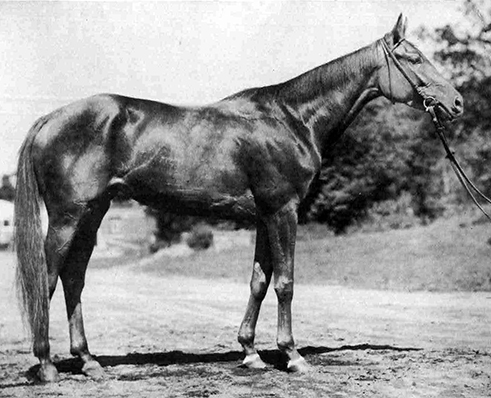
This was the USA’s Champion Female Horse for 1946 and later Hall Of Famer. Who is she?
Question answer at the bottom of the newsletter
