



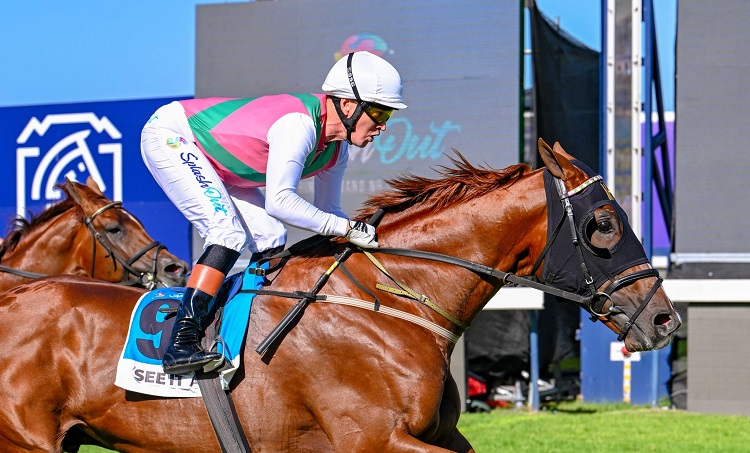
See It Again with Piere Strydom up winning the Grade 1 Splashout Cape Derby (Wayne Marks).
Striker Can Make The July Weight On See It Again
Piere Strydom revealed today his minimum riding weight for this year’s Hollywoodbets Durban July would be 57kg.
So, as things stand, he will be able to take the ride on the Michael Roberts-trained See It Again.
See It Again would carry 57kg if the weights were set tomorrow.
He would be 1kg well-in, because in a true handicap he would carry 58kg.
The clause which states three-year-olds are not allowed to carry more than 57kg takes him 1kg down to the latter weight.
The July might be Piere’s swansong.
He said, “My retirement might well come around that time. I intended it to be earlier, but if you keep on getting good rides like See It Again and Lady Of Power, it is hard to stop.”
A July win would be a most fitting way for the legend to end his glittering career because he would in that case equal the record, held by Anton Marcus, of five July victories from the saddle.
Roberts will also be out to create history by becoming one of a select few who have won the big race as both a jockey and a trainer.
See It Again will be his first July runner as a trainer.
Roberts is well aware of the effect Al Muthana’s absence has had on the July weights and added, “It going to make it difficult … 57kg is a big weight for a three-year-old.”


Cousin Casey led in by Glen Kotzen and team after winning the Grade 2 Cape Punters Cup (Wayne Marks)
Glen Kotzen Not Sure Of Cousin Casey’s Route Into July
The significance of Al Muthana’s absence from the Hollywoodbets Durban July entry list is not lost on Glen Kotzen, the trainer of the ante-post favourite Cousin Casey.


Heinrich Rix’s Stonehill Stud Offer Five Royal Mo’s
Royal Mo is sire of the biggest stakes earner in South Africa this season, the Justin Snaith-trained Royal Aussie.
The latter’s stakes earnings of R5,228,800 are over R3 million more than the next highest earner.
That was courtesy of his win in the inaugural running of the WSB R7.5 million Gold Rush over 1600m at Hollywoodbets Kenilworth on WSB Met day.
The earnings in restricted races are not official, but it should be remembered the connections forewent campaigns in other features to aim him at that lucrative race.
In the Gold Rush he beat the like of Dave The King (by half-a-length), who ran a four length third to Charles Dickens in the Grade 3 Cape Classic, See It Again (by 3,20 lengths), who subsequently beat Charles Dickens to win the Grade 1 Splashout Cape Derby and is now the highest rated three-year-old in the country, and Lord William (by 6,60 lengths), who has subsequently won the WSB Listed Sledgehammer Stakes in KZN.
Royal Aussie is entered in the Hollywoodbets Durban July and his relaxed style of racing and fine turn of foot should see him suited to the tight Hollywoobets Greyville course. He has the ability to find extra in a tight finish too, as he proved in the Gold Rush.
Royal Mo stands at Klawervlei Stud and John Koster said, “The appeal of getting him was he is by Uncle Mo, who is one of the most celebrated sires in the USA. Uncle Mo had four sons in his first crop who went to stud and three of them ended up in the top five of the two-year-old sires log at that time. So sons of Uncle Mo were extremely popular and the only reason we could afford to get Royal Mo was because he had been injured just before the Preakness. He was a top three-year-old in the USA at the time. It was fortuitous. Uncle Mo gets them to run on the turf and the dirt, which was another appealing factor.”
Stonehill Stud’s first Royal Mo going through the ring will be Lot 68, Royal Dawn, a bay colt out of four-time winning Gitano Hernando mare September Bloom. Her most significant win was over 2000m when beating her Bankable half-sister Banking April, who was a six-time winner who was runner up and third in two respective Listed events.
The second Stonehell Stud Royal Mo will be Lot 105, the filly Lady Of Arc, who is out of an unraced Irish-bred mare by Power (GB). This mare has had three runners to date and two winners. She is from the family of Group 1 winner Bold Eagle (GB) and also the well performed seven-timer winner and Group 2 winner Khaadem (Ire).
The next Royal Mo will be Lot 168, the filly Lady Elimo, who is out of the Captain Al four time-winning Listed-winning mare All At Once. The latter is a half-sister to the Listed-placed Expedite and she is from the family of the like of Grade 2 winner Alexandra Rose.
Next Royal Mo up will be Lot 365, an unnamed filly who is out of the seven time-winning Listed East Cape Paddock Stakes winner Maverick Girl, who is by Rebel King. Maverick Girl is from the family of a number of Grade 1 winners like Bold Persian, Boland Pride, Proud Pilgrim and Noble Warrior.
The last Royal Mo on the Sale will be Lot 387, an unnamed colt out of the the twice-winner Nala, who is by Trippi out of the Grade 1-winning Equus Award-winning mare Bold Ellinore. Furthermore, Nala is a full-sister to Listed winner Ha Lucy, who is the dam of the 92-rated three time-winning speedster Lucy English.


Mike Azzie leads in Ready To Charge (JC Photos).
Timely Victory For Azzie-trained Ready To Charge
The Mike and Adam Azzie-trained two-year-old Gimmethegreenlight colt Ready To Charge has a Drakenstein Stud-bred Lancaster Bomber half-brother on the BSA National Yearling Sale, so his easy 2,75 length victory on debut today at The Vaal over 1100m under JP van der Merwe was most timely.
Ready to Charge is out of the Australian-bred Charge Forward mare San Fermin, who was believed to be something special by Mike Azzie and many others when displaying an electric turn of foot from the back of the field on debut over 1400m at Turffontein in November 2017 and winning by seven lengths.
She started favourite for the Grade 3 Fillies Mile two-and-a-half weeks later, but was unplaced and in the end her sole Graded victory amongst five career wins was in the Grade 3 Sycamore Sprint over 1160m.
Ready To Charge is small in stature, like his mother, and JP van der Merwe said he jumped a bit “sluggishly”, but responded instantly when asked to get back into the race. He led and kicked again at the 400m and was never going to be caught. It was a field made up largely of first-timers, but the favourite Open Highway had made a decent debut and he beat him by 5,50 lengths. Furthermore, he did it from draw one, which might well have been the harder side of the track to win from on the day.
Mike Azzie did the interview and hinted Ready To Charge might go down to KZN for a SA Champions Season campaign.
His Lancaster Bomber half-brother is Lot 48 on the BSA National Yearling Sale, so will be in the ring during the Friday session (April 21).


Ten Of The Best At The BSA National Yearling Sale
Michele Wing was at the BSA National Yearling Sale grounds earlier this week and she and her Gold Circle team picked their ten best yearlings of the Sale.


Fairview Turf Formguides And Selections
www.attheraces.com
1 12H25 – Welcome To Nelson Mandela Bay Maiden Juvenile Plate (Fillies)
AMAZING COLOURS was beaten by a decent filly on debut. She improved in her second start and was only run out of it late. She should be the one to beat. FIRE GLOW showed promise on debut but is troublesome and has been scratched a couple of times since. Stable companion FIRST MINISTER may be looking for further but can improve. Watch the betting on the newcomers JOY AND PEACE and WINNING GRACE. JOY AND PEACE represents the in-form Alan Greeff yard and can win on debut. WINNING GRACE is a Coup De Grace filly who could run well.
Watch out for: PEDRO (6)


Martin Pipe and Peter Scudamore at Stratford in 1989 (Edward Whitaker).
Revolutionary Trainer Martin Pipe Eventually Won Respect
How revolutionary trainer Martin Pipe changed the racing landscape forever
Steve Dennis on the man who overthrew the old order, not by force but by cunning
Martin Pipe: ‘I didn’t know anything about training when I started, I didn’t have a clue’
What does a revolutionary look like? He might have the smouldering eyes of Guevara, or the unflinching expression of Cromwell, or even the luxuriant moustache of Zapata. Revolutionaries do not, as a rule, wear trilby hats, or a slightly nervous half-smile, or lay out the terms of the revolution in a soft rural burr.
“It was just common sense, really,” he says, the half-smile evolving into a half-laugh. “Doing the simple things well, and learning from the mistakes. That’s what we did.”
Pipe’s way of training was different. Moreover, he never wanted to be a trainer, and it’s tempting to conclude that Pipe was not so much a racehorse trainer as a consummate problem-solver, the problem being ‘how to get this animal to run faster than similar animals’.
One point-to-point winner and a broken thigh later, Pipe needed a new outlet for his energies. Down on the farm, at the now-legendary Pond House in the hamlet of Nicholashayne, on the border between Devon and Somerset, he already had a few point-to-pointers that he wouldn’t now be riding. One problem solved the other.
“I thought we’d train them. We didn’t have any gallops, just fields, so we built a fantastic mile-and-a-quarter gallop on top of a hill, but it didn’t give us any winners.
“I did the things that everyone else did but it didn’t seem to work. Then we bought a set of scales, started weighing the horses, started taking blood tests because that had been mentioned in a lot of books I’d read.
“A local vet did the blood test and said ‘this horse won’t win’, and I reckoned that he didn’t know anything, and this from a man who knew nothing himself. I ran the horse – and he was exactly right, it got tired and dropped away.”
Pipe’s background outside training proved a blessing rather than a curse. Unburdened by the dead weight of received wisdom, Pipe’s insatiable curiosity propelled him to seek answers from less obvious sources.
“I have an inquiring mind, and I picked the brains of everyone I could,” he says, and when everyone was asleep he sat up poring over a pile of books. He reaches now for the bookshelf, for his bible, for Modern Horse Management by Major RS Timmis, among the yellowing pages of which are his handwritten notes of long ago. ‘Water must not be given half an hour before fast work as all the space possible is required for the lungs to work. Water the horse after hard work.’
After a conference in Newmarket he was the only one to challenge one of the speakers, Barry Allen, and at the end of their conversation Allen had agreed to set up a small laboratory at Pond House to facilitate swift results of blood tests. When those results were known Pipe, a meticulous record-keeper, wrote them down, constructing a complete record of his horses’ health.
“That gave us loads of answers. It’s so simple – facts and figures give you results, they take the guesswork away. Everything was written down – that habit started when I was working in Dad’s betting shops. I could get the notebooks out now and tell you what [1981 Triumph Hurdle winner] Baron Blakeney did every day of his life.”
His zeal for knowledge took him into the operating theatre – “I helped to dissect horses, I sat in on operations, saw the internal workings so I could see how it all fits together, see how the engine works. It helped me understand more, and it was fascinating” – and into other yards, which he rarely left empty-handed.
“I used to steal their food,” he grins, before quelling the notion that he rifled the larders chez Winter and Walwyn. “We grew our own hay and oats, but I used to pop into feedstores and grab a handful of whatever they had, take it home and analyse it to see what the difference was.
“It used to ruin my suits and my wife Carol wasn’t very happy. I should have thought of plastic bags, I suppose. I’ve still got some of that old feed, and sand from gallops all over the world. It’s there if we need to check something, anything.”
Pipe the puzzle-solver was in his element. It’s tempting to wonder what he might have done had he not chosen racehorses as his line, whether we might now be holidaying on the moon if he’d turned the tractor beam of that inquiring mind towards the space race; others have wondered too.
“I had a nice letter from John Brown, who owned Shooting Light and in his role at William Hill bought my father’s betting shops before rising to managing director. He wrote ‘thank God you never joined William Hill because you’d have had my job’.
“All I did was put my heart and soul into it – my father told me that I had to be good at what I did, had to make mine the tidiest betting shop, whatever. If I had a spare ten minutes I didn’t sit about, I found a job to do. Never waste time.”
The final piece of the puzzle remained to be pressed into place. How do you get them fit? And here was the kernel of the Common Sense Revolution. Other trainers did blood tests, compared feed, knew a bit about the pastern connecting to the cannonbone, the cannonbone connecting to the kneebone. But Pipe knew that if he could get his horses fitter than anyone else’s, 100 per cent fit, they would win races. It was a problem; Pipe set out to solve it.
“We did lots of things, we thought we were giving them loads of work but it wasn’t having any effect. We didn’t have anywhere around the farm to make a gallop, so eventually we knocked out some hedges and galloped around a field and sprinted up the hill, that’s how the first winner came along.”
It is worth dwelling on Pipe’s first winner, Hit Parade at Taunton in May 1975, which owed very little to the inquiring mind and a great deal to sweet chicanery – jockey Len Lungo went around the track before the first race and loosened the second section of hurdle at each flight, so that front-running Hit Parade could blithely gallop through the obstacles without needing to pick his feet up. Back at home, though, Pipe was developing his secret weapon.
“We used upside down turfs and made the gallop longer and longer, had a dirt gallop during the summer. I wanted the gallop to be in a straight line so the horses wouldn’t have to change leads. It was five furlongs long, the horses cantered and galloped up and down – that turned out to be interval training.
“Getting there was all trial and error. The horses seemed to enjoy what they were asked to do, they were very relaxed. They love routine, love repetition. They had a break at the top of the strip and cantered back down – if you canter up something you have to canter back down because it makes you use the other set of muscles. Seems obvious, really. Just common sense.”
Indeed. That gallop, still supplying Martin’s son David with winners, should really be a listed monument given the effect it had on Pipe’s career and on racing as a whole. There are apocryphal, earlier reports of other trainers utilising the interval format, but Pipe refined the process into a system that eventually brought him 15 trainers’ championships.
The ability to get his horses fitter than any other trainer meant he could buy cheaply at the sales, secure in the knowledge that he could improve any horse well beyond what it had hitherto shown. The trademark Pipe horse was a slight, wiry hurdler with barely an ounce of surplus fat, a prominent ribcage and a zest for front-running that rendered pursuit hopeless. Catch them if you can; no-one could. In every betting shop, every day, the revolution was televised.
“You don’t see fat athletes, do you? You can make a good horse a slow horse if you run him 20kg overweight – that makes up to about 45 lengths. Do you want to give horses that much start? A racehorse is an athlete and it has to be properly fit. It’s only common sense.
“Others were very good trainers in the approach they took, but we had a different approach, trying to make life easier for the horse, because there’s more risk in running an unfit horse.”
He pauses in the relating of the doctrine to recall an archetype of the glory years, the essence of the Pipe way. “A horse called Splendid Magnolia, I remember leading it off the lorry on a piece of string. My head lad said ‘if you win three races with this you’ll be a trainer’. And we won four. There were lots of cheap horses winning little races, I enjoyed getting the best out of them, and we had good jockeys who rode them to maximise their fitness and ability.
“Every horse is different, like human beings. You study them, see what they do, how they work, and learn from it. Chatam ended up a very good horse but I simply couldn’t get him fit. Why? It took a long time to work out that the same girl rode it up the gallops every day and she weighed 6st nothing, and other horses were going up under 12st. He was a big horse and he was doing half the work of the others! After that he carried a weight-cloth – obvious, isn’t it?”
When Baron Blakeney won the 1981 Triumph Hurdle, Pipe had no more than a dozen horses. Four years later he broke 50 winners in a season for the first time, all hurdlers – “People said I couldn’t train chasers – I just didn’t have any, they were too expensive.” Four years after that he was champion for the first time with more than 200 winners, and from then on his feats were scored so deeply into the record books that they will never fade.


Cliff Top won last year’s East Cape Nursery (Picture: Pauline Herman).
East Cape Nursery Recent Winners


The now defunct Milnerton racecourse staged its first meeting in 1908.
Today’s Question

Lord Charles Somerset
