

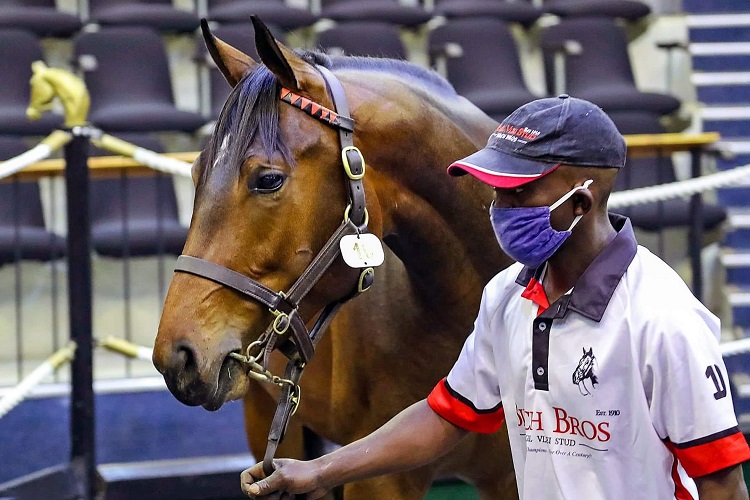
The name “Birch Brothers” is always said with a touch of reverence in South African racing circles and the ambitions of these famous thoroughbred breeders have not diminished. (Picture: Candiese Lenferna).   


Colin Birch is a fifth generation member of the famous Birch Brothers breeding family and still dreams of returning to the top.

Birch Brothers at one stage dominated thoroughbred breeding in South Africa to such an extent that they won some 40 championships in succession.
 
Colin and his father Syd are the last members of the family to be breeding thoroughbreds and operate on the family’s original farm, Vogel Vlei, situated on the foothills of the Stormberg Mountain Range near Dordrecht in the North Eastern Cape.
 
The farm was formally founded in 1910 and is the oldest existing thoroughbred stud farm in the country.
 
Colin’s great-great grandfather E.V. Birch came to South Africa from England at the beginning of the last century and initially sold Bibles for a living.
 
However, he was from a “horsey” background and he ventured out and discovered there was an opportunity to breed thoroughbreds in an ideal environment in the Stormsberg. 
 
He hence founded the Vogel Vlei farm.
 
Later, in the 1930s, he journeyed back to his native England and bought two stallions and twenty mares, which he exported to South Africa.
 
Upon landing back in SA, he sold one of the stallions and ten of the mares to cover the costs of the journey and export.
 
Fortunately, he kept a 1929-born British-bred mare called Drohsky, who is today still one of the most fabled mares in South African history and was the foundation upon which the country’s most successful ever stud farm was built.
 
The Birch Brothers probably even more important foundation stallion was the 1921-born British-bred Sunstone, who was a son of JB Joel’s homebred Epsom Derby winner Sunstar. 
 

He was imported by Sir Abe Bailey.

However, poor health affected Bailey shortly after Sunstone’s arrival and the stallion was purchased by E.V. Birch at Bailey’s dispersal sale in 1928.

Sunstone’s relocation to Vogel Vlei, would in the years that followed, prove to be the catalyst of the decades long stranglehold the Birch Bros would have on the breeders championship. 

Sunstone headed the National Sires List on five occasions, 1936 & 1937 and 1940/1/2.  He was the runner up in 1933, 1938 & 1939, as well as topping the Broodmare Sire List on more than one occasion.

He is on record as having had 12 of his sons stand at stud and was the broodmare sire of a further 19 stallions at stud.

Drohsky also had the Joel influence as she was by the Solly Joel owned-and-bred Polyphantes.
 
Drohsky must go down as the most successful broodmare ever to have done stud duty in South Africa. She was a prolific producer as were her daughters.
 
The great Sea Cottage traces to her on his maternal line.
 
Drohsky produced 13 foals in the 15 years between 1933 and 1947 all of them winners, who won a total of 86 races, with Lenin and Murmansk reaching double figures. She produced 6 colts and 7 fillies and 6 of these were Stakes winners.
 
Lenin was generally regarded as the greatest thoroughbred South Africa had produced until the arrival of Sea Cottage.
 
The Birch Brothers were famed for producing sales stock that looked “wild-and-wooly”, but who were known to be tough and durable.
 
Colin said the Birch Brothers philosophy remains the same, with just one change.
 
He explained the aim had always been to not wrap their youngsters in cotton wool and to give them plenty of space.
 
“We pride ourselves in producing tough horses with good bone. You must not grow them out too quickly. If you make them too fat too soon you break them down. So we have big paddocks and wide open camps. In these big areas the horses develop good bone structure and bone density.”
 
He continued, “We bring them up like that apart from them coming in to be prepared just before the sales and to get their coats shiny.”
 
That is the one change from the old days because wild-and-wooly horses do not sell these days. 
 
Summerveld trainers knew all about those wild-and-wooly horses. They used to have to lasso horses sent from the sales off the train bogeys at Delville Wood station. The Birch Brothers horses were always known as the toughest and to successfully lasso them was a bit of “sport”.
 
Another, advantage of breeding in the Karoo is the high nutritive value and mineral content of the natural grass and other grazing matter, which aids in the development of the horses.
 
Colin and Syd also produce pastured grass as an addition.
 
Furthermore, Vogel Vlei, which is on the escarpment, experiences temperatures that reach minus 20 degrees centigrade in winter.
 
This has the effect of sterilising the environment and makes it a great area in which to raise and keep healthy livestock.
 
Ormond Ferraris said in his recently published autobiography, “Thoroughly”, “I was always a Karoo man for horses, where breeders like the Birch Brothers were renowned for raising the young horses tough in a rough environment. Their horses, and most other Karoo-breds, stood up to training. But the Karoo has long fallen out of fashion, most of their wonderful bloodlines have run their course, and fewer and fewer come to the sales these days.
 
Colin said from there being about thirty to forty thoroughbred breeders in the Karoo in its heyday, there are now only about six or seven left. 
 
Rising transport costs are one of the reasons.
 
However, some of the Birch Brothers’ best bloodlines are still surviving.
 
Russian Sage mare Velvet Orchid’s third dam is Sea Mist, who is the dam of the Birch Brothers-bred Grade 1 winner Evening Mist. Sea Mist is the product of two July winners who both had Drohsky on their female lines. Sea Cottage, whose third dam is Drohsky, was mated with Wind Bell, who was the daughter of July winner Diza, who had Drohsky as her grandam.
 
Another current Birch Brothers mare, Innocent Gift (Greys Inn), is a half-sister to Velvet Orchid.
 
Colin, asked on how the Birch Brothers dominance ended, replied it was likely to do with the stallions they were standing not being as good as previously.
 
Following Sunstone, Birch Brothers imported High Veldt (Hyperion) in 1958, and he not only became a champion stallion but he produced a champion stallion in Elevation, who was only the second ever SA-bred after Dignitary to be champion stallion.
 
In 1974 they imported Plum Bold (Bold Ruler), who became the first USA-bred to ever be champion stallion in SA
 
The good stallions they stood, good mating plans and healthy breeding environment enabled Birch Brothers to produce many horses who would make it into SA’s who’s who of great racehorses, including Lenin, Sea Cottage, Wolf Power, Colorado King, Bold Tropic, Evening Mist, Royal Chalice etc.
 
Colorado King was a pioneer of SA-bred horses going to both campaign and stand at stud in the USA and Bold Tropic and Wolf Power followed in his footsteps. 
 
Birch Brothers have bred a record eight Durban July winners, including the dead-heating pair Sea Cottage and Jollify.
 
If races like the July, Met, Summer Cup, Queen’s Plate etc can be considered grand slam events, Birch Brothers have produced a record 34 Grand Slam victories.
 
The success of Birch Brothers led to expansion. At one stage there were three breeding farms next to each other, including the original Vogel Vlei, all owned by sons and grandsons of E.V. Birch and they all operated under the banner of Birch Brothers.
 
It is now back to just Vogel Vlei.
 
Birch Brothers currently stand Red Ray and have 30 mares in total.
 
Red Ray produced a Grade 1 winner in his first crop, Red Saxon, and has done well, but being away from the Western Cape breeding hub has made it difficult for him to win a lot of support.
 
Red Ray covers some Birch Brothers mares, while others have top stallions from around the country picked for them on the basis of nicks etc.
 
Included among their current broodmare band are Pirate Queen (Captain Al), who produced Grade 1 winner Vernichey;  Seven Veils (Rich Man’s Gold) who produced Grade 2 winner Sniper Shot; and also a new mare they are excited about, Grade 3 winner Inverroche (Ideal World), who will have a Danon Platina colt at next month’s BSA National Yearling Sale and she has a Gimmethegreenlight foal at foot.    
 
Colin and Syd’s main livelihood these days comes from sheep and cattle, while thoroughbred breeding is now “their expensive hobby.”
 
However, Colin still has big ambitions and said, “Dreaming of success is what horseracing is all about. I have a saying, ‘Dream big and live in hope’.”